
THE third angel's message was first carried to England by the living preacher when, on May 23, 1878, Brother William Ings arrived in Southampton from Basle, Switzerland. His first report contains the statement that he found the people “hungering for the truth;” and at the end of his first sixteen weeks of labor, ten were keeping the Sabbath.
Why the opening up of our work in England was delayed until twenty-five years ago, and why so little effort has been put forth since that time, can hardly be explained, in view of the fact that England for the past two centuries has been the headquarters, or fountain, of the world's missionary zeal and enterprise. That country has done more to spread a knowledge of the word of God than all other nations of the earth combined; and from among the sturdy, noble men of England and Scotland have gone forth the greatest missionaries of the past century.
To refresh the minds of our readers with the facts in this respect, it is only necessary to call attention to such missionary heroes as William Carey, the “father of modern missions,” who went to India in 1793; Alexander Duff, who reached India five years before the death of William Carey; Robert Morrison, who, early in the nineteenth century, opened up China to the light of the gospel; Robert Moffatt, David Livingstone, and James Hannington, whose names are well known among the brightest missionary lights in the “dark continent;” Bishop Patteson, missionary to the South Sea Islands; John Mackenzie, missionary to China; James Chalmers, the recently martyred missionary to New Guinea; and last, but not least, our beloved J. Hudson Taylor, superintendent of the Chinese inland missions, whose name is known and spoken in tenderest terms at nearly every Christian fireside. These are a few among the scores of noble Christian patriots who have gone from England and Scotland to carry the glad tidings of salvation to the dark nations of the earth.
The First Angel's Message
England has been the birthplace of many of the world's great religious movements. Every great reformation has found fruitful soil in the zeal, courage, and devotion of the people of the British Isles.
Although we hear but scant reference made to the fact, yet we are informed on good authority that at the time when Mr. Miller and his associates were giving the first angel's message in America, seven hundred clergymen of the Church of England were raising the cry, “The Lord is at hand.” Many non-conformists also preached the same doctrine, among whom were Drs. Cummings and Bonar. In England, also, Dr. Joseph Wolff received the truth that the coming of the Lord was near, and proclaimed it throughout all the East, as well as before many, both high and low, in England. There are still many in England who advocate the near coming of Christ.
The Sabbath Truth
Observers of the seventh day were known as a distinct sect in England as early as the sixteenth century; and John Evans, who in 1801 wrote “A Sketch of the Denominations of the Christian World,” referred to these Sabbath-keepers as deserving of distinct mention “on account of their integrity and respectability.” In the reign of “Good Queen Bess” there was much agitation over the subject; and that agitation developed men and women who counted the truth of God dearer than honor, wealth, and life.
A Natural Center
England is a natural center for a world-wide work. Her shipping lines radiate to every land. Her steamers, the best manned and most comfortable among all that sail the seas, visit every nation on the globe. Her political and religious influence, the energy, intelligence, and strength of her colonies, and her vital touch with the nations of the world, make her the center of the world's work and power. Surely the present awakening in behalf of the third angel's message in the British Isles is a most important, though tardy, movement.
The population of Great Britain is about forty-two millions, and is distributed approximately as follows: England, thirty millions; Scotland, five millions; Ireland, five millions; Wales, two millions. It will be observed that the population of these little islands is more than one half that of the United States; and from the standpoint of the third angel's message, we must count a nation important in proportion to its population, rather than the square miles in its territory.
Organization
Before the Conference held on the camp-ground in Leeds, England, early in August, 1902, our work in Great Britain was organized as a single Conference; and at that time the membership was about one thousand. During this meeting the British field was divided and reorganized. England was divided into two parts, known as the North and South England Conferences. Take your map of Great Britain, and draw a line across the island from the Bristol Channel on the west to The Wash on the east, and you will have approximately the dividing line between these two Conferences. Scotland, Ireland, and Wales were organized as mission fields. Thus, Great Britain was divided into five parts,—two Conferences and three mission fields; and all were organized under a general management known as the British Union Conference.
A New Impetus
This reorganization of the British field marked the beginning of a strong, new impetus in the work. This has been particularly noticeable in sections of Great Britain lying most remote from London. Previously to the reorganization, the work centered in London; and those who directed the work were naturally situated in and about the metropolis.
As is nearly always the case, the needs nearest at hand seemed of greatest importance; therefore only secondary attention was given to such interesting portions of the country as Scotland, Ireland, Wales, and the north of England; but when these outlying sections were organized upon a responsible, self-directing basis, and supplied with a corps of workers, and the means with which to support them, good results began immediately to appear.
The spirit of our work in Great Britain is evangelical rather than institutional; and the people have adopted with all their hearts the glorious principle that it is better to go out and touch the needs of the world with their own hands rather than create a machine to do the work.
The International Tract Society, which occupies a rented building at 451 Holloway Road, London N., is the headquarters of our publishing and tract and missionary work. This is a purely Seventh-day Adventist missionary publishing house, and the spirit of the message pervades every corner. No commercial work is done; in fact, the facilities are so few that our brethren there have been unable to do all the denominational work. They print The Present Truth, the British Good Health, and their tracts and pamphlets; but nearly all the large, bound books are let out to printers and binders in London, who do the work quite acceptably. Thus, with a small investment, the International Tract Society is able to turn over a large business, and keep free from financial embarrassments.
Every morning the manager meets with his employees for a season of worship. These seasons are a source of strength and enjoyment. The easy family feeling, and the mutual confidence and desire to help one another, which are evident between the employees and managers, are a source of spiritual strength to the little publishing house, and help to make it a proper representative of the sacred work of God.
Subscription Books and Periodicals
Great Britain is proving a fruitful field for the sale of our large books. Although at times the apprehension has prevailed that large books could not be sold successfully, yet the Lord has called faithful men to this departmentp. 2 of service, and they have always been able to demonstrate that Great Britain is a good field for the sale of these books. A strong impetus was given to that department in the spring of 1902, when a company of nine experienced canvassers was sent to Great Britain. These men without exception have been doing faithful, successful work; and they were so greatly appreciated that the British Union Conference passed a vote of thanks to the Mission Board for sending them, and endeavored to emphasize their appreciation by making a call for ten more. These also have been sent, and reports of their work have appeared in The Review from time to time.
The circulation of periodicals in Great Britain has been a marked success. With a constituency of only one thousand Sabbath-keepers, twenty thousand copies of Present Truth are circulated every week, and fifty thousand copies of the British Good Health each month. This means an average circulation of over thirty-two papers a week for each member. If the sixty thousand Sabbath-keepers in the United States would do as well, we should give our American papers a circulation of about two million copies a week.
In fact, our brethren and sisters in the British Isles are earnest workers for God. When they hear the truth, they immediately lay plans to carry it to others; and it is interesting to see the self-sacrifice and patient labor of our brethren who esteem it a privilege to work long hours on a small income, in order that they may give their lives wholly to spreading the truth.
There are fully two hundred Sabbath-keepers in the British Union Conference, or an average of twenty per cent of the membership, giving their time wholly, or nearly so, to the circulation of our literature.
The London Bible School
The London Bible School is a unique institution. It is a school at work. If we were to present to our readers a picture of the school, it would consist of the teachers and students only, unless we were to include a copy of “Webster's Dictionary” and a table, which, we are informed, is the entire apparatus.
During the school year ending about the first of May, 1902, the school was held in a little, dingy hall, about one mile from the publishing house. Many of the students were unable to advance money for their expenses; therefore, they divided their time between study and work. They attended school in the morning, and sold books and papers in the afternoon; and when the school closed, the managers reported that every student had paid his accounts in full, at both the school and the publishing house. This is a record to be proud of; and will, we trust, be an inspiration as well as a guide in forming the school's future policy.
The school year which has recently closed has been equally successful. The attendance of several young people from the United States has been a help and encouragement. The school was held in Holloway Hall, only a few doors from the publishing house. The accommodations were better than during the previous year, and yet the same simple form was maintained.
A good school depends upon the teachers and students more than upon the facilities. A magnificent school, with a good, broad course of study, and with the spirit and power of the message as its foundation and life, may be conducted in the most humble quarters, and with few facilities; while a very poor school, with the power and strength of the message sadly lacking, may be conducted in fine buildings, supplied with the most approved apparatus.
But our brethren in Great Britain have looked forward to the time when their little school could enjoy better facilities, and they have not been idle during the past three years. It is an old proverb that “All things come to those who wait.” It is a recent and somewhat pointed rendering of that proverb that “All things come to those who hustle while they wait.” Brother Salisbury and his associates, who have been earnestly working to secure funds with which to establish a better equipped school, now have in hand fully five thousand dollars to be devoted to this purpose, and it is the intention of the Mission Board to supply about double that amount, so as to enable them to establish a comfortable little school, that shall be free from debt.
Let us unite in praying that this earnest effort may be rewarded with success. The readers of the INSTRUCTOR will certainly enjoy the privilege of rendering some assistance when opportunity is offered.
The Caterham Sanitarium
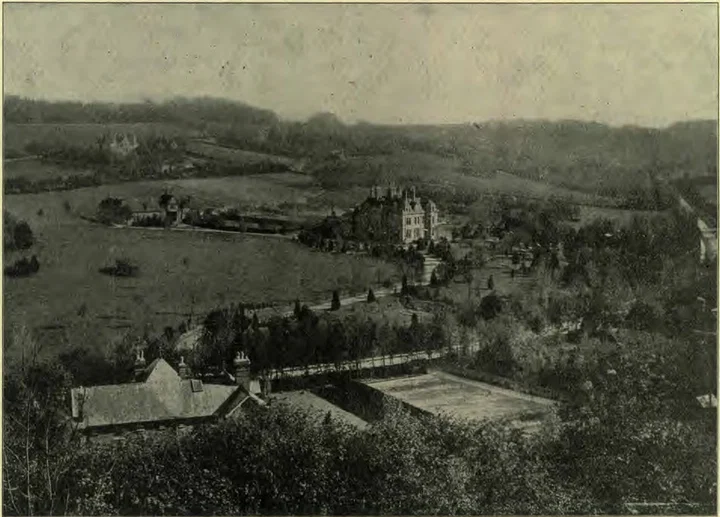
For many months the brethren in Great Britain have been looking for a proper site for a sanitarium, for which the needs of the work had been loudly calling for a long time; and finally their search was rewarded by finding a suitable place in the Caterham Valley, about seventeen miles from London; and they have opened a comfortable little institution there.
The British Union Conference promptly raised five thousand dollars for this enterprise, or an average of five dollars for each member; and the brethren in America came to their assistance by supplying two dollars for each dollar raised in Great Britain; thus they were able to purchase and equip a sanitarium, free from debt; and a few days ago it was formally opened for its work. Elder G. A. Irwin, president of the Australasian Union Conference, and Dr. David Paulson, were present to assist in the opening exercises.
Thus the good work is growing in our fatherland, and we rejoice as we see the rapid developments. The long-neglected work in Great Britain is being revived. That country will certainly soon take a strong position in carrying the third angel's message to the world.
E. R. PALMER.