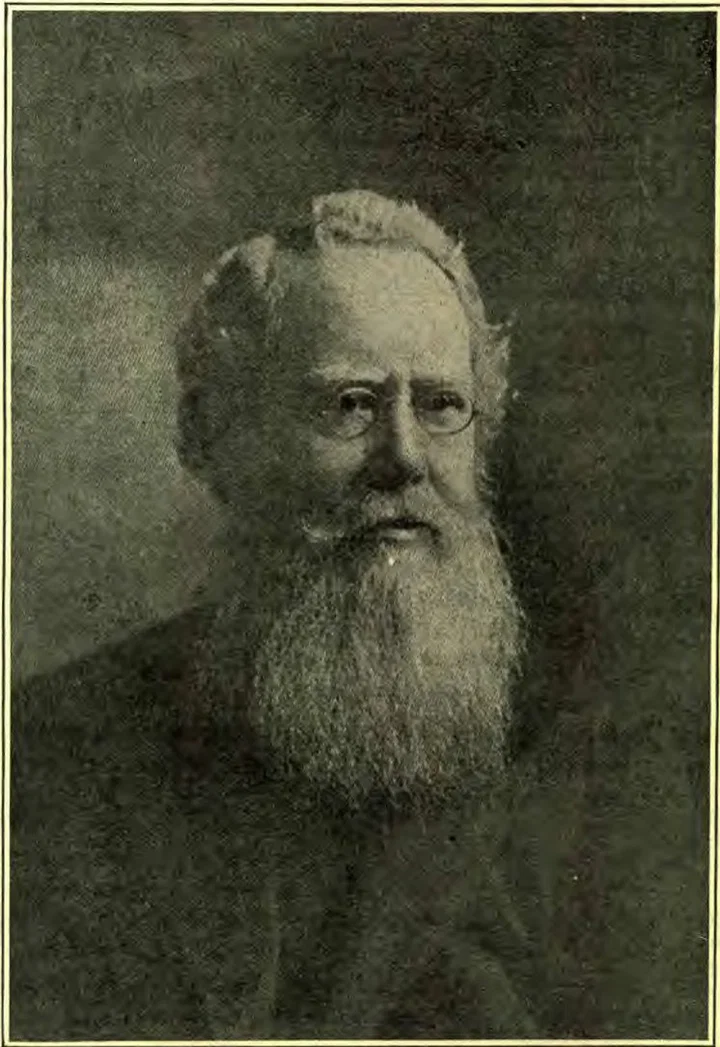
The designation, “Founder of the China Inland Mission,” is in itself an almost sufficient epitaph. When eulogy has said its last word and a full-length biography has been written, the best and the noblest epitaph of the widely beloved missionary will be, “Founder of the China Inland Mission.” The China Inland Mission is his memorial, and a nobler memorial could not be desired for any man. Wherever the work of that mission and its special characteristics are known, it will be evident that by the death of Hudson Taylor there has been removed from the sphere of earthly service one of the most distinguished missionaries ever given to the church of Christ.
Fifty-two years ago, Sept. 4, 1853, the writer of these lines went to see his friend, Hudson Taylor, shortly before he was to sail for China. During that visit Mr. Taylor accompanied himself on his concertina as he sweetly sang:—
“For China’s distant shore, Embark without delay; Behold an open door; ’Tis God that leads the way. His call is clear and loud; The missionary band Should gather like a cloud, And leave their native land.”
He was joyfully anticipating his departure for China in a few days’ time, and the words truly represented his own feelings. About a fortnight later the writer was in Hudson Taylor’s home at Barnsley when his mother arrived from Liverpool after seeing him embark for China.
It was characteristic of that loving and greatly beloved mother that she wrote and gave to each of her two daughters her “Recollections” of the parting from their brother at Liverpool. In those days a voyage to China meant much more than it does to-day. From these “Recollections” we take the following:—
On Sunday, Sept. 18, 1853, Hudson was much blessed and strengthened by the religious services of the day. . . . Seeing his mother in tears, he said: “O mother, do not grieve! I am so happy I can not; my only sorrow is to see your sorrow. I’ll tell you what I think is the difference between you and me: you look at the parting—I look at the meeting,” alluding to our reunion in the “better land.”
The next day they and some other friends met in the cabin of the Dumfries. After a little conversation, singing and prayer were proposed, and Hudson gave out in a firm, clear voice, the beautiful hymn:—
“How sweet the name of Jesus sounds In a believer’s ear! It soothes his sorrows, heals his wounds, And drives away his fear.”
After prayer, the time came to say farewell. I stepped off the vessel, scarcely knowing what I did, and was seated on a piece of timber which lay close by. A chill came over me, and I trembled from head to foot. Seeing my distress, he leaped ashore to breathe words of consolation. “Dear mother,” he said, “do not weep; it is but for ‘a little while,’ and we shall meet again. Think of the glorious object I have in view in leaving you; it is not for wealth or fame, but to try to bring the poor Chinese to the knowledge of Jesus.” As the vessel was receding, he was obliged to return, and we lost sight of him for a minute; he had run into his cabin, and hastily writing in pencil on the blank leaf of a pocket Bible, “The love of God which passeth knowledge.—J. H. T.,” returned to the deck, and threw it to me on the pier.
While we stood waving our handkerchiefs and watching the departing ship, he took his stand at its head, and afterward got into the rigging, waving his hand in token of farewell, looking more like a victorious hero than a stripling just entering the battle-field. His figure became less and less distinct, and in a few minutes passenger and ship were lost in the distance.
After a long and tedious voyage of twenty-three weeks and two days, Mr. Taylor landed at Shanghai on March 1, 1854.
Of his work during the first six years in China nothing need here be said. One fact, however, is significant, and should be named because of its relation to later developments. Writing home in January, 1860, Mr. Taylor said:—
Do you know any earnest, devoted young men desirous of serving God in China, who—not wishing for more than actual support—would be willing to come out and labor here? Oh, for four or five such helpers! They would probably begin to preach in China in six months’ time; and in answer to prayer the necessary means for their support would be found.
These few workers were given—they were the first of a great company, of whom there are now connected with the mission more than eight hundred missionaries, including wives, most of whom were missionaries before marriage. The missionary zeal and devotion of this great company is a greater cause for thankfulness than the large number. Probably two requirements have done much to prevent unsuitable persons joining the mission; namely, a distinct understanding that there was no guarantee of income whatever by the mission, and the importance attached to proved efficiency in work already done. A good record for Christian work already done counted for much; without this the candidate had but little chance of being accepted.
How the work grew—how province after province was opened for mission work—how, without collections or personal solicitation of money, it has been sustained, until now an aggregate sum of over $5,000,000 has been given, it is not our present purpose to say. In the space available our reference must be, not to the mission and its development, but to its founder.
The purpose of his life has often been referred to, but never has it been better told than in an “In Memoriam” notice of Hudson Taylor in The Guardian. The writer of this notice has gone to the heart of things, and has grasped andp. 2 stated with striking precision the object and aim of Mr. Taylor in his life-work. He says:—
He had but one aim—to preach Christ to China by any means that came to hand. With no defined views upon church order, there was nothing so real to him as the individual soul, and God in Christ for its salvation. So burning a spirit soon gathered kindred souls round him, and he launched upon China the finest missionary lance of our generation to break down in the first place opposition to the foreigner, and to make the One Name known. . . .
If any wish to realize what simple faith in God can effect in so brief a space of time, let them study the map of China in the “Student Volunteer Atlas,” and mark the stations, marvelous in number, of this mission, dotted apparently all over the western regions of the Chinese empire. The spiritual force has been so great that no church or denomination can show so imposing a mass of missionary agents in China as the Inland Mission, with the exception of the Church of Rome—with its four centuries of work behind it.
All through Mr. Taylor’s missionary life his aim was just what this writer says it was—to preach Christ to the Chinese. Nothing turned him aside from this. The desire grew, and he longed to enlist others in the work. At first, a few helpers, then more, then Protestant missionaries for each province in China in which there were none, and however impracticable at the time this project might seem, he was permitted to see the desire of his heart realized. The desire of his life was that Christ might be preached throughout the length and breadth of China. For this he labored unceasingly, and with the measure of success that has been seen.
For Hudson Taylor’s best, and all-unconsciously written, autobiography, we must read the early volumes of “China’s Millions.” The lesson taught by his experiences is that God honors faith, answers prayer, and never fails those who “attempt great things for God, and expect great things from God.”
After the many years of the most strenuous labor, there came, in 1900, a complete breakdown of health, and Mr. Taylor was compelled to withdraw from the work of active leadership. He retired for quiet and rest to Switzerland, and during his stay in that country had to bear the great sorrow of the loss of his devoted wife, whose help both in health and in sickness had been to him of inestimable value. In the beginning of 1905 he felt well enough to decide to revisit China—traveling via America to avoid the great heat of the Red Sea. After a very brief stay in Shanghai he went on to Yang-chou, to the training home for the lady missionaries of the China Inland Mission. On his way to Chin-kiang he wrote the following letter:—
April 20, 1905. My Beloved Friends: To be once again in China, and to see and hear from one another personally, is a great joy and refreshment. May I ask your prayers that we may be guided as to the employment of the short time I can remain before the great heat of summer begins? Traveling is now so much less difficult than formerly, that I may, perhaps, be able to attend a conference in Ho-nan, and visit the capital of Hu-nan, a province for which we have prayed so long. Help me by your prayers, dear friends. My strength is not what it once was, but “He giveth more grace.” He does not expect or require anything in us that he is not willing and able to impart. I have found the Lord’s word in my reading to-day so precious. “Let thine hand be ready to help me; for I have chosen thy precepts.” Gratefully yours in Christ, J. Hudson Taylor.
Mr. Taylor had set his heart on a visit to Chang-sha, the capital of the Hu-nan Province. He reached that city, and there on the third of June he died. Probably in no city in China could he have more appropriately adopted the words of Simeon. Of all the unevangelized provinces of China in which he had sought to place missionaries the province of Hu-nan was the last to receive them. It was the most violently anti-foreign province in China, and all efforts through many years to open a station had been unsuccessful up to 1898.
The faithful worker has been removed, but the lessons and influence of his life remain, and will yet mean much for the spread of the gospel in China. We close this article with some of his earnest words for China, and never were they more needed than now:—
The claims of an empire like this should surely be not only admitted, but realized! Shall not the eternal interests of one fifth of our race stir up the deepest sympathies of our nature, the most strenuous efforts of our blood-bought powers? Shall not the low wail of helpless, hopeless misery arising from one half of the heathen world, pierce our sluggish ear, and rouse us, spirit, soul, and body, to one mighty, continued, unconquerable effort for China’s salvation?—D. Broomhall.