A SHORT time ago I enjoyed the privilege of attending the annual camp-meeting of the Maine Conference, held at Portland; and after the meeting, I improved the opportunity of visiting some of the interesting surroundings and historic places—
“of the beautiful town That is seated by the sea.”
Situated upon a bold peninsula, commanding an uninterrupted view of the ocean, the island-studded bay, and the surrounding mountains, Portland may fittingly be called “the beautiful town.” Lacking neither in “good old age” on the one hand nor in “up-to-dateness” on the other, and being lavishly surrounded with the beauties of nature, Portland has easily become the center of Maine’s well-known summer resorts. It is commonly known as the “Forest City;” because of its numerous fine old trees—oak, elm, and chestnut—in the streets and parks. With a population of fifty thousand, it is a strong, conservative, prosperous, intelligent community; and as the beautiful open gateway, by which a multitude of travelers are ushered each summer into the delightful playgrounds of “the Pine Tree State,” this city is able to give to the thousands of tourists who flock there from all countries of the world a strong and fitting interpretation of New England ideas, customs, and hospitality.
The name of Portland, as applied to this city, dates only from 1786. It was known by the Indians as Machigonne. The first European settlers (1632) called it Casco Neck; and later it was named Falmouth.
Many of the fierce battles of the French and Indian War raged about this place. Early in its history it was destroyed by Indians, and in 1775, at the beginning of the Revolutionary War, it was bombarded by four English vessels under Captain Mowatt, and burned. At the close of the war, in 1783, it was rebuilt, and was incorporated in 1786. Again, in 1812, the storm of war beat against the quiet coast of Casco Bay in the memorable sea fight between the “Enterprise” and the “Boxer.”
Portland is the birthplace of Henry W. Longfellow, Nathaniel P. Willis, Sara P. Parton (“Fannie Fern”), Erastus and James Brooks, Commodore Preble, John Neal, and Neal Dow. During his childhood for several years it was also the home of Nathaniel Hawthorne; and many of the favorite haunts of his boyhood are in the vicinity of the town.
In all directions, and within easy reach of the city, there are beautiful resorts, among which some of the most celebrated are Old Orchard, Riverton Park, Cape Cottage Park, and Deering’s Woods.
Casco Bay
The well-nigh unrivaled Casco Bay, whose picturesque islands of granite and green woods are described by Longfellow as—
“the Hesperides Of all my boyish dreams,”
enjoys, and justly, too, a world-wide fame. Rudyard Kipling recently expressed the opinion that the islands of Casco Bay have no parallel for natural beauty among the islands of the world. There are said to be exactly three hundred and sixty-five islands in the Bay,—one for each day of the year.
In company with a number of the brethrenp. 2 and sisters who were returning to their island homes from the camp-ground, I had the pleasure of an all-day’s cruise on the little steamer which plies daily among the islands of the bay. This trip will ever stand out as one of the distinctly bright spots in my travels. The day was perfect, the sea smooth, and the keen salt air was like a tonic. We called at Cliff Island, which has a population of about one hundred and twenty-five, nearly all fishermen. The third angel’s message has secured a strong foothold among these honest, true-hearted people, about one half the inhabitants of the island having accepted the truth. This is one of the largest and strongest churches in the Maine Conference. They have a comfortable little church building, and a church school which has just begun its fourth year, and has an attendance of twenty-six. Upon this quiet, beautiful island, entirely separated from the roar and struggle of commercial life, these simple-hearted fishermen have abundant reason for being a happy little community.
We sailed nearly to the extreme eastern end of Casco Bay, the last call being made at Orr’s Island, which was at one time the home of Harriet Beecher Stowe, and where she wrote her first book, entitled “The Pearl of Orr’s Island.”
Nearly all the islands are inhabited. The people are mostly fishermen and entertainers of the pleasure-seeking public. Farming is carried on to some extent, and in several instances a farmer owns an entire island. It sounds strange to hear men talk of buying and selling and leasing islands; but among the islands of Casco Bay there are several which can be bought for from one to two thousand dollars.
The Birthplace of Longfellow
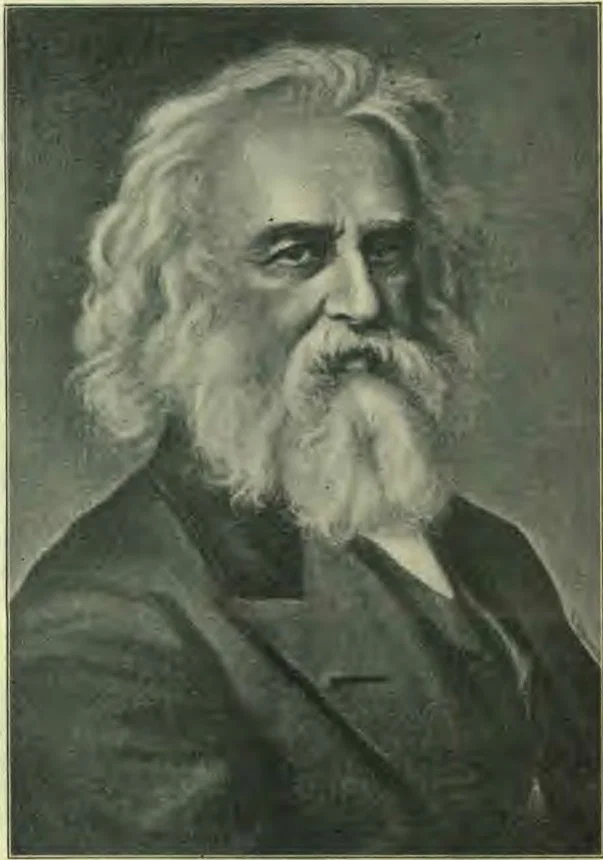
But among the many attractions in and around the city of Portland none are more interesting than those places connected most intimately with the boyhood days of Henry Wadsworth Longfellow, “the best-loved singer of the English race.” He was born in this city on February 27, 1807. The first of his American ancestors, William Longfellow, born in Hampshire, England, came to this country in 1676, and settled in what was at that time the wilderness of Maine. His father, Stephen Longfellow, was a man of much influence throughout the State, a lawyer of ability, and an honored member of the American Congress. His mother, Zilpah Wadsworth, was a person of “distinguished excellence,” and a lineal descendant of the Pilgrim colonists, John Alden and Priscilla Mullins, whose unique courtship was so gracefully sung by their tuneful descendant, Henry Longfellow, two centuries later in his beautiful poem, “The Courtship of Miles Standish.”
He was only five years of age when the war of 1812 began; yet its stirring events and the solemn sound of battle, rolling up Casco Bay, awakened undying echoes in the soul of the listening child. More than forty years later he wrote:—
“I remember the bulwarks by the shore, And the fort upon the hill; The sunrise gun, with its hollow roar, The drum-beat repeated o’er and o’er, And the bugle wild and shrill.”
“I remember the sea fight far away, How it thundered o’er the tide! And the dead captains, as they lay In their graves o’erlooking the tranquil bay, Where they in battle died.”
Such stirring events, historic places, and natural beauties as formed the environment of Longfellow during the days of his childhood were well suited to feed the awakening fancy of the imaginative youth.
One of his favorite playgrounds was Deering’s Woods, a fifty-acre forest, now beautified and protected as a park, and more commonly known as The Oaks, as all the trees are either white or red oak. Among the grand old trees are beautiful walks and drives, with hundreds of seats beneath the wide-spreading branches. Upon the pond are row- and swan-boats for the amusement of the children, while in cages and in fenced enclosures about the park are deer, bears, monkeys, and other animals. This park is also mentioned by Longfellow in his poem, “My Lost Youth:”—
“I can see the breezy dome of groves, The shadows of Deering’s Woods.”
Here was fought one of the fiercest battles during the early French and Indian Wars from 1676-1689. On the western edge of the park can still be seen the cellar of the house once occupied by Anthony Bracket, who was killed in this battle.
The Wadsworth-Longfellow House
One of the most interesting attractions of Portland is the Wadsworth-Longfellow House, the childhood home of the poet. The house was given by Annie Longfellow Pierce to the Maine Historical Society, and is open daily to the public. The following is a brief history of the house, as told on the little card furnished to visitors by an attendant:—
“The most historic house in Maine, and the first of brick in Portland. Built by General Peleg Wadsworth, the poet’s grandfather, in 1785-1786. The home of Lieutenant Henry Wadsworth, and the birthplace of Commodore Alexander S. Wadsworth in 1790. The home of Honorable Stephen Longfellow and his wife, Zilpah Wadsworth, the poet’s parents. The birthplace of Annie Longfellow Pierce, the donor of the house, and where she died in 1901, aged ninety years. In this house four of the Wadsworth children were born, and three died. Here the poet’s parents were married, six of their children were born, and from the parlor five were buried, as also the father and mother. Longfellow was brought here when less than a year old, here he grew to manhood, and here he was a constant visitor through life. It was here he received his first inspirations, and wrote several of his poems.”
The house is a plain three-story brick building, having twelve commodious rooms. The Maine Historical Society has, with much care, brought together within its walls an interesting collection of furniture, pictures, curios, mementos, etc., which have, in one way or another, been associated with the beloved people who have occupied the old “mansion.” Among them is the little old desk first used by Longfellow when a boy, and on which he wrote “The Rainy Day” and other early products of his imaginative genius. Here are also his school-books, and the little round study-table on which, in truly boyish fashion, he drew pictures of his youthful heroes. One of these is a rather crude representation of Daniel Webster.
Like every person of genuine feeling, Longfellow carried the memories of his childhood in his heart to the end. The reminiscence throbs into the music of “My Lost Youth:”—
“And with a joy that is almost pain My heart goes back to wander there, And among the dreams of the days that were, I find my lost youth again.”
His love of this parental roof is beautifully told in his own words:—
“Truly the love of home is interwoven with all that is pure and deep and lasting in earthly affections. Let us wander where we may, the heart looks back with secret longings to the paternal roof. There the scattered rays of affection concentrate. Time may enfeeble them, distance overshadow them, and the storms of life obstruct them for a season; but they will at length break through the cloud and storm, and glow and burn and brighten around the peaceful threshold of home.”
The Cradle of the Message
Readers of the INSTRUCTOR have special reason for regarding Portland with interest; for this city more than fifty years ago cradled the third angel’s message in its infancy. Here and there about the city are still to be found interesting landmarks connected with the rise of our work. The little church in which Elder James White and Sister White, Elder J. N. Andrews and Elder M. E. Cornell, held meetings in the very beginning of our history as a people is still standing. It is a small building only sixteen by twenty feet situated in Clark Street. At that time it was known as “The Shop,” and it is now a shop in fact, being occupied by a painter. This was probably the first building occupied as a church by Seventh-day Adventists in Maine. No changes have been made in it, except by a small addition in the rear.
Portland was the childhood home of Mrs. E. G. White, who was born in Gorham, Maine, November 26, 1827; but soon after her birth the family moved to Portland, where most of her early life was spent. The schoolhouse where she attended school for several years is still standing, and is unchanged; but her childhood home has been removed, and a larger structure built in its place.
Brother W. S. Dunscombe, who was born next door to the house occupied by Sister White’s parents, and who has lived ever since in that street, was our guide to these places, and gave us these interesting facts.
E. R. PALMER.