O WONDERFUL, mighty Ocean! How many secrets are borne in thy bosom! Thy wild waves dash and foam, but, safely hidden in thy depths, are myriads of lives, each kept by a loving Father.
“Full many a gem of purest ray serene, The dark, unfathomed caves of ocean bear.”
The waves wash ashore many empty houses, or shells, and, in the delicately tinted walls, are seen evidences of the abounding goodness of Him who has filled even the sea with beauty. Had the little workers that secreted these beautiful homes which are now empty no secrets that we may learn?
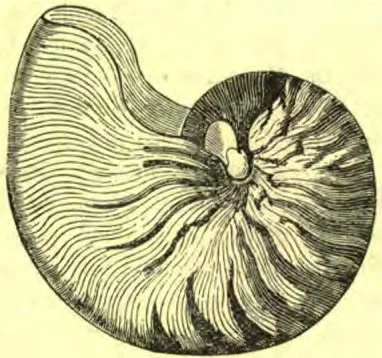
The story of one of the ocean’s treasures, the pearly nautilus, is especially interesting. It is a relative of the familiar oyster, both being mollusks. The nautilus lives mostly in the Indian Ocean. Parts of the shell, and sometimes whole shells, have been found on the shores of the East Indies, Australia, and the South Sea Islands. The shell, being thick and strong, is used in many ways by the natives, and is also made into various ornaments in China and elsewhere. Living specimens of the animal are rarely seen. The first one known to scientists was discovered by Dr. Bennett, in 1829, near New Hebrides.
A tiny baby mollusk was not as tenderly cared for as you and I. Its mother lived by herself in a shell, both curious and beautiful. It was shaped like a flat coil, and although only about four by five inches in size, it had many rooms. The largest and outer one was the dwelling-place. She could put her head and arms out of the open front door when it was necessary for her to swim about, or to catch her food which consisted mostly of crabs. With a pair of large, staring eyes, a powerful mouth, and about forty arms, she would seem well able to care for the little one. But dangers were many. It was a struggle to live; so baby nautilus at the very first started out for himself.
It then had a plain little house of one room, just large enough for its small body. But the baby ate and ate, and soon it outgrew the room. Then it built another room, larger than the first, and fastened it to the old one; and as the new room formed, he gradually moved into it. Time passed; another still larger room was added and occupied. It was impossible to ever get back to the small rooms, but the animal kept in touch with all of them by means of a slender tube that passed through each partition and ended in its first tiny home. Dr. Holmes beautifully describes this habit of the nautilus:—
“Year after year beheld the silent toil That spread his lustrous coil; Still, as the spiral grew, He left the past year’s dwelling for the new, Stole with soft step its shining archway through, Built up its idle door, Stretched in his last-found home, and knew the old no more.”
Thus the shell of the pearly nautilus is “chambered.” The empty rooms are filled with nitrogen gas. By cutting open the shell these rooms are seen to be arranged in the form of a spiral. They grow smaller and smaller toward the center, and have curved partitions. Scarcely could a king’s palace be more glorious, the inner walls having the luster of the most exquisite pearl. Outside there is another layer—porcelain white, streaked with reddish chestnut.
The pearly nautilus bears the family title of Cephalopoda, a long name both for the little creature and for us.
This pearl of the ocean by its life has taught man many lessons of value.
“Build thee more stately mansions, O my soul, As the swift seasons roll! Leave thy low-vaulted past! Let each new temple” truly be “nobler than the last,” till there is built a character, fit for eternity. MARY RICE.