Few tourists visit California without paying a visit to the justly famous ostrich farm of Mr. Edwin Cawston, which is located near South Pasadena, in southern California. This farm, or “ostrichy,” is one of the novel and curious sights of the Pacific Slope. Every year thousands of persons visit the place.
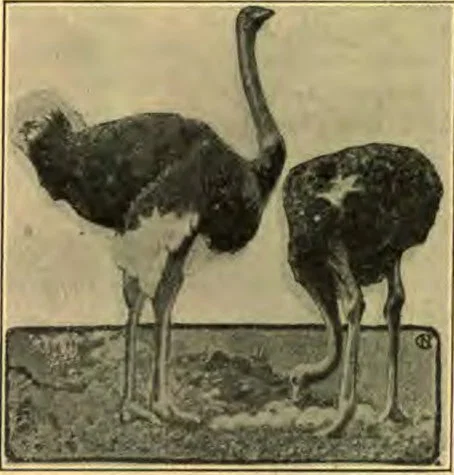
Nearly twenty years ago Mr. Cawston started his ostrich farm. At the beginning he had only a very few birds. The ostriches have thriven remarkably well, and now he has hundreds of grown birds. This farm is among the very few ostrich farms in the United States, and one of the very largest in the whole world. Mr. Cawston has a large tract of land, which is covered with subtropical plants and trees, and is really a spacious park. In this wide space these great birds may wander at will. The enterprise has been most successful, and ostrich farming promises to become one of the great industries of California.p. 4
The ostrich costs but little to keep. He is a hardy creature, and has a very careless appetite. On an average an ostrich yields annually to his owner about thirty-five dollars. The average increase to the stock each year is about fifteen ostriches to the pair. Some pairs have been known to yield as high as thirty-five in a year. Some of the birds are kept in large pens at times. The young grow with wonderful rapidity. In six months the young bird will grow from the size of a domestic duck up to a height of six feet. A full-grown ostrich often reaches eight feet, and weighs over three hundred pounds.
These great bipeds are remarkably powerful, and can run with wonderful swiftness. Usually they are very gentle, quiet, and tractable, unless provoked and angered. The appetite of these creatures is most voracious. Their gluttony can never be appeased. Young ostriches are fed on green grass, alfalfa, bran, cabbage, and other vegetables. The older birds thrive well on chopped hay, grasses, and other grains. They relish watches, buttons, pins, and most any other trinket they can snatch from the curious visitor. They have even been known to greedily swallow lighted pipes, tennis balls, nails, keys, and small stones. These creatures have no gizzard like ordinary fowls, and retain their food until digested in a queer sort of sack about the long, hairy neck. They are exceedingly fond of apples and oranges, and, if permitted, will swallow a dozen or more at one time.
As a rule, the ostrich lives to a great age. Some claim that these birds have been known to live from seventy-five to even one hundred years. Until they are from twelve to fifteen months old, one sex can not be distinguished from the other, the plumage of both being a dull, brownish gray. Then gradually the feathers of the male turn black.
For some reason these birds have a great hatred for children and small animals, particularly dogs. This dislike the creatures show on all occasions, and are ever ready to make an attack. Any brightly colored trinket instantly challenges their attention, and they are ready to snatch it away and gobble it down. These creatures have many other queer habits. When angered, they have been known to savagely attack their keepers. Several men on the farm have been severely injured, and had narrow escapes for their lives. Often these birds, particularly the males, fight among themselves.
The nest consists of a mere shallow hole scooped out in the sandy soil. In forty days the eggs are hatched out. Each chick is worth twenty-five dollars as soon as it bursts the shell. One egg is usually laid a day by the female. About fifteen eggs constitute a sitting. Every egg weighs about three pounds. When the last egg is laid, the parents begin sitting, the male staying on the nest at night and the female during the day. At first the chicks are allowed to run in the sunshine during the day, but are placed under cover at night. In a few weeks, however, they become quite hardy, and require no shelter.
When the ostriches are a year old, their handsome, brilliant feathers are ready for the market. The cropping, or clipping, of the gaudy plumage is accomplished by placing a hood over the ostrich’s head, and wielding a strong pair of sharp shears. This clipping process is repeated every eight months. The feathers on the large side wings are clipped off near the roots; the smaller feathers on the tail are pulled out carefully, without pain or injury to the bird. These feathers are then carefully graded, and sent to the manufacturers of New York and other large Eastern cities, where they are sold for a good price. The feathers are very highly prized for rich hues and delicate silken texture.—J. Mayne Baltimore, in Children’s Visitor.