The second of October, 1904, in company with two friends I visited the czar's winter palace, facing the Neva, in St. Petersburg. We entered the building about half-past eleven, and remained until after two o'clock, and visited only on one floor. It is impossible to see the rooms occupied by a living ruler of Russia; for one is admitted only into the apartments formerly belonging to the emperors or empresses.
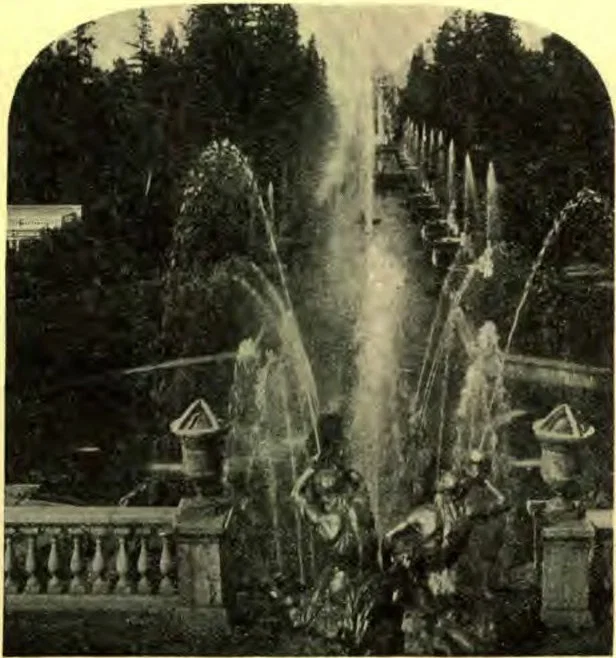
FOUNTAIN AT CZAR'S SUMMER RESIDENCE
We first showed our passports, and received a card to admit us. Then we entered the massive building, and were hastened from one room to another, all too fast to comprehend everything that was shown us. Having visited a king's palace before, I had some idea of what I should here see; but the splendor, the immensity, the almost incredible grandeur of the display, the Croesus-like wealth, were quite beyond my expectations. The scores and scores of very large oil-paintings, mostly representing battle and naval scenes, showed that the Russians have at least done their share in military operations, and gained a due proportion of the victories in war, and been able to constantly add new territory to the empire, as well as to protect western Europe from the depredations of the Mohammedans.
When a visitor is shown single diamonds worth more than five hundred thousand dollars; when he sees pearls, rubies, emeralds, jaspers, beryls, gold and silver shields, and all manner of crystals, in such abundance as I saw them here, he must admit that Russia is not a poor country. However, the common people receive no special benefit from these almost countless treasures.
Some of the rooms were large, and had high ceilings, beautiful carpets, and other furnishings. In the holy place where the czar worships (he has his own church in the palace), we saw many valuable precious stones, relics, and pictures of saints. The Russian Church is especially well provided with these objects of worship. Here we saw the reputed right hand of John the Baptist, a picture of the mother of God,—made without hands and bearing the signature of Luke,—and a bone of the arm of Mary Magdalene. On the sixth of January an imperial religious procession begins here, and the czar, his family, the high spiritual leaders, and the chief government officials go out upon the Neva, and in an ice chapel erected for the purpose, bless the water, converting it into “holy water.” The people then take home bottles filled with this water, to drink in case of sickness.
There was another suite of rooms here which interested me very much—the apartments occupied by Alexander II, who was killed by the Nihilists, in 1881. This ruler was undoubtedly one of the most wise and progressive men that ever governed this great empire. He instituted reforms, gave more liberties to his subjects, and attempted to dispense justice, but for all that, he was unable to escape the assassin's hand. That he was much beloved of the Russians one can easily believe when he sees with what care the czar's apartments in the palace are still kept up. Even his writing materials, books, dressing-gown, boots, tobacco and cigarettes, letter-files, and in fact everything pertaining to his person or dwelling, are carefully preserved as they lay that fatal morning. We could but feel to suffer with his people because of the loss they sustained when the good czar was so suddenly taken from them.
Leaving the palace, we shortly found ourselves in New Prospect Street, the Broadway of St. Petersburg. This is a wide street, as are the thoroughfares of the Russian capital in general, and it is full of life and diversity. All sorts of wagons, carriages, and carts are to be seen here. The czar's equipages are known by the bright-red-clad servants and liverymen. The princes and the rich are there, as well as the middle classes and the poor. Many nationalities and tribes display themselves on the walks, or in the horse-cars, or the trams. There is one sort of train I never saw before. It goes not in a regular iron bed, but wherever the driver wishes. The hacks and small carriages are to be had for only a meager sum. There are between seventeen thousand and twenty thousand coachmen in the city. Many of them drive fine, fleet-footed, nimble-limbed black stallions. The common Russian coachman has the queer style of making himself as large as he can by the addition of cotton batting wadding to his clothes, so that his outward appearance is that of a very portly person. In winter this superabundance of clothing may be useful; but in the summer the style is superfluous. But it is to be expected that Russia would have some way of showing allegiance to the goddess of fashion.
The various uniforms one sees is another noticeable feature of street life in St. Petersburg. Nearly one tenth of the men in the city wear some sort of uniform, even the students, who were an interesting class to me, and compare favorably in appearance with students of other countries. They stand for a freer government, and for reform in many lines, but they often get into trouble with the police and ecclesiastical authorities.
I would not forget to mention the long-haired priests, and the church beggars, who here, as in other parts of Russia, are in evidence. Although the church is wealthy, there are many persons who ask alms for the church.
On this New Prospect Street lies the Kazan Cathedral of the mother of God. This I also visited. It is fashioned after St. Peters at Rome. I saw in this building one of the saddest things I had seen,—two little children, poor, ignorant, evidently of the lower class, about eight and four years of age, came in, and went from one holy picture to the other, crossed themselves, kissed the glass over the pictures, and in most cases the larger sister had to lift up the smaller, that her lips might touch the lifeless pane. This scene could but thrill a Protestant with pain and sorrow.
But the church which is the pride of St. Petersburg is St. Isaac's Cathedral. I will give you a few facts about this magnificent structure. It was about forty years in building, and was finished in 1858. To provide the foundation, a regular “forest” of masts had to be driven into the ground, and even later a very costly substructure was necessary to prevent a sinking on the side next to the Neva River. The church cost about $27,500,000. It is built of marble and granite, and the statuary and trimmings are of bronze. It is in the form of a Greek cross, three hundred fifty feet long, two hundred seventy feet wide, and three hundred forty feet to the top of the eighteen-foot-high cross. To the tip of the cupola inside is two hundred seventy-three feet, and the dome is eighty-seven feet in diameter. It is gilded on top, and from a distance looks like burnished gold. There are four entrances: the two larger are on the north and south, respectively, where the roomy porches are fashioned after the Pantheon in Rome. Each of the sixteen columns in these two porches is of one piece of polished Finnish granite, fifty-eight feet high and seven feet in diameter. The bases and capitals are of bronze, as well as the outside relief work (representing the history of the church), which these pillars support.
I have seen many churches and cathedrals in various parts of America and Europe, but I never saw anything to excel this in grandeur, magnificence, and display. The massive oak bronze-adorned doors we entered are said to have cost fifty thousand dollars. The polished white marble statues, and the two hundred beautifully wrought paintings on the walls, the thirty-three large mosaic pictures made of costly stones, the pillars covered with malachite or with lapis stone, the grandeur and beauty of the holy and most holy places,—these are things of which I had not seen before the equal. Of course the temple of Solomon was a more glorious building, and the splendor of the temple in the city for which we look is beyond even a comparison with this cathedral, the pride of Russia.
But the form, the pomp, the outward display, do not constitute true Christianity. The numerous shrines, chapels, churches, and cathedrals do not prove that the people need no gospel. A short visit to any of these churches will only convince one of the great need of the people,—their lack of instruction in the Scriptures and the salvation that is free to all. God prizes the humble and contrite heart much more than all the glory that man can bring to him. GUY DAIL.