After crossing the Nevada Falls bridge, we take the trail which leads around to Glacier Peak. We have already had a long tramp; but we have as far to go to get back to camp as we have come, and to cover this distance we must descend about one third the distance we have elevated ourselves, and then ascend again to a still greater height to reach Glacier Peak; and yet every step of the way is a joy in spite of weary limbs. Just before beginning to make the ascent to Glacier Peak, we crossed a little stream, flowing leisurely along, and giving no indication of being able so soon to transform itself into a thing of beauty; but only a few rods from the bridge, it made its plunge to the valley floor. It is the smallest of the falls, with the exception of Ribbon Fall (which was not in operation while we were there); but it has a beauty peculiarly its own. Like the little wood violet which prefers to bloom in some retired nook, this fall seems anxious to reach the level below with as little noise and ostentation as possible. One can ride by it on horseback and not see it, so sudden its dip, so far its fall, and so shut in is it on both sides. We succeeded, however, in securing a good position from which to view it, and felt well repaid. Like silken drapery, it hangs straight down some hundreds of feet, and most of the noise of its fall is swallowed up in the depths below. Its name is Tululaweack.
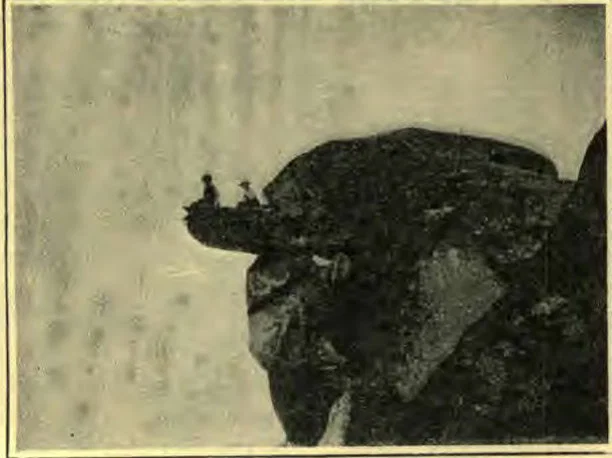
A long, steady, but not steep climb brings us to what is one of the most commanding views of the whole valley. It is called Glacier Peak because of certain scarifications of the ledges which scientists claim to have been made by glaciers thousands of years ago. The view all around is grand, sublime, unsurpassable. At this place Iva and Professor Ballenger went out upon the overhanging rock, and Carrie, seeking an equally perilous position, took a picture of the others. The height above the valley does not show in the cut; but a person falling from this position would find no place of rest until he had descended some thirty-seven hundred feet.
From this point a short side trail takes one to the Fissures,—great clefts in the earth,—while still another trail leads to Sentinel Rock; but our company was well contented to get down to camp by the shortest way. The sun was well up when we began the descent; but the friendly moon was our only light long before we reached the floor of the valley. The sinuosities of the downward trail are something to be wondered at, and there are several places on the way where one could easily step out of the world. One of our horses, tired of the long descent, attempted to end his troubles in that way, and was stopped just at the edge of the precipice. He was riderless at the time. Various members of the party expressed the belief that the bottom had fallen out of the valley, so long seemed the down grade to our tired knees.
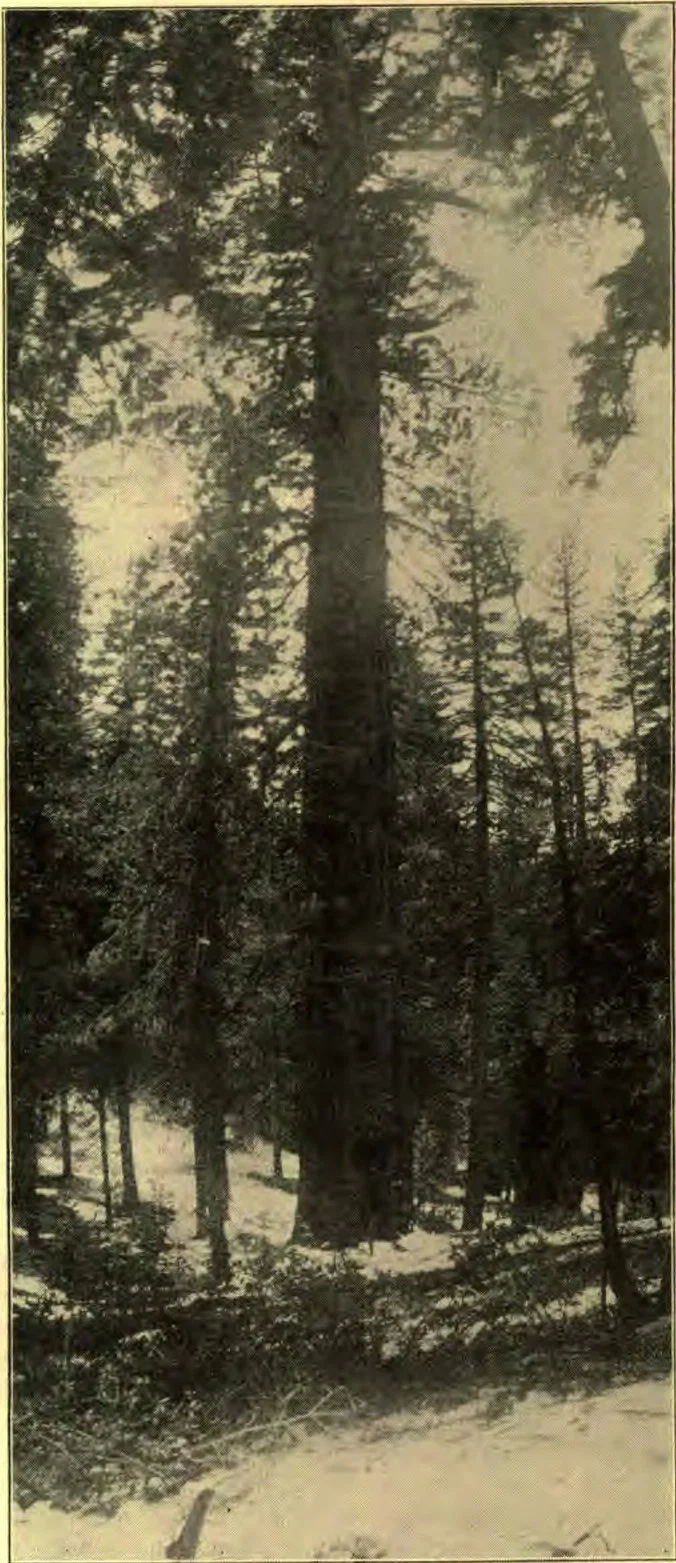
One of the California Big Trees (Sequoia gigantea). Notice the difference between the size of the tree and the size of the man standing in front of it.
We spent eleven most delightful days in the valley, visiting and revisiting places of interest, fishing, and getting acquainted with our Piute neighbors. I would say that in our fishing we did no harm to the fish.
On one of the trips which I took alone I met a party of some thirty men, women, and children of the Piute tribe of Indians, who were coming into the valley to visit their neighbors. They were all either riding or leading ponies. Some of them had beautiful saddles of American make, and all the women and children were arrayed in all the colors of the rainbow and the flower garden. The women, strong and sturdy, were leading their ponies, and were laughing to one another as they passed me, evidently amused at the fact that I had to stop and rest on the trail.
We had a chance while in the valley to study some of the ways of the Indians. Their manner of preserving food was interesting to me. They had gathered a large quantity of acorns, which a white person would hardly think of using as an article of diet, because of their bitter taste, and the “puckery” feeling which they leave in the mouth. The Indians, that is, the women, old men, and children, sit down in a circle, take the shells off the acorns, grind up the meats, and then wash the pulverized mass until they have taken out the properties that make the acorn so unpalatable. The “dough” is then made up into small loaves about the size and shape of half a muskmelon that has been cut in two lengthwise. The loaf is flat on one side and rounded out on the other. These loaves are wrapped in cloth separately, and boiled. After the boiling process, they were taken to the stream and dumped by the basketful into the water. The Indian girls then rolled up their dresses to the knees, waded into the water, took each separate loaf and gave it a thorough washing with their hands. This done, the loaves were handed up to a young Indian woman seated on the bank, who placed them in baskets. When the whole baking had been washed, the young women carried the baskets of acorn bread back to their cabins. There must have been at least a hundred loaves in that “batch of bread.” It was evident that the keeping qualities of the bread must have been exceptionally good, or else the Indian is not delicate of taste in the matter of stale bread.
When winter invades these regions, and covers the ground with a heavy coating of snow and ice, the acorns can not be found, and it is doubtful if they would be palatable, after lying on the ground under the snow, even to an Indian. Therefore large stores of acorns are gathered up in the autumn; and the Indian has a novel way of preserving his precious horde from squirrels and mice. The acorns are “cached,” but not in the ground. Four poles about twelve feet long are driven into the ground, each one of which forms a corner post for the cache. A platform is built in between the poles, high enough so that it will be above the snow. Then a receptacle is arranged on this platform, in which the acorns are deposited. The top and sides and bottom of this cache, or receptacle, are covered with long pine needles, all pointing downward, and so thickly set that no squirrel or mouse could possibly force its way2into them. We saw quite a number of these caches in the valley. So the Yosemite Indian, even though he should not stay in the valley during the winter, knows that when he does return in the spring, there will be plenty of that kind of food waiting for him. The Indian has been so accustomed to finding his food in the woods that he will live in what would be to him comparative comfort where a white man would soon starve. He knows the roots and plants that are edible; he knows how to get food from the fruit of the oak; and above all, he knows how to get along with scarcity.
THE ADVENTURERS OF GLACIER PEAK
Many regard the Indians as slovenly and uncleanly in their habits; but one little circumstance will serve to show that they are particular in some things. In front of one of the largest buildings in the valley was a public drinking place, where persons were frequently quenching their thirst. A tin cup was the common drinking vessel. A young Indian woman with several children, brothers and sisters, came to the fountain for a drink; but this child of nature would not drink from the cup, nor permit the little folk to do so, until she had washed it out to her satisfaction. She washed it with her bare hand, having no cloth to do it with, and subjected it to several rinsings before it was clean enough for her and her charges to use.
Having entered the valley over the Big Oak Flat Road, which brought us through the Tuolumne Big Tree Grove, we decided on our return to take a different road, and visit the Merced Grove of forest giants. To do this we must take the Coulterville Road, which follows the river out of the valley, and emerges over a lower range of hills than that over which we had come in. It was a magnificent drive along the brink of this rushing river. The Merced River is four thousand feet above sea-level when it passes out between El Capitan and the Two Sisters, so it naturally attains some surprising velocities before it reaches the valley of the San Joaquin, to find its way slowly and sluggishly to the great Pacific Ocean. From the place where the road parts company with the river, it was a long, steady climb to the summit; but we had mastered it before noon, having passed through one of nature’s most beautiful colonnades. Here on the summit of these hills the mountain pines attain an enormous growth. At the base they range in size from large barrels to a size at least a half larger than the largest hogsheads, and they reach a tremendous height. These pine-wooded hills might be termed rolling hills, and one can look off considerable distances through these colonnades of gigantic trees. There is no undergrowth to obstruct the view, no low branches on the trunks of these trees, and all the ground is covered with the smooth, brown carpet of fallen pine needles. It is with a feeling of awe and indescribable veneration that one lies down upon this natural carpet, and looks up through the interlacing boughs of these grand standard-bearers of the everlasting hills. They have stood here for centuries, and they seem good for centuries yet to come. While they are not so old or so large as the sequoia gigantea, they are old, and they are large. So true, so straight, so grand they stand that they do not seem to have been in any sense the plaything of the winds, but rather its playmates, and have come almost unscathed through many a titanic wrestling-match. Lessons of strength and courage do they speak to man. It is a beautiful drive from the summit down through and among the hills—but a dusty one after July. The road has been so laid out that it is one continual, gradual descent, winding in and out among canyons, wooded slopes, and beetling hills; and when night comes down, and the tent is pitched for repose, it is hard to repress a sigh—not of weariness, but of regret that it is all in the past.
And so it is with the close of the outing—all too short, but packed so full of pleasant memories. So, too, our eyes now never turn to the beautiful hills without the recollections of the wondrous works of God in that grandest of nature’s museums—Yosemite Valley.