The Magnet

9%

Review and Herald Publishing Assn. · Washington, D. C. · February 7, 1905

FromThe Youth’s Instructor, Vol. LIII, No. 6

Read the full edition

The Magnet

One day, when the world was many hundred years younger than it is now, Magnes, a shepherd, watched and tended his grazing flock on the slopes of Mount Ida, in ancient Greece. To aid him in climbing and in driving his herd, he carried an iron staff with a crook at the top, like those you have often seen in pictures of shepherds.
The days were long sometimes, and Magnes often grew weary of the monotonous round of work and the same blue sky that smiled overhead.
On such occasions he looked about him for something new with which to pass the time away.
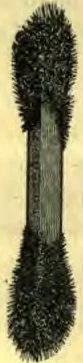
At last he found something that afforded him hours of amusement. On the slopes of the mountain were scattered large masses of loadstone, and Magnes noted with curiosity one day that the iron crook which he had carried manifested a strange tendency to adhere to the rock when placed close to it.
This discovery of the attractive power of loadstone by Magnes led to the name now in common use, the magnet. The power of loadstone to impart its properties of attraction to iron or steel, when rubbed or even touched by it, was also known at an early day; but it was not fully discovered until the twelfth century that loadstone, when freely suspended in the air, would instantly assume a north and south direction. This peculiarity led to lengthy discussion by the writers of that time, who were led astray by old, unproved ideas which had been handed down to them from generation to generation. Dr. Gilbert, an Englishman and diligent student, first understood this peculiar tendency of loadstone to point north and south. In a book which he wrote upon the subject he said: “The loadstone, like the earth, has from nature its two poles, a northern and a southern, fixed definite points in the stone. It is to be understood, however, that the force of the stone does not emanate from a mathematical point, but from the parts themselves, and from all these parts. These poles point toward the poles of the earth, and move toward them, and are subject to them. Whether its shape is due to design or chance, the loadstone ever has and ever shows its poles.”
Dr. Gilbert was careful in all of its study and work, and much lasting credit is due him for his clear ideas concerning the subject of the magnet and magnetic principles. It was he who first discovered that midway between the poles of the earth was a place of no attraction, which he called the equator. The line which connected the imaginary poles he called the magnetic axis. He also pointed out clearly the difference between true magnets and mere magnetic substances. From his investigations and those of other scientists of his day, it was learned that if a piece of iron or steel be rubbed by a piece of loadstone or other magnet, it immediately becomes magnetized, and assumes the properties of attraction peculiar to the magnet itself.
This method of magnetizing was of great importance in the old days, being put to particular use in the construction of the mariner’s compass, without which the navigation of unknown and distant seas would have been impossible.
Great changes and modifications have been made since Dr. Gilbert’s day, especially since the magnetizing effect of an electric current has become universally known. Discoveries by Oersted, Arago, and Ampere in the seventeenth century showed that magnetic influences surround a conductor carrying an electric current.
The principles advanced by these men led to the invention of the electric magnet by William Sturgeon, and first described by him in 1825. An electro-magnet is simply a piece of iron surrounded by a magnetizing coil of wire carrying a current. Its properties of attraction depend entirely upon the magnetic properties of the iron which forms its core.—Hilton R. Greer, in Children’s Visitor.