To know the trees, especially our fine American forest trees, is to possess friends whose character can always be depended upon, and whose intimate acquaintance brings continual and increasing pleasure.
As one becomes acquainted with these noble and beautiful plants, he soon finds that each tree differs from every other tree just as each human being differs from his fellows, and yet there are families and classes of trees just as there are races and nations among men.
It is quite a wonderful thing to know that in a forest containing thousands of trees, with their millions of leaves, no two leaves are exactly alike, and yet we can readily distinguish the maple leaves from those of the oak, the beeches from the birches, and so on through the list, just as we can tell Chinese from negroes, and Indians from white men, in the human family.
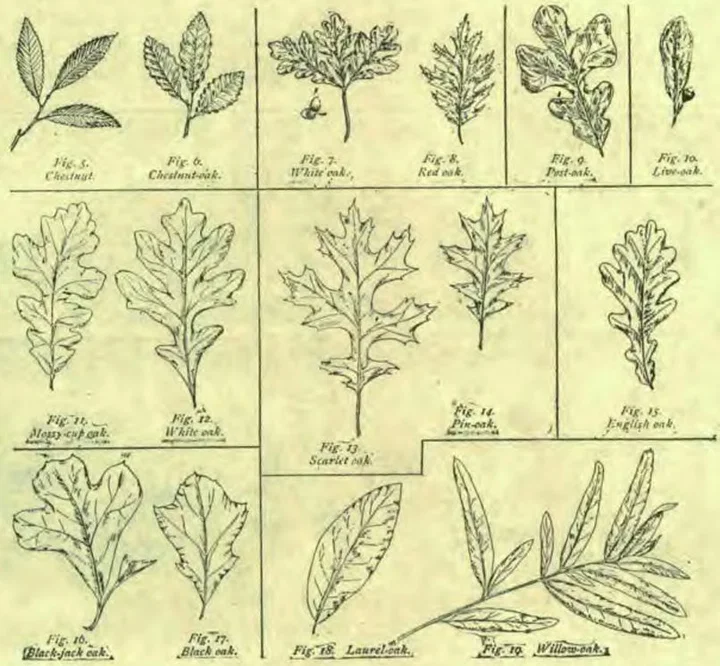
On the other hand, some leaves are so nearly alike that we must observe them very carefully in order to discover whether they belong to the same kind of tree. For example, in Figs. 5 and 6 we have two leaves, which, at the first glance, seem quite similar, but which, on closer examination, prove quite different. The one on the left is the chestnut, so dear to all of us, while the other, which is wider and has rounded instead of sharp teeth along its edges, is the chestnut-oak.
Of course if we had the two trees standing side by side, we could distinguish them immediately by their fruit, because one would bear burs containing chestnuts and the other acorns. The chestnut-oak is a true oak, and is so named simply because its leaves so closely resemble those of the chestnut. It is a noble tree, and grows to a great size, often being found a hundred feet in height. There is one near Fishkill-on-the-Hudson famous for its age and size. This tree is seven feet in diameter. It is claimed that in 1783 Washington used to mount his horse under it when he rode from his headquarters to the army encampment at Fishkill.
Sometimes we better appreciate the value of a tree if we know of what use it is to us. The chestnut-oak, besides being one of our most beautiful trees and valuable for the timber it furnishes, has a bark which is rich in tannin, a substance used extensively in tanning leather.
The chestnut-tree needs no description to American boys and girls, as we all have spent glorious days in the crisp autumn weather searching for the plump brown nuts in the dry leaves, and afterward roasting them over blazing hot fires during the long winter evenings.
The boys may be interested to know that chestnuts prove a very profitable crop. Experts claim that an orchard of chestnuts will bring greater returns to the owner than an apple orchard of the same size, as the nuts are retailed on the street corners at about six dollars a bushel, while the Italian who sells roasted chestnuts receives pay for them at the rate of at least eight dollars a bushel. The tree is one of our most rapid growers, and has been known to bear fruit at five years of age.
The Oaks
The large family of American oaks is one of which we are justly proud, and it is difficult to say which is the finest. Among trees the oak stands for all that is sturdy, reliable, hardy, and useful—a symbol for the honest, true, and patriotic citizen among men. Although it is perhaps not as graceful as the elm, nor as luxuriant as the magnolia or the palm, its strong and heavy trunk, its gnarled branches, and its clean, healthy foliage give it a prominent place among our American trees. Its wood ranks high as valuable timber, being strong, hard, and durable, with a handsome grain which takes a fine polish.
Figs. 7 and 8 show the leaves of the two oaks which are the best known and most common about New York City. Their leaves are so different that they can never be confounded. The white-oak leaf is deeply indented and has rounded lobes; there is not an angle nor sharp point anywhere on the leaf; while the red-oak leaf on the right is sharply toothed and bristling with points. Both of these leaves are large, the white-oak being of a beautiful light-green color, while the red-oak is darker, stiffer, and very glossy.
Both trees grow to a very large size, and their timber, which is used extensively in shipbuilding, carriage-making, cooperage, and cabinet-work, is the standard among woods for strength and durability.
There are several kinds of oak closely related to these two trees. For instance, the post-oak (Figs. 2 and 9) has a leaf resembling the white-oak in shape, yet it is a simple matter to distinguish either the trees or individual leaves. The leaves of the post-oak are very much darker, thicker, and more leathery than the delicate and refined leaf of the white oak, and the indentations are not so deep. The whole tree is rougher in its bark, leaves, and general appearance, and the leaves have a habit of clothing the entire branch, from the point where it leaves the trunk out to the very tip. The wood is so hard that the tree is often called the iron-oak. It is very common on Long Island and all along the eastern coast of the United States.p. 3
Another tree which resembles the white oak is the magnificent mossy-cup or overcup oak, with its long, shiny leaves, which are sometimes a foot in length. Figs. 11 and 12 show the difference between the two leaves; but the principal points of difference are the peculiar, corky ridges found on the young branches of the mossy-cup, and the beautiful, single acorns of the latter, with the heavy fringe around the nuts, from which the tree takes its name. This tree is primarily a Western oak, and reaches its finest development in the Mississippi Valley, but is occasionally found in the Eastern States. It grows to a great height,—one hundred and fifty feet being not unusual,—and its wood is of a superior quality.
The great oak family might be divided into two classes; those that ripen their acorns in one season, such as the white, post, and mossy-cup oaks just mentioned, and those which require two full years, such as the red, scarlet, and black oaks. To the first class belong the chestnut-oak and the live-oak of the South. This latter tree for generations played an important part in shipbuilding, but has now been superseded by iron and steel. The leaf, which is an evergreen, is entirely without indentations, and is thick and leathery. The wood is very heavy and strong, has a beautiful grain, and is susceptible of taking a high polish. At one time this wood was so valuable that our government paid two hundred thousand dollars for large tracts of land in the South, that our navy might be sure of a supply of live-oak timber.
To the second class of oaks we are largely indebted for the gorgeous colors of our autumn leaves. The red, scarlet, and pin oaks, with their brilliant reds, scarlets, and browns, are close competitors with the maples in giving our American landscapes the most wonderful autumn colorings to be found anywhere in the world. These three trees have leaves which at first glance are quite similar, but by careful examination may always be distinguished.
The red-oak is an unusually large one, of a dark-green color and very shiny. By comparing the sketch of it with that of the scarlet oak, it will be apparent that the indentations are not nearly so deep in the former, which has a broad, massive appearance, while the latter is so deeply indented as to give a skeleton effect. The deeply cut foliage of the scarlet oak makes it the more handsome tree of the two, but each of these oaks grows to a large size, and is valuable both as a shade and a timber tree.
The novice at tree study is much more apt to confuse the scarlet and pin oaks than the red and scarlet. Referring again to the diagram of leaves, one sees at a glance that the pin oak has a smaller leaf than the scarlet oak, and this difference in size appears to even better advantage on the trees than in the drawing.
The pin oak, which has recently become a favorite among nurserymen as an ornamental tree, takes its name from the pin-like appearance of the tiny branches which sprout from the main trunk and the limbs; its timber, however, is not so valuable as some of the other oaks. No list of oaks which are common about New York would be complete without the black-oak and the black-jack varieties. These two trees—the latter being sometimes called the barren oak—thrive in exposed and sterile regions, such as the sandy flats of New Jersey and Long Island, where no other tree except a stunted pine seems able to live. Their whole appearance, from the individual leaf to the framework of the stripped tree, is summed up in the two words “tough” and “rugged.” The leaves are tough and leathery, while the wood is gnarled and strong, and altogether these trees are in perfect harmony with their wind-swept surroundings. The leaf of the black-jack oak (Fig. 16) may be easily recognized by its three lobes or rounded points, from which it rapidly tapers to a point at the stem. The leaf of the black oak (Fig. 17) is very slightly indented for an oak leaf, the sharp points being few, far apart, and separated by shallow recesses, as shown in the sketch.
Occasionally one will find in the parks or along the roadside an oak which bears fine, large acorns, with a leaf which somewhat resembles our white oak, but is poorer, smaller, and very inferior in size and symmetry. This is the famous English oak (Fig. 15), which has been imported into this country as a shade-tree. A curious thing in connection with this leaf is the fact that practically all of the wood-carving we use, in which oak leaves and acorns are prominent features, represents the English oak. Our artists will find a mine of wealth in our American oaks and acorns that has hardly been touched.
Then, too, we find some interesting freaks in the oak family: such as the willow-oak, whose leaves closely resemble the long, narrow, and familiar leaves of the willow; and the laurel-oak, whose thick, glossy, and dark-green leaves remind us of our evergreen laurel. These two varieties are not common around New York, however, but reach their highest development in the South and West; the willow-oak being a remarkably beautiful shade-tree, familiar to all dwellers below Mason and Dixon’s line.—Edwin W. Foster, in St. Nicholas.