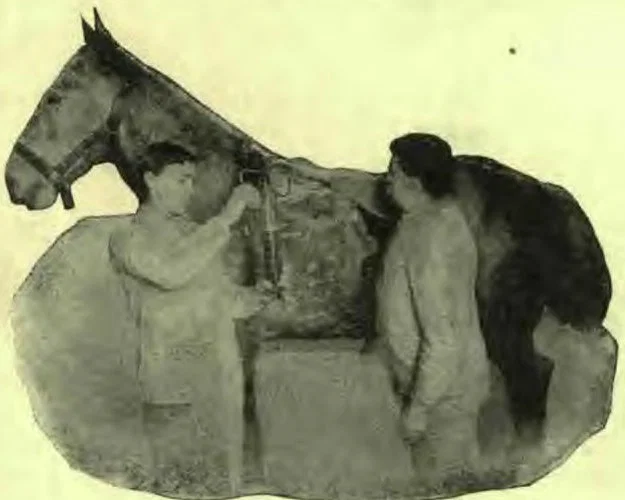
Last week we gave a description of the process of preparing diphtheria toxin. In order to prepare antitoxin, the fluid containing the toxin is injected into a horse, beginning with a very minute dose, and gradually increasing the amount of the dose as the horse is able to bear it. Each dose produces a slight illness in the horse, but in a few days he is over it, and ready for the next dose. The process is repeated at intervals of a few days, the quantity being increased each time, until at the end of a number of months, the animal can take enough diphtheria toxin to kill several hundred ordinary horses. The horse is now immune to diphtheria toxin, the immunity being due to large quantities of antitoxin which have formed in the animal as a defense.p. 7
Now a large quantity of blood (but not enough to endanger the health of the animal) is drawn, in a way not to cause it any particular pain. The blood is drawn with every care to avoid contamination with germs, into sterile test-tubes. The blood, after a time, coagulates, or clots. The accompanying illustration shows four such tubes. At the bottom may be seen the clot. The clear liquid, or serum, seen at the top of each tube, is drawn off, and put into sealed tubes, each tube containing the right quantity for one dose.
This serum, known as “diphtheria antitoxin,” is kept by druggists, ready to be called for when needed by physicians for a case of diphtheria.
Physicians generally have now such great faith in antitoxin, that a doctor who fails to use this remedy in a case of diphtheria is considered inexcusable; and in case his patient dies, his neglect to use the antitoxin may get him into trouble. Still, there are intelligent doctors who have no faith in antitoxin, as there are those who do not believe in vaccination.
When the physician gives you a tonic or a cough mixture, he tells you to take so many drops, or spoonfuls, as the case may be. Antitoxin is not dosed out by spoonfuls, nor even by drops. The reason is that no two lots of antitoxin have the same strength. One lot may be twice as strong as the other, consequently some way had to be devised for ascertaining the exact strength of each lot. This is done by testing the antitoxin on guinea-pigs; thus its strength is determined and indicated on the package in “units.” The usual dose is one thousand to three thousand units, though a smaller amount is used to prevent well people from “catching” diphtheria.
The accompanying cuts were kindly furnished by Parke Davis & Co., of Detroit, Mich. One picture shows the operation of injecting the toxin into a horse; the other shows four of the large tubes in which the blood is collected. The proportion of serum and clot may be readily observed. MIKE ROBE.