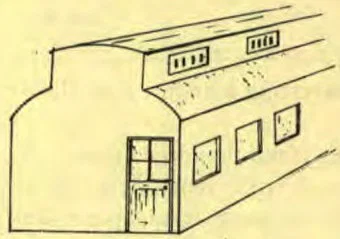
ELDER CONRADI and I left Hamburg, Germany, September 26, to catch the steamer for Helsingfors, Finland, where our first meeting was to be, September 29 to October 4. As we were to be on the train only one hour and forty minutes, we went fourth-class. You may not know what fourth-class is, so I will tell you by giving a description of our apartment. It was on a small, four-wheeled car, perhaps eighteen feet long by eight feet wide. Our apartment was occupied by men and women, thirty-six of us in all. There were hard, one and three-fourth-inch boards extending the length of the apartment on either side, making room for about twenty-four passengers. The rest who came in stood up, or sat on their luggage, of which there was quite a quantity in the open space in the center. The door was in the end, near the side of the car, and had movable glass windows, that could be let down from the top. This part was open all the time. There were two windows on either side, opened from the top. There were ventilators, three on a side, made of simple wooden boards about four inches wide and eight inches long, in which were four small holes, to admit air, if opened. A ventilator is shown in the illustration. This is a movable slide, and these air-admitters are closed by pushing the slide to the right or to the left, as the case may be. The end projection of a car is shown in the drawing. A good class of people sometimes travel fourth-class, though of course a “gentleman” goes second- or first-class. The middle class generally ride third in Germany.
In a few minutes from Hamburg we were in the province of Holstein. The country through which we passed is rolling,—now and then there are level stretches,—and reminds one of parts of Ohio. The land, while more fertile than between Hamburg and Hanover, for example, is yet not rich soil as Americans understand that word. I was interested in observing, instead of the universal pre-eminence of the German village so prevalent in southern Germany, that there are now and again isolated country cottages along the route, as in the States. Another sight reminding me of America was a genuine threshing-machine where there was a steam-power machine at work, in the neighborhood of sixteen small, round stacks. As it is so damp here, the customary large wheat-stack of the West would not give the best returns. In the German threshing and farming operations, the peasant women have a more active part than do the women in the States.
Lubeck is a city of about ninety-six thousand inhabitants. It is one of the “free cities” (Bremen and Hamburg are the other two), which were established during the Middle Ages, and belonged to the Hanseatic League.
Upon calling for our tickets, we were asked if our passports had been viseed. This is very important to one going to Russian territory. My pass had just been renewed in Berlin in May, and yet I had to go to the American consul and pay him 4.25 marks (one mark equals about twenty-four cents) to get him to certify to its present validity; and I also had to swear that I am a Protestant, and bring a certificate to that effect to the Russian consul, who, in turn, viseed the passport, charging me 4.90 marks. As we are to return via Rumania, we secured from the Rumanian consul in Hamburg a similar vise—four marks.
Our ticket, second-class, to Helsingfors cost us, including two dinners, which we were obliged to pay for whether we ate or not, 46.40 marks.
After buying our ticket, we called on our missionary in the city, Brother O. Stoye, who expects to begin a course of lectures there this evening. Lubeck is an old city. I was much interested in some of its unique architecture. I give here a rough sketch of the gable ends of some of the houses. (See second page.) Our work in Lubeck is just beginning, but we hope a church may soon be raised up. There is quite an amount of commerce carried on with Lubeck. It ranks in this respect as third or fourth city in the empire.
Once on board the steamer “Lumea,” we waited a while for the customs officer to accompany us to the Baltic. The Trave River is quite winding here, so that at least an hour was consumed before we could put on full steam in the open air. On either side the river are large tracts of made land, and three dredgers were still at work, deepening the channel, the sediment being conducted to shallow water, where, little by little, the government is converting marshes into tillable soil.
The vessel carries four hundred tons. Its cargo was made up of fruit, machinery, furniture, chemicals, small evergreen trees, spirits, and musical instruments, with some other things, to the value of one quarter of a million German marks.
Finland will export lumber, tar, wood, paper and pulp, spools, butter, meat, leather, some granite, and a little oats and rye, in good seasons. The Finns are just beginning to introduce a system of replanting their forests, as in Germany, Denmark, and other European countries. In some parts there has been a ruthless destruction of the trees. In others only the large trees have been taken, so that there may be another lumber harvest, in twenty years or so.
The fogs so delayed us that we reached Helsingfors fourteen hours late, having made one stop; and after our passports were accepted, and we had received a small piece of stamped paper to give out as we left the boat, we were allowed to land. The customs officers were kind, and in one minute we were able to go out and take a small Finnish carriage for our mission.
Helsingfors is a fine city. It contains about one hundred thousand inhabitants. It is built upon granite rock,—in this respect Finland reminds one of Norway,—and during the last twenty-five years the city, as well as all Finland, has made rapid advancement. Things, however, are fast becoming Russianized. There are outward signs of this. Recently new street names were put up, and these are printed in Russian, Finnish, and Swedish. Formerly the Swedish stood first, and Russian last. The police must be dressed in Russian uniforms. The Finnish regular soldiers were ten times as numerous as now—there is but one battalion of five hundred. All state and city officers must learn Russian, or give up their positions. Now, of course, many can not learn Russian, and many will not attempt to do so. So it comes about that there are hundreds and hundreds of Finnish and Swedish emigrants who leave their country, many coming to America. As fast as the Finns go away, the Russian colonists arrive. Especially do Russian soldiers who have been detailed here, remain after their time has been served, as this country offers advantages they might not enjoy in their native provinces. To patriotic Finns these changes forbode much evil to the future of their country.
There is some building going on in the city.p. 2
Most of the houses are of wood, but some are constructed of granite, and a few of brick. There are some as fine business blocks in the city as I have ever seen. The main buildings are of granite, brick, and cement. The stores are, many of them, large and well stocked. I was surprised when I saw the modern air of the city. The university, the senate house, the czar’s residence when he chances to visit Helsingfors, the soldiers’ barracks, the new Finnish theater of Finnish granite, the observatory, the St. Niccolai church, the two Russian churches, the hospital, museum, a few large hotels, the electric street-railways and lights, give to the place an air of prosperity which is surprising to one whose attention has been called only to the darker side of the political situation.
There is coeducation here. Many young women visit the higher schools, and become teachers, government employees in post-offices, or engage in other lines of work. As so many men are leaving, some of the work which they would do were they more numerous, is now done by the women. There are women street-sweepers, hod-carriers, and freight-forwarders and handlers. The nurses are all women, as well as the bath attendants. In some parts, especially in the north, it is no rare thing to find house after house destitute of male inhabitants. Women in Finland seem to enjoy more liberty than in other European lands I have visited.
Race rivalry is not dead. The Swedes and Finns often fail to see things through the same eyes, and the increasing immigration of the Russian element only adds another foreboding cloud to the already dark political horizon.
As I write, I hear blasting on either side of me. They are cutting a subway through the ground (here the “ground” means Finnish granite), for the electric cable now in process of construction. This blasting is carried on under the very eaves of the houses where people live. It costs something to do excavating in this city.
Their art work also surprised me. Not only are there fine painters in the land, but there are skilled earthenware and chinaware manufacturers. I visited the art collection in the city—a collection of Finnish and foreign pictures which a city of much greater size might well prize.
GUY DAIL.
(Continued)