What We Require – Food
IF you want to keep a horse, or a cow, or a dog, or a cat, or even a canary, you find that it costs something to feed it. It costs nothing to feed germs—except your health. Goats will live on weeds, paper boxes, rags, old rope, and some even say—but I do not believe it, do you?—that they eat oyster cans! Germs will live where a goat might starve. Anything that has once been alive—what we usually call decaying matter, such as you find in the barnyard, or in the wash-tub, or in the garbage barrel, or in the ice-chest, possibly—will do to feed the germs.
It may be as large as the stove, or so small it can not be seen; the germs will find it. Not because they have eyes and nose and wings, but because they are so plentiful—floating around in the air—that there is no spot, no matter how small, on which they are not constantly lighting. Everything that would be food for any animal would be food for some germs, and many things that no animals can utilize are foods for germs. Some germs are very choice of their foods, and can not grow except on specially prepared foods, or upon some live animal’s body. But there are always large numbers of germs in the air which live on almost anything, or I might say, upon almost nothing.
Distilled water, prepared by condensing steam, is very nearly pure water; and yet it contains enough other matter to afford nourishment for some kinds of germs. Other germs seem to multiply in well water and spring water as it comes out of the ground; but such germs, as a rule, do not thrive in the body.
Moisture
Perhaps you have wondered how we, having no mouths, can use food. We take it the same as any other plant, drinking it in through the skin, or outside covering. All our food must therefore be in a liquid form. Have you ever wondered why it is your mama dries her fruit in order to keep it, and why it is that drying meat and fish preserves them? The reason is this: We germs—some of us—are floating around in the air all the time, and lighting on everything. When we fall on any liquid containingp. 3 something that nourishes us, we begin to absorb it, and grow; at the same time we give off substances that break down the thing we fall on. If it is meat, it begins to soften and smell bad. If it is fruit, it begins to soften and decay. If it is a dish-cloth hung up wet, it soon sours. Now if these are dried out so there is no moisture left, we can not grow, any more than can a lot of dry corn in a tin can. The dryness may not kill us, but it keeps us from growing. Perhaps you have noticed that if dried fruit gets damp, it is liable to sour. Some foods which contain much water have so much other matter present that the water is too “thick” for us to utilize it, so we can not grow. Sugar is a very good food for us; but when it is dry, we can not use it, or when it is in too thick a sirup. Honey will not sour for this reason. When the bees first gather it, it is then so thin that it will run out of the combs easily. If it is drawn off in this condition, it will sour readily; but the bees are wise enough to leave it uncovered until it evaporates to such a thickness that it will keep; then they cap it over. Do you suppose the bees understand anything about germs?
Darkness
I think I told you that we germs do best where there is no light. Green plants must have sunlight in order to thrive, but we do better in the dark. Some of us are killed in a very short time by the direct sunlight. You will understand, then, what a nice place a dark, damp cellar is for us, or a dark sink closet where there is a leak, or how we delight to have a little of the dinner leavings left in the sink, or to have a wet dish-cloth hung up under the sink. We enjoy it hugely, and are glad the people are so accommodating; but we do not show our gratitude in a very becoming manner. In our joy at having such good things as darkness, and dampness, and some particles of left-over food to eat, we have a good time, and then the poor people who provided such a rich feast for us have to suffer. Mean, isn’t it?
Temperature
You do not see many banana plants or pineapple trees growing in this country. If you were to plant them in the open air, the chances are they would not grow; it is too cold. But you can grow in hothouses many plants which would not thrive outside. Most plants do as well or better when outside. There are among the germs some that demand so high a temperature that they may be called hothouse plants. They do not grow or thrive in springs or rivers, nor in fruits and other foods, but only where the temperature is at or near that of your body. Among these delicate creatures, are some which are most dangerous to man and to animals.
These are called parasites, because they live in some living animal. These germs (the germ of diphtheria, for instance), while they grow with more or less difficulty outside of the body, will grow in a susceptible body—one which does not resist or throw off the disease—very rapidly and produce poisons which cause the disease.
Some germs can grow at temperatures much higher than that of the body, as in some of the warm springs. They have probably become accustomed, gradually, to this temperature. Others can grow and thrive at quite a low temperature; but, so far as is known, no germs grow at the freezing temperature, though they may continue to live indefinitely in ice, ready to grow as soon as it thaws.
Some people think that germs can not live in ice, but this is not so. They may live for months in ice, but they will not grow until the ice melts. People who use ice from a pond or lake, on the supposition that all the germ life has been killed by freezing, are running considerable risk. There have been numerous cases of typhoid fever traced to the use of ice from some infected pond or stream.
Oxygen
Bacteria, or germs, differ very much in their requirements. Some, as you have learned, prefer a warm climate; others do better in a moderately cool climate. Some thrive best on one kind of food, others do better on a very different food. Some there are that require abundance of oxygen. They need air, though not necessarily as much as a person. Others can not exist if there is much air present. They grow deep down in animal tissues,—under the skin, in the blood, or in some place where the air can not reach them. There are still others that can live either with or without air. The germ of lockjaw is one of the germs which grow only in the absence of air. It is not so liable to secure a foothold in the body where the skin is bruised off as where a nail or a tack goes up deep into the flesh. Such a wound as this is much more dangerous than one which is made by a knife, and bleeds freely. It is commonly supposed that lockjaw is caused by a wound from a rusty nail; but it is not the rust, but the germs, which cause the lockjaw. Boards containing nails sticking up should never be left around, as they may cause dangerous wounds. When one has run a nail or a tack in his foot, the safest plan is to have the wound opened by a doctor, so it will bleed freely.
It may be apparently well, and then after nearly three weeks an attack of lockjaw may come on. It is too late then to save the patient. The time to treat lockjaw is before you know that the patient has lockjaw.
Where We Are
We grow wherever we can find food—wherever there is organic matter in moist condition. We may be found thriving on the waste matter in rivers, lakes, and ponds, in the streets of cities, in houses and stables. We grow rapidly where people are careless and leave decayable matter around. When the wind blows, we are carried everywhere, as dust—not that dust consists entirely of microbes, but that it contains microbes in great numbers.
We may be found in the greatest abundance in the soil; for every rain brings us down from the air in countless millions. Perhaps you have thought of rain-water as being the purest kind of water; but that which falls the first part of a storm, especially after a long dry spell, is filthy from the amount of impurities washed out of the air. Such water will spoil on standing a few days, because of the decay of the organic matter, through the action of the germs.
Well, the rain falls on the earth, and many of the germs are left there; for as the water percolates down through the soil, the germs are filtered out and left behind. While, near the surface, the soil is so thick with germs as to be almost all germs, at the depth of twelve feet it is said to be entirely free from germ life.
But the filtration can not be relied on where the liquid is too badly contaminated. For instance, if a well is located near a privy vault, you may be quite sure some of the obnoxious matter from the vault will get into the well. The same is true of a barnyard, or a cesspool, or similar surroundings.
In addition to the germs carried into the soil by the rain and by gravitation, there are varieties that live chiefly in the soil, and change the nature of the soil, making it more fertile. Without germs to carry on a certain part of the work, it is probable that plants could not long exist on the earth.
At the tops of high mountains, in the air over the middle of the ocean, down deep in the earth, and in the icy regions near the poles, there are no germs, but elsewhere they are present. In the middle of desert regions they are probably present in small amount, if at all.
MIKE ROBE.
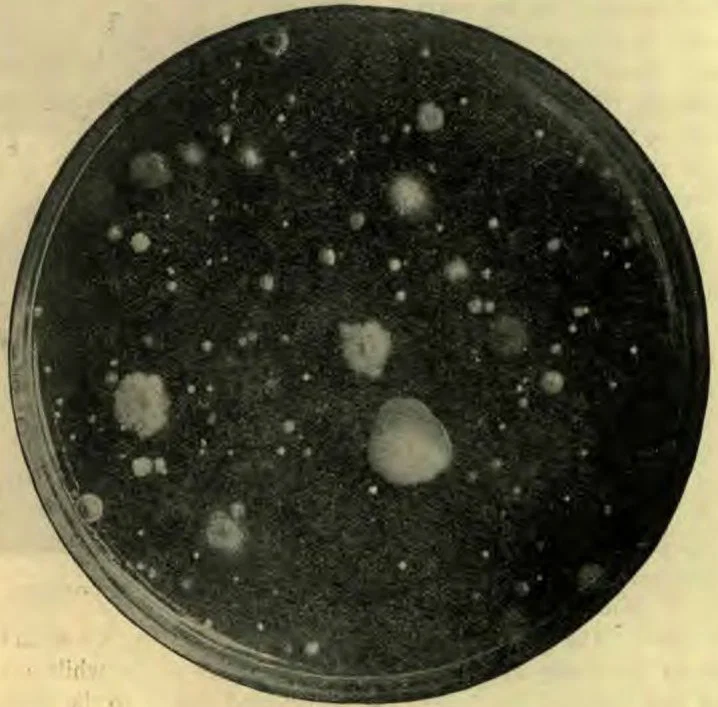
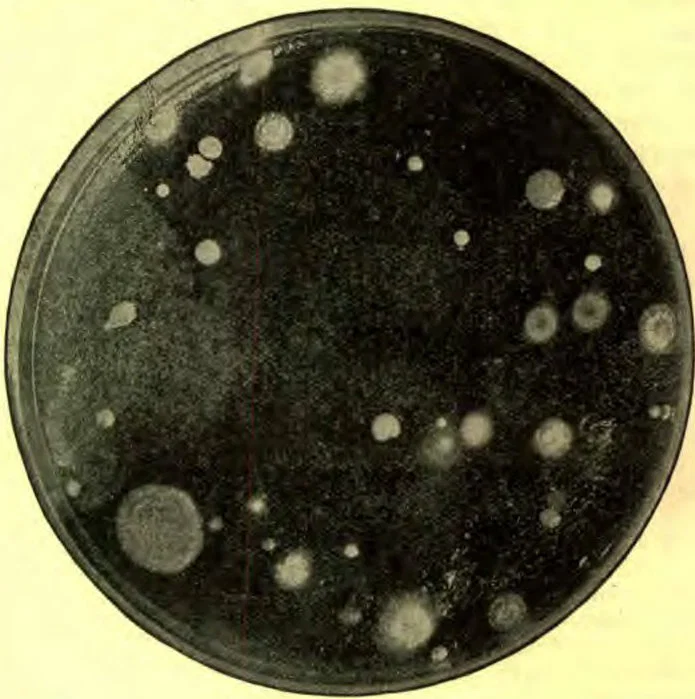
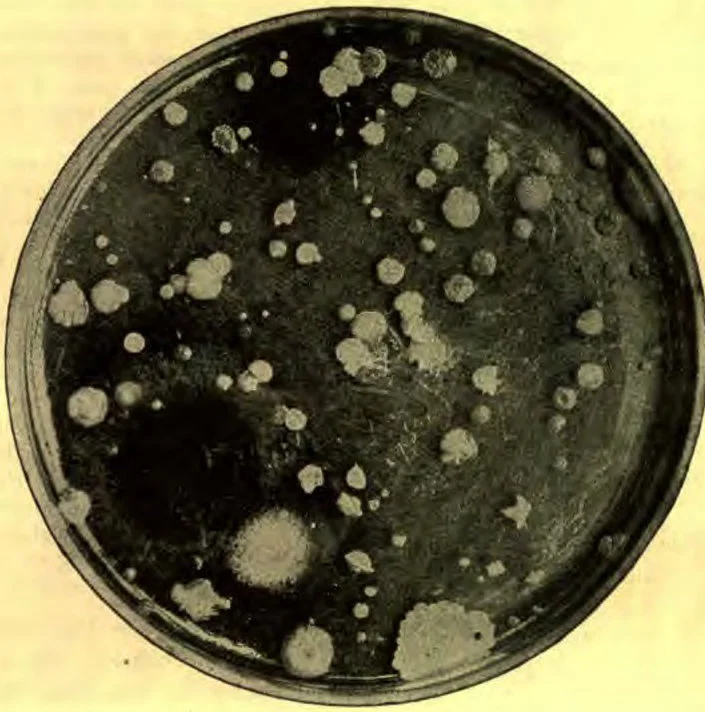
The illustrations in this article, borrowed from Household Bacteriology, through the courtesy of The American School of Household Economics, Chicago, are reproductions of photographs taken from gelatin plates which were exposed to the air under varying conditions. The exposure in each case was for ten minutes.
Each spot is a “colony” developed from a single germ, or ancestor, which has fallen onto the gelatin; so the number of spots represents the number of germs which fell on the plates in ten minutes, and is a fair index of the comparative number of germs floating in the air.
The sweeping was done with a well-moistened broom. With a dry broom, or with careless sweeping, the number of germs afloat would have been much greater. It will be readily seen that sweeping and bed making stir up a large number of germs.