WOULD it not be a clever trick for the Japanese to compel the Russians to manufacture ammunition and guns to destroy themselves, or lay mines to blow themselves up?
Well, some clever scientists have done just such a thing with the diphtheria germ and other dangerous germs; for they make the diphtheria germ help in the manufacture of the diphtheria antitoxin, which is now regarded as a certain cure for diphtheria, when used soon enough.
You are familiar with the process of vaccination, by which a mild kind of smallpox, we may call it, is produced on the arm. A successful vaccination, if recent, seems to be almost an absolute protection against smallpox. A case was recently reported, in which a mother with a seven-months’ sucking child was taken with a very severe form of smallpox, fourteen days after the child had been vaccinated. The mother was taken to the pest-house with the child, and during her entire illness, nursed the child, which was also handled daily by about fifty smallpox patients in all stages of the disease, without contracting the disease. One who can not take a disease is said to be immune to that disease. This child was evidently immune to smallpox, having been rendered so by the vaccination. One who is not immune to a disease is said to be susceptible.
The method of making diphtheria antitoxin is very interesting. A horse is exceedingly susceptible to diphtheria toxin or poison; but by beginning with very small doses, and gradually increasing the dosage, the horse, after a number of months of such treatment, becomes immune, so that a dose of diphtheria toxin that might be sufficient to destroy several hundred horses may be injected into it with impunity. The blood of such an immune horse contains a substance called antitoxin, which, if injected into the body of a child having diphtheria, will, if given early enough, and in sufficiently large doses, save the life of the child.
In order to produce the diphtheria poison in large quantity, beef broth is prepared and put into flasks holding, perhaps, half a gallon. These flasks of broth are sterilized by utilizing the same principle that your mother uses when she cans fruit. But much more care is needed here than in the canning of fruit. Before anything is put into the flasks, they are cleansed, dried, and plugged with stoppers of absorbent cotton. They are then placed in a sterilized oven, and left there long enough for the heat to destroy any germs that might be in the flasks. Then they are filled about two thirds full of the beef broth, corked with the cotton stopper, and placed in a steamer, and left long enough to raise the temperature of the broth to the boiling-point. This steaming process is repeated on three successive days.
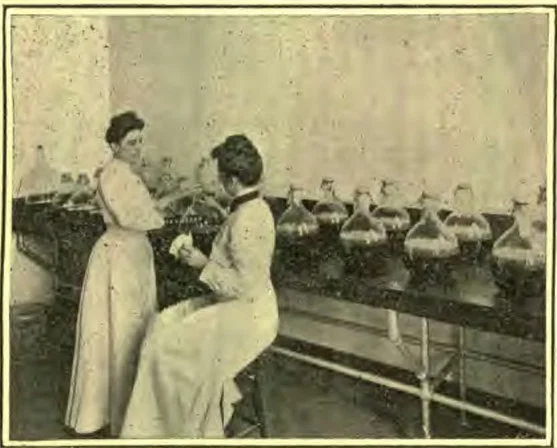
The broth in each flask is next sown or planted with diphtheria germs, as shown in an accompanying illustration.1 The flasks are now placed in an incubator where the temperature is most favorable for the growth of the diphtheria germs. It is necessary that this be a “pure culture,” that is, a culture containing nothing but diphtheria germs. At the end of two or three weeks, the germs will have formed a scum on the top of the liquid; meantime, there will have formed in each flask, as the result of the growth of the diphtheria germs, a quantity of the deadly diphtheria toxin. The flasks are now examined by an expert bacteriologist to make certain that they contain nothing but the diphtheria germ.
It is necessary that extreme care be exercised at every step, for a little carelessness might result in the loss of many lives. Such a case occurred a few years ago in St. Louis, when several children, inoculated with antitoxin, afterward died of lockjaw because of carelessness in the preparation of the antitoxin.
The broth is now filtered through paper and then porcelain, in order to separate the germs from the liquid.
This liquid, which contains diphtheria toxin, but no diphtheria germs, is now ready to be used in the manufacture of antitoxin. Here, it is necessary to have the help of the horse. One might think that any broken-down horse would do for this purpose, but the conscientious manufacturer does not think so. He realizes the importance of having sound horses, and of keeping them under hygienic conditions which will insure the preservation of their health. We give herewith a picture of the interior of a stable used entirely for the housing of horses used in the manufacture of serum. The next article will describe the method of producing diphtheria antitoxin from the toxin. MIKE ROSE.