New Earth Geography—II

8%

Review and Herald Publishing Assn. · Washington, D. C. · July 25, 1905

FromThe Youth’s Instructor, Vol. LIII, No. 30

Read the full edition

New Earth Geography—II

In the preceding article we considered mainly the physical conformation of the new earth. Let us now study the political—if we may, in its first and purer meaning, use such a term—the political geography. The center, geographically as well as governmentally, of the new earth is the capital city, now known as New Jerusalem. (The basis for the most of this part of the article is the forty-eighth chapter of Ezekiel.) It lies foursquare in a plain, surrounded by a group of seven mountains. (“Early Writings,” pages 13, 14. While the passage on the latter page has reference to the temple, which is outside the city, it is evident that the temple and the city are in close proximity.) Its measurement, as given by John, is twelve thousand furlongs in circumference, which by our computation is fifteen hundred miles. This would make it three hundred and seventy-five miles each way. We will further consider the city a little later.
Leaving this part for a time, we will go to the extreme north. Here is the land of Asher. (While the list as given by Ezekiel puts Dan at this extreme northern point, the omission of its name in the catalogue given later by John, indicates that the persistent idolatry and impenitence of that tribe has caused it to be left out; and so we put the next in order, Asher, in the place. This course is supported by the arrangement made by Ezekiel, of the gates in the city, which not only makes the substitution plausible, but seems almost to have anticipated it and provided for it.) We must not suppose this land, though far to the north, to be bleak or forbidding, for that is not a possible thing in the new earth. And while the meanings of the names which mark the northern boundary do not indicate tropical luxuriance, they do show the surroundings to be pleasant and salubrious. It may be that there will be some differences of climate, but not to a degree to be greatly noticed, or such as to make life in one incompatible with life in another.
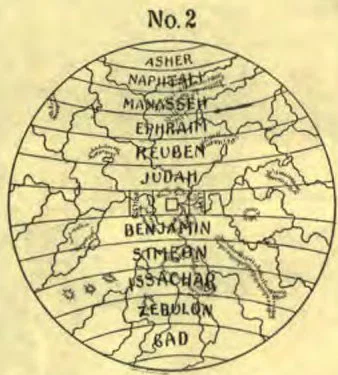
From east to west, the record states, a section is set apart for this tribe, and thus we may suppose it extends around the earth in a broad belt, giving this quarter of the globe to the enduring sons of Asher. Next to them, at the south, comes the land of Naphtali. Upon its southern border the Manassites dwell, and beyond the Manassites’ boundary live their brothers of Ephraim. Reuben comes next, and Judah fills the remainder of the northern hemisphere. Thus six tribes are given inheritance in the north.
To the south of the border of Judah is set apart a strip “in length as one of the other parts,” and the sanctuary of the Lord is in the midst of it. Eze. 48:10. The holy city occupies the center of this territory, and round about on every side of it is a broad tract of land, its suburbs, set apart for cultivation by the priests, the inhabitants of the city. To one side, perhaps the east, perhaps the west, of these suburbs, in the broad strip in which the city lies, and upon the south border of Judah, is the portion of the tribe of Levi. They do not possess the whole of the remainder of this territory, however, for the size of their portion is definitely stated, as that of the other tribes is not, “and the residue,” it is declared, “shall be for the prince,”—that is, the great King of earth.
Passing now to the south, we find next in order Benjamin, and upon his southern border Simeon; then, descending still toward the south, Issachar, Zebulon, and Gad, which last tribe occupies the southernmost position. Thus we may roughly divide the earth after this manner.
No. 2
No. 2
Every week, upon the Sabbath, and every month, at the new moon, the inhabitants of the earth come up to the great center, for worship of their King and communion with him. From the north throng the people of the tribes of Judah, Joseph, Asher, and their neighbors; from the south come the Benjamites, Zebulonites, Gadites, and the men of their kindred tribes. Great armies, mightier in numbers than the biggest hosts ever marshaled on this earth, and incomparable in power and glory, gather toward the great city. They enter the city through twelve great gates, three on each side, upon each gate being the name of one of the tribes. Rev. 21:12. A majestic angel warder stands at the gateway, not as a guard, but as a sign. Each tribe to its gate; from the south the Benjamites sweep around to the east to enter the southernmost of those three gates, next to the entrance ways of Ephraim and Manasseh; the Gadites part to the left, to enter a gate upon the west side; while the men of Simeon, Issachar, and Zebulon enter the three gates upon the south which bear their names. From the north Reuben and Judah come down, and are joined upon the north side of the city by the Levites, and each tribe enters its own gate. The two northernmost tribes, Asher and Naphtali, have their gates upon the west side, next to that of Gad, though between them flows out the beautiful river of life. Eze. 48: 31-34.
The approach to the city upon every side is through the most varied and beautiful scenes. Through forests of illumined palms, oaks, cedars, firs, these different tribes take their ways, now walking amid groves of citrus, apple, pomegranate, and all manner of fruits, now examining the vineyards whose plants rear their graceful heads without support. (“Patriarchs and Prophets,” page 47.) They pass many houses, whose noble columns support their light framework, and mingle their gleaming brightness with the green and purple of the grape. Cascades along the way fall over ledges, not of broken, somber rock, but of gleaming quartz, of gold and silver, and of many-colored precious stones. Fountains jet and throw their feathery forms aloft in the sunshine, catching in their arms as they rise and descend the swiftly playing colors of the rainbow, such as that which spans the throne. On bridges of crystal and gold, magnificently wrought, the pilgrims cross the streams that throw their network about the city of God, and finally they pass over that wonderful crystal sea that spreads before the gates of the city. No bridges, indeed, do they need, nor paths nor streets to walk in, for there in that country they journey by ways we know not of, and the pilgrimage from far-away Gad can be made without the loss of a moment. But surely, as we are told not only of fields and forests, of flocks and herds, but also of houses and of walls, it is meant that we should see in that coming kingdom things to which our eyes here are accustomed; and so may we be permitted to fill out the picture with conceptions of all things beautiful that even man can make, to humanize and make real that very real world in which we, with the immortal spirit glowing within our incorruptible bodies, shall delight.
But who shall tell the glories of the city within! City it is indeed, but not such cities as we have here. No close-packed rows of houses there! It is the paradise of God, a garden hundreds of miles in diameter, and besides having broad gold-paved avenues, it has winding walks among the trees and the flowers of the garden, in the midst of which are hidden away the palaces of the priests. Country estates, we would call them here. Though near enough to one another to make possible constant intercourse of their owners, they are buried in the midst of the creation of God, where every leaf speaks lessons and every rivulet murmurs new secrets of the glory of our matchless King.
And the palaces, do you think of them as being like the mansions men build here, with solid walls, and roofs impervious to rain? There are no thieves there to break in and steal, nor cold winds to howl down upon a shrinking world, no rain-clouds to mar the face of the sky and threaten men, nor shall the sun light on them fiercely, nor any heat. No, we need not such close-built palaces there! Stately columns of precious worth are reared for walls (“Early Writings,” page 13), and between them twine the flowing vines of many fruits, and what shall roof them better than the trees and vines? (“Patriarchs and Prophets,” page 47.) Here and there, perhaps, we see delicately wrought walls of lattice-work and arabesque, with designs which human genius has most nearly approached in the graceful if too elaborate Moorish art.
We may talk of the glories of that place, we may give our imaginations latitude unbounded, we may please our most artistic conceptions, and yet know that the reality will surpass them; and if we fail to realize their exact form or plan, yet rest assured that what we shall see will not condemn us, but, while amazing, will fascinate and charm us. Does not the contemplation of these things thrill us with a desire for their consummation? But they who enter those pearly gates and tread those green fields of Eden, will now be having a work done in them and by them that is not dreaminess nor speculation; for they who enter there are without spot or wrinkle of character. “Blessed are they that do His commandments, that they may have right to the tree of life, and may enter in through the gates into the city. For without are dogs, and sorcerers, and whoremongers, and murderers, and idolaters, and whosoever loveth and maketh a lie. I Jesus have sent mine angel to testify unto you these things. . . . And the Spirit and the bride say, Come. And let him that heareth say, Come. And let him that is athirst come. And whosoever will, let him take the water of life freely.”
A. W. SPAULDING.