3—In Ancient Abyssinia
THE Abyssinians lay claim to great antiquity for their royal house and government. The queen of Sheba, they say, who came from the ends of the earth to see the glory of Solomon, was of their land. Whether this be so or not, Abyssinia is an ancient land with an interesting story.
Although it is not far from the great ocean highway to the East—lying inland west of the southern end of the Red Sea and the Gulf of Aden—it is even yet a country little known. A few travelers have reached it in recent years, and have told us of the land and its people. But missionary work has been discouraged by the government, and very generally the Abyssinians have avoided contact with Europe. They have too often suffered by such contact in the course of history. There seems a change now, and the country is more open. Not long ago the United States sent a representative to negotiate a commercial treaty with King Menelik. He was cordially received in the royal city of Adis Adaba. We hear now of a proposed visit to Europe by the king. As mid-Africa generally is opened up, we shall hear more and more about Abyssinia.
From the point of view of our missionary work, it is a land of special interest to us. We ought to be foremost in entering. In the early centuries Christianity was introduced there. It was before the doctrine of lawlessness had trampled the Sabbath out of sight, and the Christians of Abyssinia were taught to honor and reverence God’s holy day.
In the breaking up of the Roman empire, and later in the Mohammedan invasion of all North Africa and Syria, Abyssinia was cut off from all contact with northern civilization. It was lost to European knowledge. “The Ethiopians slept near a thousand years,” says Gibbon, “forgetful of the world, by whom they were forgotten.”
During all that time the papal church in Europe had grown more and more corrupt, and the Sabbath had been set aside altogether, save as here and there persecuted remnants of the old-time faith kept the light of truth dimly burning amid the darkness.
The Dark Ages passed at last, and the first streaks of the dawn of the Reformation had begun to brighten the horizon. New life was stirring, and men began to explore the world in which they lived. Portuguese navigators rounded the Cape of Good Hope, and made their way up the African east coast. So they found the lost empire of Ethiopia, the present Abyssinia. They found a people with the Bible, keeping up the form of Christianity, and that, too, of a far purer stamp than the Roman Catholic Church knew.
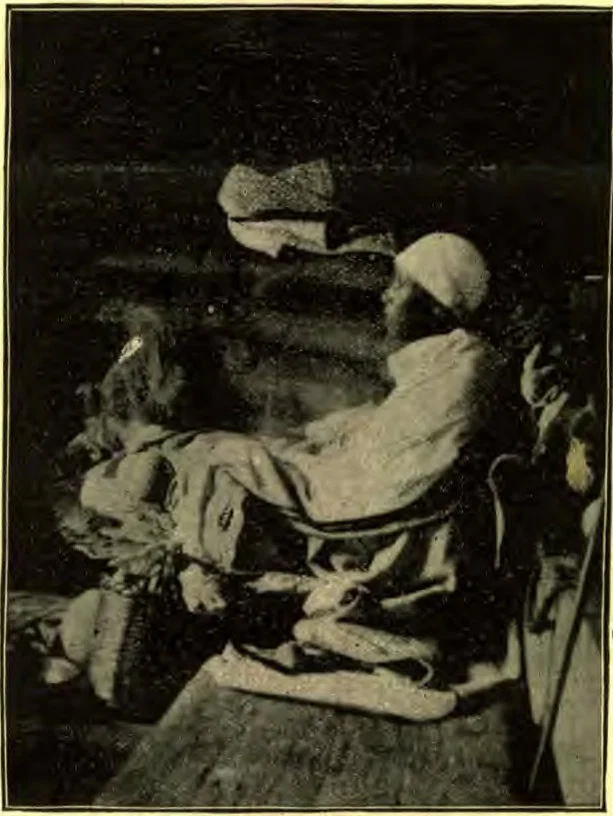
They knew nothing of the doctrine of mass, of purgatory, or of image worship. And they were keeping the Sabbath. A representative of the Ethiopian church was taken to Lisbon by the Portuguese in 1534. He explained to the king their reason for keeping the seventh day:—
“Because God, after he had finished the creation of the world, rested thereon; which day, as God would have it called the holy of holies, so the not celebrating thereof with great honor and devotion seems to be plainly contrary to God’s will and precept, who will suffer heaven and earth to pass away sooner than his word; and that, especially, since Christ came not to destroy the law, but to fulfil it. It is not, therefore, in imitation of the Jews, but in obedience to Christ and his holy apostles, that we observe that day.”
They had many superstitions mixed with their religion, but it was too Scriptural a faith for Rome to let alone. After a generation of effort and intrigue the Abyssinian church submitted to the pope. He commanded them to give up the Sabbath, and the king made laws threatening severe penalties for Sabbath-keeping. Later the tyranny of the priests of Rome was such that they were expelled, and the Abyssinians succeeded in shutting themselves off again from nearly all intercourse with Europe and the churches of Europe.
Their religion now is no doubt a sad mixture; but they are still witnesses to the fact that those who received the gospel in the earliest centuries received also the Sabbath; and they have not even yet forgotten it. Dean Stanley, the English historian, said of them in his “History of the Eastern Church:”
“There alone the Jewish sabbath is still observed, as well as the Christian Sunday. They (with the exception of a small sect of the Seventh-day Baptists) are the only true Sabbatarians in Christendom.”
Elder L. R. Conradi tells of interesting conversations that he had with Abyssinian Christians not long ago. He says: “While traveling from Beirut to Joppa on the steamer—traveling steerage as I was—I had opportunity to get acquainted with those on board. I noticed six or seven strange-looking, tall persons, and they had shepherd’s crooks. They had very little baggage or clothing with them. They had a place on the boat very close to me. When supper time came, they would stand, leaning on their crooks, and the lady in the party would pray before they sat down to the meal.
“I knew they were Christians, and I was curious to know what kind of people they were. So I got a man who understood the language to interpret for me, and I learned that they were Abyssinians. I began to talk with them a little. ‘We are Christians,’ they said; ‘we are going to Jerusalem to worship at the holy places.’ I asked this man what day he kept. He replied, ‘The Sabbath.’ ‘What day of the week is the Sabbath?’ ‘The seventh day, Saturday,’ he replied. I wanted to be sure; so when I came to Jerusalem, I asked our Brother Krum, ‘Haven’t you an Abyssinian church here?’—‘Yes.’ ‘Let us go up there,’ I said. Friday evening, as the sun set, we went up to the church, and what did I see?—The people assembling for worship. And on the Sabbath day also they assembled for worship.
“I inquired if they had not some man there, a man of learning, with whom I could converse. I was shown to the church of the Holy Sepulcher, where they have a small place that is given to them. They are poor people. Calling there, I was told that the bishop was not there. He had gone back to Abyssinia to see King Menelik; but the sub-priest was there, and I talked with him through an interpreter. I said, ‘Are you Christians?’—‘O, yes.’ ‘Do you believe in Jesus Christ?’—‘Yes.’ ‘Do you believe in the Word of God?’—‘O, yes.’ ‘Do you believe in the ten commandments?’—‘Yes.’ ‘What day of the week do you really keep as the day most holy?’ He said, ‘Sabbath, Saturday, the seventh day of the week.’ Then I asked him, ‘Now why do you keep Sabbath?’—‘Because it is commanded in the ten commandments.’ ‘Do you keep any other day?’—‘Yes; we keep Sunday, too; but Sunday is not so holy to us as the other day.’ ‘Why do you keep that day?’—‘O,’ he said, ‘our forefathers had introduced that.’ And I noticed that when I began to talk on that subject, he did not like to say very much, and he did not have the facts of Scripture as for the other practise.”
These people must hear the message of Sabbath reform also. We are pushing downward toward them from Upper Egypt, and we are pushing up toward them from South Africa.
W. A. SPICER.