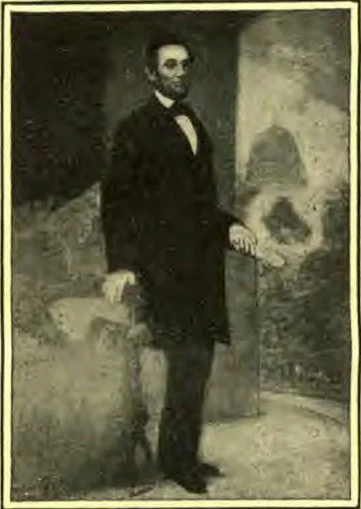
AMONG those who might fairly claim to have known Abraham Lincoln were the pupils in a primary and intermediate school located near the White lot in Washington, the yard of which was separated by a fence from the rear end of the White House grounds. Most of the reminiscences of the president, which the boys carried away with them were small events not easy to relate, but such, nevertheless, as gave to them a growing love, for the great man who sometimes found recreation in watching and applauding their sports, and who more than once visited the school and addressed the children. One incident, however, stood out distinctly, and is described by a witness, one of the boys then attending the school.
One day the teacher gave a lesson on neatness, and asked each boy to come to school next day with his boots blacked. They all obeyed; but one of them, John S., a poor one-armed lad, brought down upon himself no end of ridicule, for he had used stove-blackening, the only kind of polish which his home afforded.
Boys are sometimes merciless in their ridicule. The poor child, only nine years old, and doubly sensitive because of his lost arm, tried to be brave, but his lips were quivering, and the tears were in his eyes, when the jeering suddenly stopped; for there, leaning upon the fence and listening, stood the President.
Mr. Lincoln uttered no word of reproof, but entered the schoolhouse and made inquiry of the teacher. He learned that John was the son of a dead soldier, and that his mother, who had other children, was a washerwoman. Then he went away, and it was many days before he came back again.
The next morning John was at school in a new suit, and with new shoes radiant with the best blacking. The change was so great the boys hardly recognized their companion, whom they plied with questions. John replied that the afternoon before, the President and Mrs. Lincoln and another lady had called at his home in their carriage; that the President had taken him to a clothing store and bought him two suits, and that while he was doing this, the ladies made inquiries of his mother, which later were followed by clothing for the two little girls, and a supply of coal and groceries. In addition to this information, the lad brought to his teacher a scrap of paper containing a verse of Scripture, which Mr. Lincoln had requested to have written on the blackboard:— “Inasmuch as ye have done it unto one of the least of these my brethren, ye have done it unto me.”
Some weeks afterward, when Mr. Lincoln visited the school again, the verse was still there, and the teacher called his attention to it. Mr. Lincoln adjusted his spectacles and read it, then removed his glasses and wiped them, and the boys thought there were tears in his eyes. But he replaced his glasses, and taking a crayon, said, “Boys, I have another quotation from the Bible, and I hope you will learn it, and come to know its truth as I have known and felt it.” Then below the other verse he wrote:—
“It is more blessed to give than to receive.”
A. LINCOLN.
One boy, at least, never forgot it. He is now himself a teacher in the public schools, and often tells the boys he teaches of the two texts which President Lincoln taught to him and his schoolmates.—Selected.