One dewy morning an ill-natured bumblebee flew grumbling over a clover field. Looking into so many cheerful faces, as the clovers turned their heads up to look at him, made him crosser than ever; and the bee finally made a spiteful dart at a jolly, red-faced clover, who seemed especially happy, and mumbled in her ear,—
“You ridiculous thing! You wouldn’t look so pleasant if I should sting you. What would you do, if such a thing should happen?”
The clover seemed not in the least disturbed. “I should give you a smell of the perfume of the meadows,” she replied.
“Perfume,” boomed the indignant bee; “perfume! What do I care for perfume?”
“Then I should offer you a taste of honey; it is good to sweeten things,” innocently replied the red-faced clover, bowing to a passing butterfly, who was a good friend of hers.
“Honey! honey! Do you suppose anything of consequence can waste time on such trifles? Honey and perfume, indeed! I shall have no more to do with you till you learn something of life.”
The red-faced clover continued to smile as serenely as ever, and began rocking the grasshopper that had settled on her stalk. But for all its color, her face bore a knowing expression, as she watched the bee disappear, and she nodded wisely to some of her neighbors who leaned their heads together with an air of understanding.
Meanwhile, the bumblebee winged his way out of the clover meadow, to the side of an old mossy well, where a great tabby cat was lapping water.
“Ah!” said the bee, “here is a creature worth talking to. He no doubt knows something more of life than honey and perfume. I think I shall take a sip of water with him, in order to make his acquaintance.”
But no sooner had the bee given his first obsequious hum in puss’s ear, than the latter started fiercely, and instead of the flattering welcome expected, gave his visitor a blow from his paw, which landed him, dazed and helpless, under a clump of ferns, growing where the water trickled from the spout. It was quite a moment before the bewildered bee recovered from the shock, but finally he gathered up wits and wings, and, much crestfallen, flew slowly away again, just in time to escape additional punishment for his impertinence.
Flight through the fresh air soon revived the strength and spirits of the conceited bee, and by the time he had reached the river bank, his ill-nature had returned to comfort his wounded pride.
“The rude beast, to treat a stranger so!” he droned, indignantly; “I shall never attempt to be friends with him again. But here is a kind-faced cow, sleeping in the shade. I’m sure she’ll be glad of my company, while I rest on her ear a minute, in this cool place.”
But he had only just alighted on his chosen perch when the mild-appearing cow uttered an angry snort, and, giving her ear a vigorous twitch, flung the bee into the water. He floated for a time helplessly, and no doubt would have drowned if he had not drifted near a bunch of leaves, upon which he crawled to regain breath. But when, at last, the sunshine had dried his wings, and he flew back to shore, it could be seen that he went more slowly.
Nevertheless, the proud fellow still had something to learn. He would persist in constantly striving to do that for which he was unfitted, or desiring something that could only bring him harm; consequently he was always in trouble. A hawk chased him into a tree; a cart jostled him in the dust; a teamster struck at him; a blue-jay pecked him, injuring one wing: then he was forced to lie idle for a time, nursing his hurt in a thistle-bloom hospital by the highway.
Being scarcely able to fly at all, he one day fell into the hands of a cruel boy, who wanted a swarm of bees of his own, in order that he might always have all the honey he could eat. He carried a large empty bottle, into which he put all the bees, of all sorts, that he could capture about the fields and waysides, and into which went our poor, humbled bumblebee, along with the rest.
Here, forced to mingle with creatures whom, in prouder days, he would have scorned, the bumblebee began to see how he had wasted the golden summer days, together with their greatest beauties and sweetest charms. An old honey-bee, whose work was nearly done, told him things he had never dreamed, of joys that were safe and innocent, but only found in buckwheat fields, the rose-tree thickets, the clover meadows, or other places where honey and perfume abounded. From her he at last began to understand that in such spots life was at its best, and that honey and perfume would bring him happiness and rest. Then he began to long for one more chance to fly in the balmy air, and see if it all were true.
For several days, the captured bees were imprisoned in a dark hive, under some trees, until they were so hungry, the boy said, that, when released, they would gladly proceed at once in search of the coveted honey. Then one evening, the hive door was opened, and the bees, smelling the fresh air once more, crept joyously out of their prison. The bumblebee’s wing had become quite well, and he was very happy as he made a short trial flight in the orchard, then rising high, flew swiftly off toward the pink evening sky. His conceit and arrogance were gone. He had lost all desire for the society of the proud and lofty. He was hungry, thirsty, and weary, and eager only to test the truth of the honey-bee’s tale of the clover meadows, so away he went, without a pause, and strange to say, without a grumble, but humming a little song of thankfulness for life and freedom.
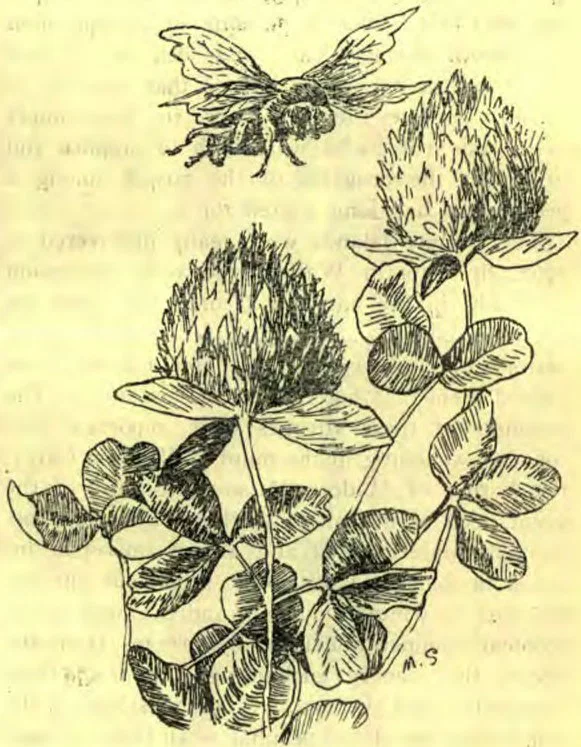
In the clover meadows, the first thing the bumblebee did was to seek out the red-faced clover; who smiled at him as kindly as ever, but waited for him to speak.
“I’m so tired, dear clover,” said the bee, creeping close to her heart.
“Poor fellow!” she answered, softly; “smell the meadow perfume; it will revive you.”
“Thank you!” he said, gratefully; “and just a sip of your honey, dear clover, for I am hungry. O, how good it is!”
And the red-faced clover laughed, contentedly, and replied, “Yes, the honey is good, and so is the meadow perfume. I knew you would say so some day.”
“How did you know?” asked the bee.
“Because,” said the red-faced clover, “I have seen the same thing before.”
And ever since then, bees have loved clover meadows, and can not be happy without a share of their honey and fragrance.
MINNIE ROSILLA STEVENS.