THE highest solid monument in the world is the famous Washington Monument, which is seen towering against the sky long before one reaches Washington. In the city its tremendous height confronts one at every turn, and has place in a thousand vistas—from the avenues and parks, from the Capitol, the White House, the hills of the Soldiers’ Home, the heights of Arlington, and from far down the river on the way to Mt. Vernon. Go where you will, the one prominent feature of the landscape is the monument. Seen at different times of the day, it has a new character for each new hour; its appearance changes with the varying lights, and with alternations of clear sky and cloud. In stormy weather it suggests a mountain peak standing immovable with the mists driving by.
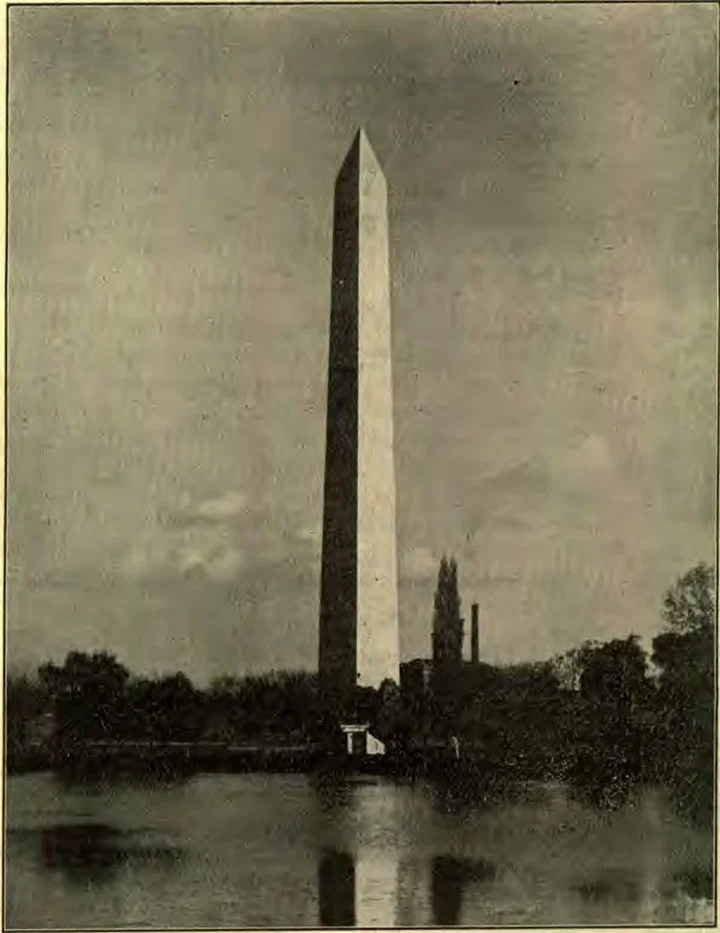
The foundation of this giant obelisk is of rock and cement, and is thirty-six feet deep, and one hundred and twenty-six feet square. The monument is fifty-five feet square at the base, and thirty-four feet at the top; the walls are fifteen feet in thickness at the base, and eighteen inches at the top of the shaft. The height is five hundred and fifty-five feet, five and one-eighth inches. The total cost of the monument has been one million three hundred thousand dollars.
The interior is lighted with electricity, and an elevator carries visitors without charge, ascending every half hour. A stairway of nine hundred steps leads to the top; but not a large number care to attempt the ascent or even the descent. It is really a great undertaking.
A magnificent view is afforded from the eight windows which pierce the walls at the height of five hundred and four feet. Immediately below, and stretching away to the White House on the north and the Capitol on the east, is the beautiful landscape gardening of the Mall and the parks, the city beyond, and then the hills rolling away to the horizon. On an eminence in the northeast is the Soldiers’ Home; on the Virginia Hills, across the river to the west, is Arlington, the beautiful military cemetery; on the northwest is the Naval Observatory. The Potomac’s winding course may be followed for miles; and, on a clear day, one may discern in the western distance the mountains of the Blue Ridge in Virginia.
It was built as a memorial of the “Father of his Country.” The names of forty States and many societies that supplied a share of the money to pay for this mighty obelisk, are inscribed on special stones on the inside of the marble shaft—pure-white marble without and granite within, tipped at the summit with a pyramid of pure aluminum, visible from below only from a certain position, and then on a particular moment of the day, when it shines out like a brilliant star from the point of the monument. On this point are inscribed the words Laus Deo, “praise to God.”
Washington himself is said to have selected the site afterward adopted. The corner-stone was laid in 1848. In 1855 the shaft had attained a height of one hundred and fifty-two feet. Then, the funds being exhausted, the construction was suspended for twenty-three years, and was resumed in 1878. The monument was finished and dedicated February 21, 1885. The orator on that occasion was the venerable Robert C. Winthrop, who, thirty-seven years before, had delivered the oration at the laying of the corner-stone. The object and intent of the monument are impressively described in the following words uttered by the orator on the laying of the corner-stone in 1848:—
“Lay the corner-stone of a monument which shall adequately bespeak the gratitude of the whole American people to the illustrious father of this country. Build it to the skies: you can not outreach the loftiness of his principles. Found it upon the massive and eternal rock: you can not make it more enduring than his fame. Construct it of the peerless Parian marble: you can not make it purer than his life. Exhaust upon it the rules and principles of ancient and modern art: you can not make it more proportionate than his character.”
J. S. WASHBURN.