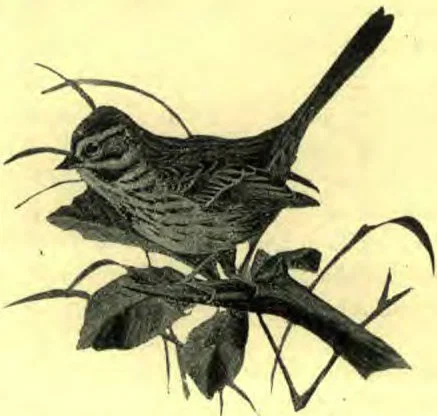
The Song-Sparrow
By Eva Jenks
DEAR little song-sparrow! Who does not love him?—modest, unassuming, ever happy and musical, even in the cold, blustering days of March; and trustful and thankful when the early snows of winter have driven southward most of the feathered songsters, and covered the little brown seeds with a white mantle.
A few of this species remain in the North during the coldest months, but most of them seek a warmer and more friendly climate. In early March, however, some sunny morning, we are awakened to the fact that Winter’s icy grasp is being broken, and Spring, with her attendant train of birds, sunshine, and flowers, comes on apace. From orchard and roadside we hear the melodious notes of the song-sparrows, who have arrived with the bluebirds, and who confirm, by a sweet, continuous chorus, the solo performances of their brilliant blue neighbors, who assure us, over and over again, that “tru-a-ly, tru-a-ly,” spring is coming.
The song-sparrow is a plain bird, with a grayish-brown back, marked with reddish streaks, and plain brown wings and tail. His head is brown, streaked with gray; and he has a brown stripe on each side of his throat. Underneath, he is grayish white, spotted with brown. These spots come together, and form a dark patch, or breast-pin on the center of his breast. By this breast mark he may always be recognized from other sparrows. What this bird lacks in brilliancy of plumage, it abundantly makes up by the sweet persistency of his song. It has been suggested that his song resembles the words, “Maids, maids, maids, hang on the teakettle, teakettle, ettle, ettle.” This is the common song of these birds, which we hear coming from every meadow, brook, and roadside bush. Individuals vary this song. The song-sparrow also has a more complicated and brilliant performance, which he gives on the wing.
Some of the best gifts of nature are the most abundant. So it is with our little song-sparrow. During the warm months, one can not go far in the country without meeting this friendly bird, and being greeted by his cheery song.
The nest is rather thick, largely built of fine dry grass, and mostly lined with horse-hair. The parent birds hide it carefully near the base of an old stump, surrounded with grasses, or among protecting bushes. Sometimes, when snakes or mice abound, it is elevated a little way above the ground, in the crutch of a low-spreading shrub.
Three broods are usually raised in a season; and as the birds are scrupulously neat, they occasionally raise two broods in the same nest.
The birds take turns in occupying the nest; and after the young are hatched, each parent takes part in providing food for the growing family.
Late in November most of them leave our northern climate.
Many useful lessons may be learned as we study the life of our unassuming friend, but one of the most important is a lesson of faith. Whether flying among the glad spring flowers or gleaning a scanty pittance among the frosts and falling leaves of autumn, his song is full of trust and good-will. EVA JENKS.