“O! JUST let me see these specimens that I have fixed, will you please, uncle? I’m so anxious to see how they look through the glass.”
Uncle Frank turned his head, and there stood his young nephew, with two or three small pieces of glass in his hands, upon each of which was some substance almost too small to be seen by the unaided eye.
“I found a mosquito down by the river; I haven’t seen one before this summer; the rascal bit me, and I killed him for his pains,—see uncle, it is quite swollen. But I want to see how his head looks, and his bill, and—”
“I hope you saved the wing,” said Uncle Frank; “if you have, you will be surprised at its beauty.”
“I think I did, uncle, I meant to; but I want to see his bill,—the thing he bit me with.”
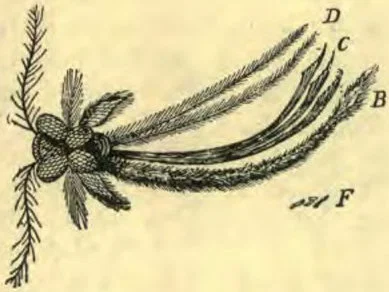
Uncle Frank put the tiny head under the glass at once, and smiled. “You have a fine specimen here, only your mosquito is a gnat, very much like the mosquito, however; in fact, we may call them cousins. You may see the proboscis which stung you; now you don’t wonder the wound has swollen a little, do you?”
“Why! can it be that this is the head of that little chap? Well, his bite hurt, but not so much as the sting of those bees. But what is that great thing beside the head? O, I see! that’s the wing. I stuck that down on the glass because I wanted to know all about it. The head is as pretty as a plant, and looks a little bit like one, too; and the wing—O my! that looks like anything in the world but a gnat’s wing, doesn’t it, uncle?”
“It looks much like a mosquito’s wing, only the embroidery, or trimming, as we might call it, around the edge, is not quite so elaborate. A great many years ago, when the country was newer than it now is, mosquitoes were not quite so much of a curiosity as they are now in this section of the country. I can remember sleeping in the barn many a summer to get rid of them.”
“Didn’t they creep through the cracks, uncle?”
“O, no! the smell of the clover and hay drove them away. O how I used to enjoy those nights in the old barn, sleeping on the fragrant hay! When we would shut up the house for the night, ready to go to our sleeping quarters, the hm-m, hm-m of the disappointed insects left behind was loud and fierce,—for there were myriads of them,—and right glad we were to escape them.”
“But how did you manage in the daytime? You couldn’t stay in the barn all the time.”
“They were not so troublesome days; though I can remember standing by my mother’s side, when a child, and fanning the blood-thirsty insects away from her while she sewed.”
All this time, Uncle Frank was busy adjusting another lens to his instrument. “I have an idea there is something else here worth looking at, but it is too small to see plainly through the first lens. Ah, here we are,—I thought so: you noticed maybe that the proboscis looked rough and strange through the first lens. The fact is that it is completely covered with tiny feathers, which this stronger lens reveals.”
“Feathers! O uncle, there’s something strange and new all the time. Think of feathers on the bill of a little gnat! I wonder what they are for. How strange they look.”
“I can not tell you their use, but you may be sure they act some part in the physical make-up of the little creature. We can not understand all the ways of the great Creator; they are past finding out,” said Uncle Frank, reverently. “But,” continued he, “this little instrument called a sting, or proboscis, is really composed of six tiny lancets, covered over by the feathery sheath. The wings of the gnat are also most wonderful pieces of mechanism. They are estimated to vibrate three thousand times a minute when the insect is flying. Think of a joint so delicate as that which must connect this wing to the body, and yet so elastic and smooth that it will allow of such tremendous speed and motion as this!”
“I should think the joints would need oiling pretty often,” said Harold.
“And yet the little insect is almost constantly using his wings. So delicate, and yet such perfect mechanism! It is wonderful, and the more we study these things, the more astonished we feel. The earth and the sea are filled with tiny creatures, some of them too small to be seen by the unaided eye, and yet when we place just one of them under the magnifying-glass, we find enough to keep the wisest philosopher studying almost for a life-time; and then he will not find out all there is to know.”
“It makes a little boy like me feel pretty small and ignorant, Uncle Frank,” sighed Harold.
“That is the way the wisest feel,—small and ignorant. But here is something else I would like you to examine. I was at considerable trouble to mount and prepare the specimen, for I am not very skilful in the business. Now what do you suppose this is?”
“I haven’t the least idea, uncle; it is very pretty; it looks almost like a piece of lace.”
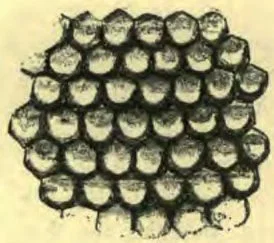
“You would never guess it to be the eye of a common fly, would you?”
“A fly’s eye! O uncle! what are those little six-sided blocks?”
“They are single, separate eyes, and it has been computed by adepts that there are at least seven thousand such little eyes in one single large eye of the fly.”
“Well, I don’t wonder that I never can surprise a fly. They always see me, no matter on which side of them I come.”
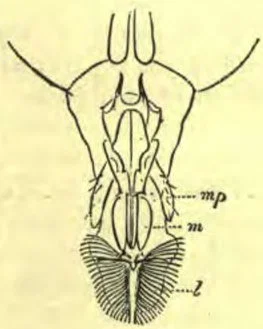
“Yes; you may surprise a person if you approach him from behind, for he can not see you; but a tiny insect can not be caught off its guard for a moment. And here,” continued Uncle Frank, “is the mouth and tongue, or proboscis, of the fly. Isn’t it wonderful? You see it is particularly adapted for sucking juices. Flies, as you know, are great eaters.”
“That’s what mama thinks, I am sure; she is always hiding things from them; they are filthy fellows, aren’t they, uncle?”
“Yes, they are not at all particular about their food; indeed, they seem to be a trifle fonder of carrion than anything else. One great naturalist declared that three flies would consume the dead body of a horse as quickly as a lion could do the same; that is, the flies and their offspring. They begin to eat at once, and never cease. And when we remember that one single blow fly can become the parent of twenty thousand others, the statement of the naturalist does not seem unreasonable. And so we find that even these ugly creatures that are shunned and detested by mankind are really useful scavengers, ridding the world of an enormous quantity of deadly, poisonous matter. But now, my dear Harold, we must close our studies for the present, because, you know, I must start on my homeward voyage to-morrow. But I am sure you have become sufficiently interested in the things you have seen and heard about insects, to continue your studies, which you can do even without a teacher; and, my dear boy, if you and I are so happy as to be numbered among the blessed company of the saved, we shall have an eternity in which to learn more and more of the wonderful works of the God whose name is Love.”
The next week when Harold’s birthday came, he received a beautiful microscope, a present from his Uncle Frank.
MRS. L. D. AVERY-STUTTLE.
(Concluded)