The People—Some Strange Customs
THE population of Korea is variously estimated at from six to ten millions, the lower figure being probably nearer the truth. As a race they have the same yellow complexion, black eyes and hair, as the other Mongolian peoples. There is no authentic record of their origin; but there is a theory that they originated from the union of a Mongolian branch with an Aryan race from western Asia. It is said that there are elements in the language that show a derivation from the languages of India; and one often sees a face decidedly Aryan in type. In size they are quite well developed, being decidedly superior to the Japanese in stature.
In temperament the people are more expressive and boisterous than their island neighbors. An angry or excited Korean scolds and shouts, when a Japanese would only mutter, or perhaps smile. A Korean gentleman is polite and cordial, yet with far less ceremony than is observed by the Japanese. You miss the profound and repeated bowing seen in Japan; yet well-bred children are carefully taught to bow low before their elders, and to guests.
Intellectually the Koreans are bright and clever, and make good students. They excel as linguists, but do not take so well to mathematics and the sciences. It is to be regretted that they have no general system of education; the only schools are of a private character. Yet this very fact makes Korea a promising field in which to conduct Christian schools for the education of the young.
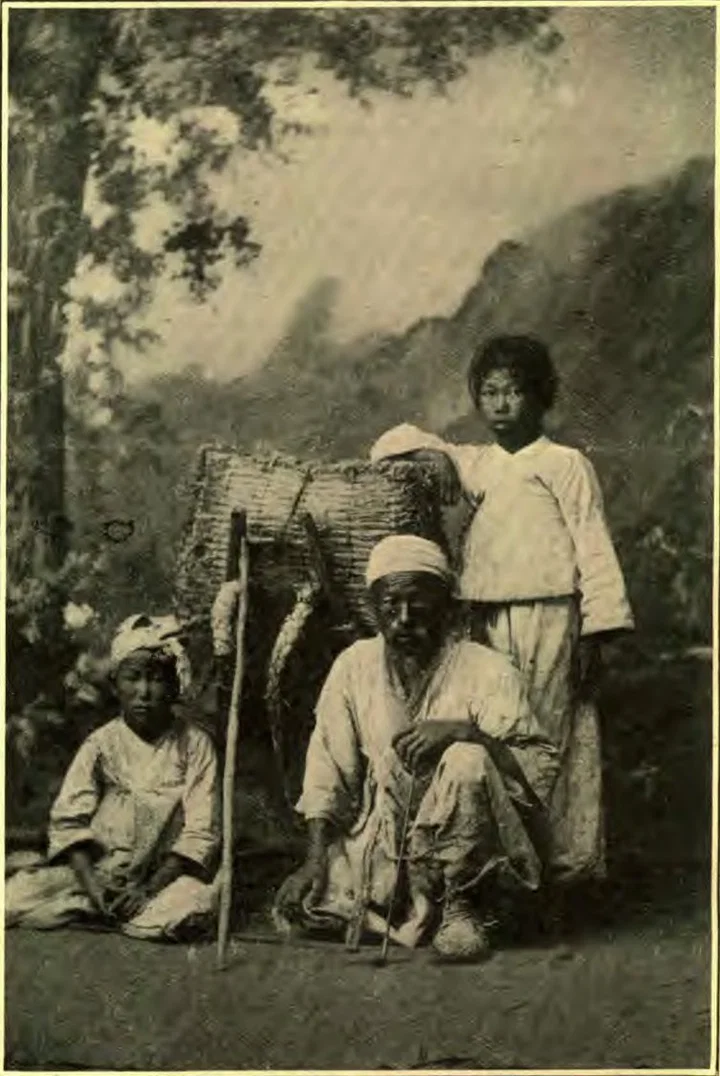
Every country has its customs that possess all the force of statute law. In Korea there are many sights and some sounds that seem strange to the foreigner. Several of the most striking ways of doing things may be worthy of notice here. In America we are accustomed to seeing the commodities of trade transported through the streets in wagons drawn by horses. In Japan it looks strange to see most of the drays and delivery wagons, or carts, drawn by men. But in Korea it looks stranger still to see everything carried upon men's backs. And here let me describe the rack or saddle which supports such a load. Two pieces of wood between three and four feet long are fastened together by several crosspieces, like a short ladder. Each of these two upright pieces has a natural branch projecting from it, these two branches project behind, and support the load. The whole is carried on the back, suspended from the shoulders by stout ropes of straw. At the ports of Korea, scores of men are seen carrying heavy loads of all sorts upon these queer saddles. Farmers carry loads from the fields in the same way. During our trips across the country, we employed a man with one of these contrivances to carry our baggage. A similar thing is used in the country districts of Japan, where wagons are scarce. It seems a hard way to make a living; but there is a heavier bondage resting upon the world than any which daily toil imposes. It is the bondage of sin.
The work which falls to the lot of women in Korea also presents some strange ways of doing things. One of the most interesting is their manner of doing laundry work. The soiled clothes are first taken to a well or pool of water, placed upon a flat stone after being well soaked with water, and then pounded with a wooden club. After this treatment, the clothes are well rinsed in a small tub. I could not see or learn that any soap is used; but the process is certainly effective, for the clothes are made spotlessly white.
But still more curious is the method of making the clothes smooth after drying. A garment, instead of being ironed, is folded in several layers, laid upon a smooth, flat stone, and pounded with wooden clubs. Usually two women sit facing each other, with a club in each hand, and pound with alternating strokes that make quite a rhythmical rub-a-dub-dub. Sometimes the garment is wrapped around a wooden cylinder, and then beaten. In this case the roll is turned with the left hand, and beaten with the club in the right. Now, I may not have described this process accurately enough so that the reader could succeed well at it; but the women of Korea understand it well, as their smooth and even polished clothes bear witness. And there is never a garment scorched!
We may learn from the customs of other peoples that the whole sum of wisdom is not wrapped up in our ways of doing. Let us have charity and a teachable spirit; and then we shall be able to teach others the things that pertain to their eternal welfare. F. W. FIELD.