THE island of Hongkong, the most eastern of the British possessions, situated at the mouth of the Pearl River, about ninety miles from Canton, is eleven miles long, seven wide, and about twenty-seven in circumference. The name “Hongkong” signifies fragrant mountain, so named on account of the abundance of fragrant shrubbery which covers the mountain slope.
Before the British took possession of the island, it had scarcely any history. It was scantily peopled by fishermen; but in 1841 it was ceded to Great Britain by the Chinese government. This was not done, however, without some difficulty. England felt the need of a place on the coast where British trade might be controlled and protected, and where merchants and officials might be freed from the insulting requirements of the Chinese authorities. As early as 1834 England’s representative in Canton, having sufficient foresight to see the great commercial and naval advantages that would come to Britain from a possession so admirably situated, urged the home government to send a force from India to take possession of Hongkong. Later the chief superintendent of trade required that all the ships of Her Majesty’s subjects, at the outer anchorages of Canton, should proceed to Hongkong, hoist their colors, and be prepared to resist all attacks of the Chinese government. When the British community left Canton, Macao, being a Portuguese colony, offered them protection from the enemy; but when the Chinese threatened bombardment of Macao on account of the refugees, the English felt they could no longer accept this hospitality, so took to ship, where they could make a home for themselves until the accomplishment of their object—the taking of Hongkong.
At first, progress was rapid. Queen’s Road, now the principal street, was laid out for a length of three or four miles, and buildings were rapidly constructed. But things were soon checked, owing to the unhealthful condition arising from the upturning of the malarious soil. The abandonment of the island as a colony was seriously discussed. One man who recommended the idea of abandonment, cited, as a reason, the loss of two hundred fifty-seven men by death, from a single regiment within twenty-one months, and of the Royal Artillery fifty-one out of one hundred thirty-five men died within the space of two years. He said it was a delusion to hope that Hongkong could ever become a commercial emporium like Singapore. But the governor argued against this pessimistic idea, and said time alone was required for the development of the colony, and for the correction of some of the evils which hindered its early progress. The governor lived to see his predictions largely fulfilled. The people continued to suffer from malaria for some time, and even now it has not entirely disappeared; but the colony is prosperous.
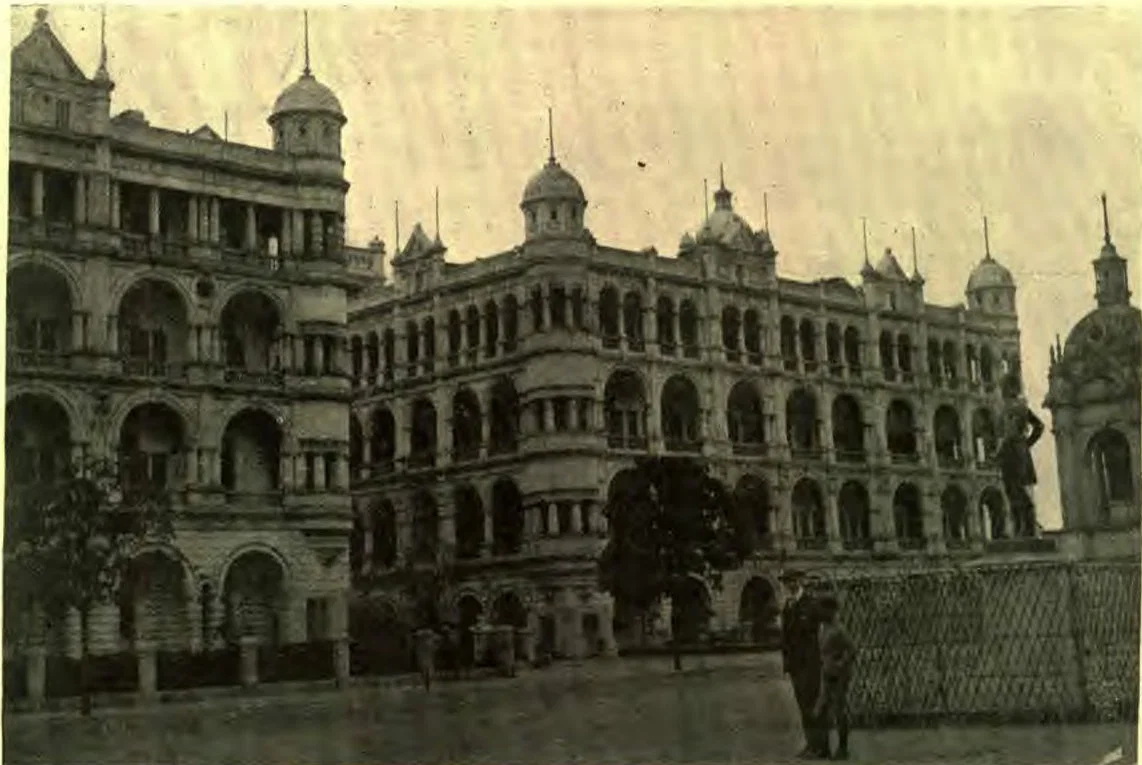
PRINCESS AND QUEEN'S BUILDING IN HONGKONG
In 1862 the Hongkong mint was established. In 1874 one of the most destructive typhoons visited Hongkong, causing enormous damages and the loss of thousands of lives. The year 1894 is memorable, in the colony, as the disastrous year of the bubonic plague, from which twenty-five hundred persons died. A hundred died in a single day. The government used every measure to impede its progress and crush it out wherever possible. That portion of the city where it raged worst was cleared of inhabitants and destroyed, the government promising to reconstruct it in accordance with sanitary requirements. Special hospitals were erected, and the medical staff was increased by additions from army and navy and the coast ports. Then, as now, the plague disappeared gradually as the cooler weather came on. The past summer as many as thirty cases were reported in a day, but this means only a part of the actual number stricken, as the natives are not fond of reporting. When it is known that a member of a native family has the plague, it is quite common for the family to remove to other quarters, and leave the dead or dying in the vacated home, or else, if the sick can be moved without detection, they board a steamer, and take him to his native home in the country to die. God’s promise in the ninety-first Psalm is especially comforting during this season to his believing children.
The government of Hongkong is administered by a governor, aided by an executive council consisting of five officials and two non-officials.
Hongkong is a free port. It is now the fourth city in the world in commercial importance. Trade consists chiefly in opium, cotton, sugar, salt, flour, oil, cotton and woolen goods, yarns, matches, metals, earthenware, amber, ivory, sandalwood, betel, granite, and vegetables. It possesses unrivaled steam communications. The European and American mail is conveyed twice a week. Several less important steamers also carry mail.
The harbor of Hongkong is one of the finest and most beautiful, having an area of ten square miles. With its diversified and varied shipping scenery, it presents an animated and imposing spectacle. It is enclosed on all sides by lofty hills, formerly destitute of foliage, but now the slopes are gradually covered with young forests, the result of the afforestation scheme of the government.
The city of Victoria is beautifully situated, the houses, many of them large and handsome, rising tier upon tier, from the water’s edge to a height of over six hundred feet on the face of the peak, while many bungalows are visible on the very summit of the hills. Seen from the water at night, when lamps twinkle among the trees and houses, the city, spreading along the shore for more than four miles, furnishes a sight not soon forgotten. The roads and streets are well built, and are clean, and many of them nicely shaded by spreading banyan trees. The European business quarters occupy the central portion of the city. The botanical gardens are situated just above the government house, and consist of finely laid out terraces, slopes, walks, and parterres. There are twelve or more churches, and many schools—government, parochial, and private.
There are printed here three daily English newspapers and two weekly. The native press is represented by four daily papers, also a Portuguese paper published weekly, besides a number of smaller papers.
The approaches to the port are well lighted. A lighthouse is situated at the western entrance, the light being a fixed dioptric of the fourth order, visible at a distance of fourteen miles;2and the eastern approach is indicated by a group of flashing dioptric lights of the first order, visible at a distance of twenty-two miles. A lighthouse thirty miles distant from Hongkong is connected with the port by a cable, and the approach of vessels is signaled from it to the post-office.
The city is supplied with water from three immense reservoirs upon the mountain. The water is caught and conducted by means of little drains all about the surface of the mountain, into these large reservoirs, and from them through iron pipes to our homes. There is an electric-tram road in process of construction, but thus far our means of travel is by jinrikishas drawn by the natives.