A Case of Need
By Pansy
[The incidents in this story happened in San Francisco a few weeks ago.]
EDWARD had his fork half-way to his mouth with a morsel of food on it. As Nana spoke, he laid it down, and looked across the table at her. “It seems as though I ought to save it,” he said.
Nana laughed. “O, no,” she answered; “eat it; there isn’t enough of it to save.”
“It’s enough to choke a fellow,” said Edward, gloomily.
Nana laughed again. “I shouldn’t think it was big enough for that,” she said. “You needn’t look at me as though I had no feelings. I might as well laugh as cry, but I’m just as troubled as you are. Mama seems real weak to-day, and it’s no wonder. There is nothing to tempt her to eat. She’s been crying, too. She turned her head away quick when I went to ask her how to make that miserable sloppy gruel that she couldn’t eat, after all. I almost told Dr. Colton this morning when he talked about all those delicacies, that he might as well order gold-dust.”
“Did he say she must have them?”
“Not exactly; he only spoke of it as a matter of course. ‘Give her nourishing food,’ he said; ‘broths, and fruits, oranges and pineapples, anything that she fancies.’ It all sounds so easy when he gets it off! I almost giggled; it seemed so funny to think of our being able to buy them! Mama shook her head at me. I guess she was afraid I was going to disgrace her by saying some such thing.”
“Mama ought to have what the doctor orders. We can’t expect her to get strong if she doesn’t.”
“I know it,” said Nana. “But what can we do? I should be willing to beg if mama would let me. I thought of it last night when I stopped at Benham’s, and saw them unpacking a great box filled with fruit. I know I could have said: ‘O do please give me one orange and a little piece of pineapple for mama!’ If it hadn’t been for mama’s asking me questions, I believe I should have done it.”
“Something has got to be done,” said Edward, as he pushed his empty plate away and rose up. His sister did not look encouraged. They had both said that before, and meant it; yet nothing had been done.
Edward was nearly fifteen, and his sister Nana, a year and a half younger, thought him almost a man; but he felt bitterly that he could not earn a man’s wages.
Both of these young people, however, seemed older than they were, for the reason that almost from babyhood they had shared their mother’s cares and troubles, and tried to help her plan.
Little Sara, their eight-year-old sister, was just beginning to talk plainly when the father died, and trouble began. The pale little mother, who had never been strong, did her best. She gave up the front room of their small house for a store, and had moved into it whatever things were given to her after the auction sale at her husband’s store. A queer, tumbled-up mass of things there were. Many of them nobody wanted, and the little mother did not know how to arrange those that might have been sold. She had never learned how to keep store. But she managed to get enough to feed and clothe them and keep the children in school, until she fell ill.
Then the two older ones tried to shoulder her burdens. Edward found, after long hunting, a place as errand boy in a down-town grocery; and Nana was housekeeper, nurse, and saleswoman at home. Customers did not hinder her much. Sometimes for days together the little bell over the front door did not ring.
It rang that day just as Edward pushed back his chair. Nana answered it, and came back smiling. “Ten whole cents!” she said, holding up the dime. “The first sale I have had to-day.”
It was very still in the little kitchen after Edward had gone back to the store and Nana to her mother. Little Sara was alone with Betsey Amelia, her one dear dolly. If you had been watching her, you would have noticed that the little girl hugged Betsey Amelia very often; and sometimes, after she had put her face down to the doll’s, there would be tears on Betsey Amelia’s painted cheeks.
A great thought that meant a great sacrifice had come to little Sara. In order to understand it, you will have to know about Philip.
Philip was a boy who went to the public school where little Sara went, and who had been for some weeks trying to raise twenty-five dollars with which to buy a pony. All the children in school had heard about it. When Philip had twenty dollars, he was in despair for the other five. The owner of the pony would agree to wait for him but one more day. Then Philip had a bright thought—his bicycle. What should a boy with a pony want of a bicycle? He tried to find a purchaser among the boys, and failed. Then he advertised in the morning papers:— “FOR SALE: A first-class bicycle in good order, for five dollars. A case of necessity.” Within twenty-four hours Philip’s bicycle had changed hands, and he was the owner of a pony. It is true that Philip’s father said the wheel was worth more than the pony; but Philip did not think so, and little Sara did not know it. Advertising was the way to sell things. That was what little Sara had learned.
She had but one thing of her “very truly own” that she thought anybody would care to buy, and that was her dear and dearly loved Betsy Amelia. Could she part with her?—Yes, for mama’s sake, she could. A doll not so pretty as she, and not quite so large, stood in a show-window that little Sara passed on her way to school, and was marked “Only one dollar.” Little Sara was no dunce; she knew that one dollar would buy several oranges, and a pineapple, and berries, and even cream. What if she had a whole dollar to spend for mama? Wouldn’t anybody who cared at all for dolls be glad to give a dollar for Betsy Amelia? Little Sara felt sure of it. Left to herself that afternoon, she worked hard, and printed her advertisement.
“FOR SALE: A dear dollie named Betsey Amelia for one dollar. A case of need.”
When she went to school the next morning, she took her advertisement along, and stopped at the office of The Daily Bulletin, the editor of which was a good friend of hers. He always said, “Good morning, Mouse,” when she met him, and often exchanged for a kiss an orange or a red-cheeked apple. He had often told her that his girls were all boys, and she could play that a piece of her was his little daughter.
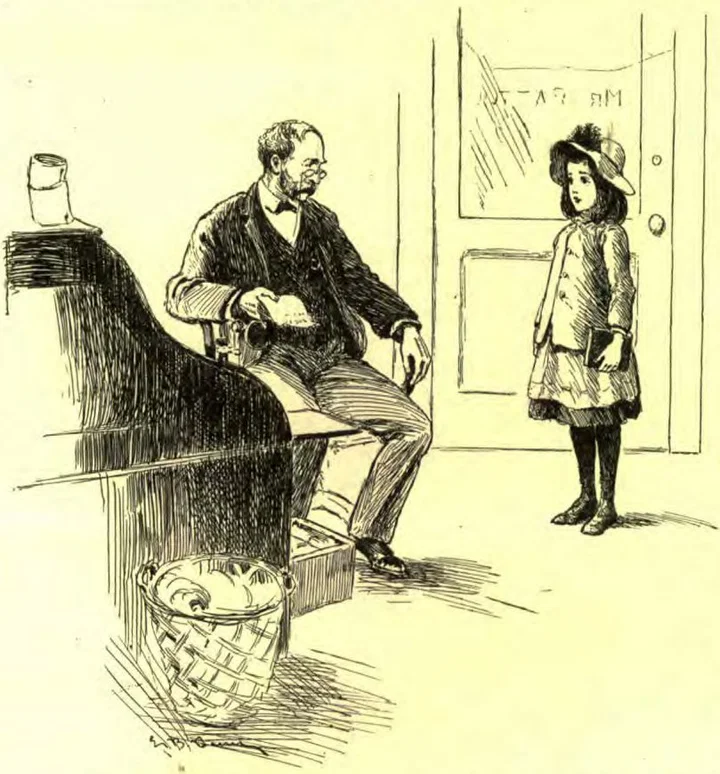
He took her advertisement with a grave face,p. 6 and was very businesslike indeed; only he asked her one queer question. “Isn’t ‘Betsey-Amelia-For-One-Dollar’ a rather unusual name for a doll?”
“Why, why! Mr. Patten, what can you mean?” said little Sara; “that isn’t her name: it is just Betsey Amelia.”
“O,” said the editor, meekly, “I didn’t understand.” As little Sara closed the door, she thought she heard him laugh; but she might have been mistaken.
The next day was Saturday, and little Sara arose early, and dressed Betsey Amelia in her best, and set her in the store window. She never had a chance to see The Daily Bulletin; but of course the editor put in her advertisement, and told where the doll was to be found: he had promised; and little Sara believed that people would begin to come early to look at the doll. She had not yet told either Nana or Philip. Indeed, she would have liked to make the dollar a surprise for both of them if she could. At the breakfast table came up a plan that she saw might help her do this.
“Do you suppose, Edward, I could leave little Sara to look after the store for two hours this morning? There is hardly ever a customer, especially in the morning; and mother wants me to go myself with that work she finished last week, and explain why it was so late, and show her about the bad place in the lace.”
“I should think she might be clerk as well as not,” said Edward, smiling at little Sara’s eager face. “She knows the prices of things, and can count all the money she will get, I am sure.”
Was everything ever better planned? What if she should have a whole dollar to give to Nana as soon as she got home! Then mother could have all she needed for over Sunday, and there was no money coming in from anywhere else. When Philip asked whether money was to be paid for the work that was to be taken home, Nana shook her head, and said, soberly, that it was to be charged on their coal bill. The thought of what she might do made little Sara feel almost happy in spite of the fact that she was to part with Betsey Amelia.
Never was there a neater-looking little saleswoman than the one who took her place in due time behind the counter, charged with watching two bells, the one on the door, and the one that her mother was to ring if she needed anything.
The door-bell rang first; but before it rang, a carriage stopped at the gate, and a lady stepped out of it.
“Is this the dolly that I saw advertised?” she began, looking smilingly at the small saleswoman and then at Betsey Amelia. “It is a dear little doll, I am sure. Is it yours, my dear? and may I be told what the ‘case of need’ is?”
Little Sara had not meant to tell, but the lady was so sweet that before she knew it, she was explaining the whole plan and the reason for it. The lady was pleased with it, too, and told little Sara that it was a very kind, unselfish thought, and that she would be glad to take the dolly, and considered two dollars not a cent too much to pay for one so neatly dressed. More than that, she looked at pins and thread and buttons and needles, and liked them so much that when she went away, she left five whole dollars in the cash-drawer, which had been empty for weeks. Little Sara was so excited that she forgot to feel bad about Betsey Amelia.
What a morning that was! No sooner had the first carriage rolled out of sight, than another stopped, and three ladies made their way to the door. The small clerk met them eagerly. “O!” she said, “I’m sorry. I mean I’m glad;” then she stopped in confusion, and began again. “If you came to see dolly, she has been sold.”
Of course they were sorry. Each lady had meant to have her. But they came in, and looked about them, and wanted tape and soap and pins and hair curlers. While they were still there, others came, and little Sara began to think that something must have happened the night before to all the pins and needles in the city. How else could it be accounted for that so many ladies wanted them at once? Before Nana came back, every pin was sold; then they began on the buttons and thread. Never in its history had the little store had such a wonderful morning. The ladies kept coming, and every one of them asked about the “case of need,” and every one of them bought what cost much more than the price of the doll.
“Isn’t this the little girl who used to bring such nice cookies to school with her luncheon?” one lady asked. “My children used to have bites of them, and tell how good they were. I wish you had some of those for sale. But if your mama is ill, she can not make any, I suppose.”
“My sister Nana knows how to make them,” said little Sara, eagerly. “Mama said hers tasted every bit as good, and I know she would like to make you some.”
Then every lady there wanted two dozen cookies as soon as she could get them.
When Nana reached home, she found a little saleswoman with cheeks so red that they almost seemed to blaze, and $23.30 in the cash-drawer, and nine dozen cookies ordered.
But the strangest thing in that strange day happened at night, just as little Sara had laid her tired head on her pillow, and was trying to keep back the tears because for the first time in Betsey Amelia’s life she was sleeping somewhere else than by her side. The little bell over the store door rang once more, and Edward answered it, to receive a box and a note for “Miss Sara Newton.” The note read:— “DEAR LITTLE SARA: My Lilian has been very happy to-day with Betsey Amelia; but to-night she thinks the dolly is homesick for her own dear mama, and wants her sent back to you with Lilian’s love. I am sure you will keep her for my little lame Lilian’s sake, for she truly wants to make you a present of her ‘to keep,’ she says.”
And there, in the box, smiling her own sweet smile, was dear Betsey Amelia!
“I’m glad she’s got back,” said Edward, looking down on her, and speaking with a queer tremble in his voice. “I didn’t know I loved dolls, but this one has cured mother, and made our fortune.”—Pansy, in Junior Christian Endeavor World.