As we stood on Inspiration Point, we could make out, far below us, the horses of other campers, grazing on the floor of the valley. The horses looked like ants, and the trees like sprigs of grass, or like the smallest of toy trees on a beautiful green carpet. At two o’clock we were in the valley, with a drive of four miles before us to reach the office of the superintendent, where every guest must register before he is allowed to pitch his tent.
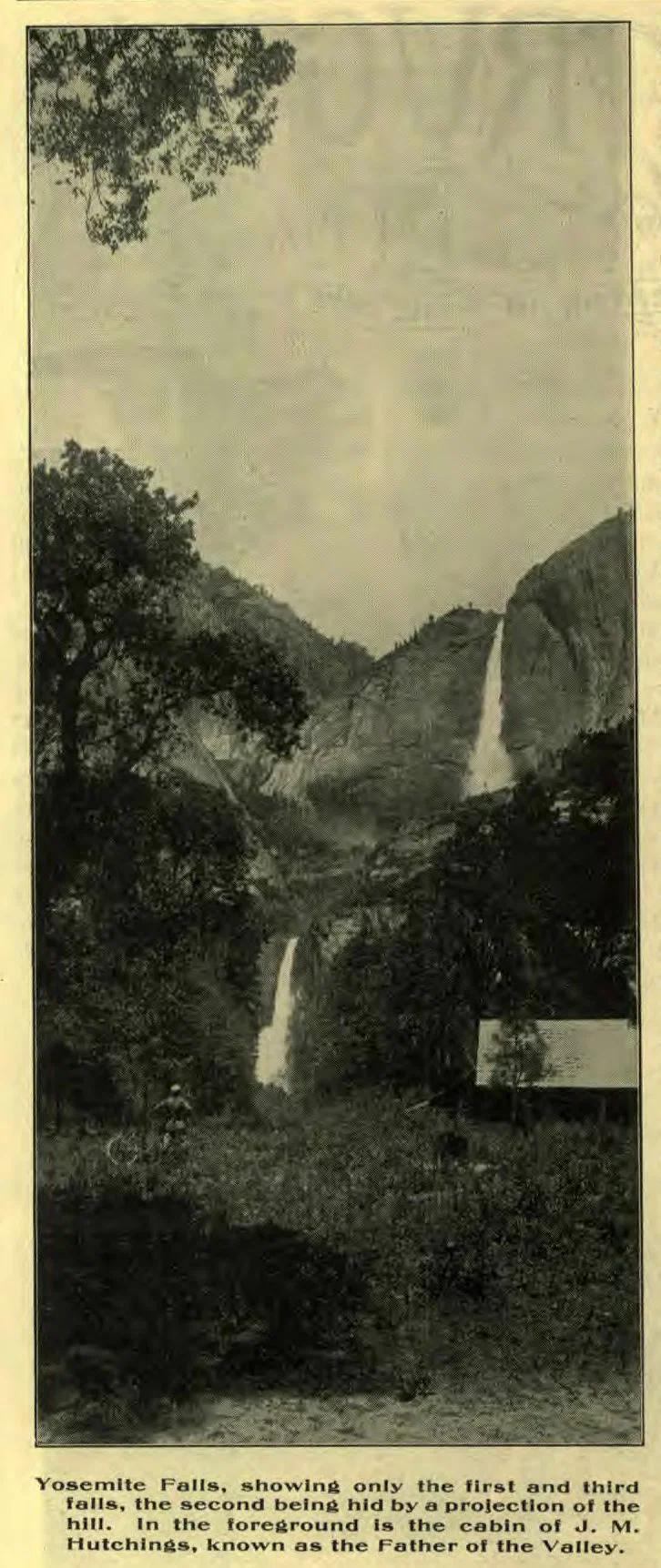
Beyond El Capitan are the Three Brothers, the tallest of which is known as Eagle Peak. On the right, again, is Sentinel Rock, reaching up, tall and silent, from the precipitous heights above us. On the left and beyond the Three Brothers, tumbles down the great Yosemite Falls, fairly dropping out of the clouds; for the water begins its descent twenty-six hundred feet above the floor of the valley. It was a wonderfully inspiring sight. The first section of the fall came down sixteen hundred feet, almost hid itself among the great boulders, and then took two more plunges to reach the pool at the foot of the cliff. This is one of the most beautiful sights of the valley. It is utterly impossible to describe the captivating beauty of Yosemite Fall as it swings and sways in misty festoons down the dripping face of the great black cliff. The wind plays with it as a romping child might play with a lace curtain, only the wind is never weary of the game. It really seems as if there were a great loom at the top of the cliff, weaving and flinging out this unending web of entrancing texture, whose warp is the mist, and into whose threads the shuttles of the sun are weaving the woof of rainbows.
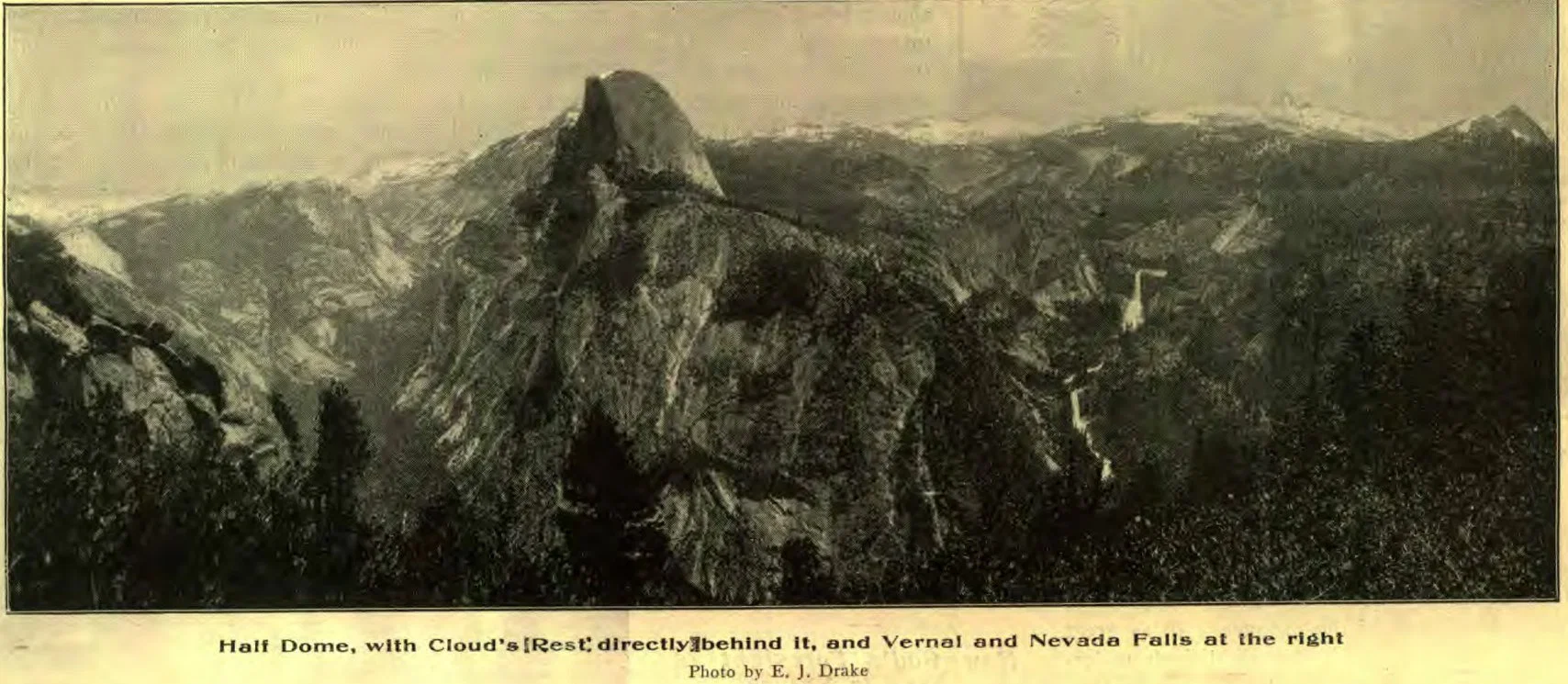
Half Dome, with Cloud's Rest directly behind it, and Vernal and Nevada Falls at the right
But we turn from the entrancing scene, cross the bridge over Merced River, and enter the village. There are about twenty buildings here, including hotels, post-office, express office, superintendent’s home and office, stores, and photograph galleries. There are also a school and a chapel in the valley, but these are not in the village. After registering, securing our location for a camp site, and patronizing the grocery, we returned across the bridge, and pitched our tent in a shady spot near the foot of Yosemite Fall, “next door” to the abode of Mr. E. S. Ballenger, who had entered the valley about one week in advance of us.
From our camping place we had a good view of the whole contour of the valley. Opposite our camp the valley takes a turn to the right, and there are the Royal Arches, the great Half Dome, North Dome, and Cloud’s Rest. The Royal Arches are simply great arch-like configurations of the north wall of the valley. During some cataclysm the sides of the cliff had split away and fallen off, leaving on the sides of the mountain the arch-like formations mentioned.
North Dome is a mountain peak, round and bald and gray, ever aging, but never crumbling. Half Dome is also round and smooth on its top and sides, but the half toward the valley has been split off, clean and perpendicular, down about two thousand feet. Its lower section slopes steeply into the valley floor, down to the very edge of Mirror Lake. But the latter is not visible from our camp. By the time we had finished making camp, the floor of the valley began to bloom with evening primroses. It did not take these flowers long to make a very perceptible change in the coloring of the valley carpet.
No tourist sees Yosemite Valley who does not take the trails to the different vantage points on the top of its ramparts. So at about eight o’clock we “struck” the Yosemite and Eagle Peak trail, which winds back and forth up the side of the mountain wall. It was a puzzle to us how the road builders ever found the way; for from the valley we could see no possible way of reaching the top of Yosemite Fall along the sides of the precipitous cliff. There is a way, however, but it is not down-hill. We hired no burros to carry us up. At eleven o’clock we relieved the lunch basket of its load, and as this distributed the weight more evenly among the members of the party, the writer also felt a sense of relief. As we had not yet reached the foot of the upper Yosemite Fall, we had over sixteen hundred feet of perpendicular climb still before us. As we mounted higher and higher, we got a better view of the valley, and this inspired us to keep on. The result more than paid for the exertion.
We rested for a time at the foot of the upper fall, and then pushed on; for we had to climb2up all the distance that water was falling down. How we wished that we might accomplish at least a small part of the distance with as great ease as the water did. But all difficult undertakings come to an end in time, and so did this. When we reached the top, it was a dizzy and difficult climb down the sheer face of the cliff to the point where the water plunges over. There is an iron railing to prevent the dizzy tourist’s plunging over with the water. The view from this point comprehends all the valley, and is one of the grandest views on earth. One can see nearly all the great points of interest. No writer can give to any reader an adequate description of the scene laid out before him. It is an awe-inspiring spectacle to lean out over the iron railing and watch the mad plunge of the waters.
Yosemite Falls, showing only the first and third falls, the second being hid by a projection of the hill. In the foreground is the cabin of J. M. Hutchings, known as the Father of the Valley.
Across the valley, and at a greater height, are Glacier Peak and Glacier House. At that point adventurous tourists have their pictures taken on the large overhanging rock, where a misstep would send them down thirty-seven hundred feet to the valley floor.
But we had to continue the trail around to Eagle Peak to get a different view of the valley, and so could not spend all the time here that we would have been glad to. This part of the trail was not so difficult, and the view from Eagle Peak was another matchless one; but caution was necessary here, for there was much loose gravel and shale at the top, and no protecting rails to save one if he should step in a dangerous place.
After a half-hour’s rest we began the descent; but the sun was down long before we were, and being on the dark side of the valley, it was often difficult to retain one’s footing on the narrow, shaded trail. We were tired enough when we reached camp; for we had made a journey of sixteen miles, half of which was up, and sometimes our protesting knees almost made us wish that the other half was up too, instead of down. After a time, traveling down a steep incline is almost as hard as going up the same incline.
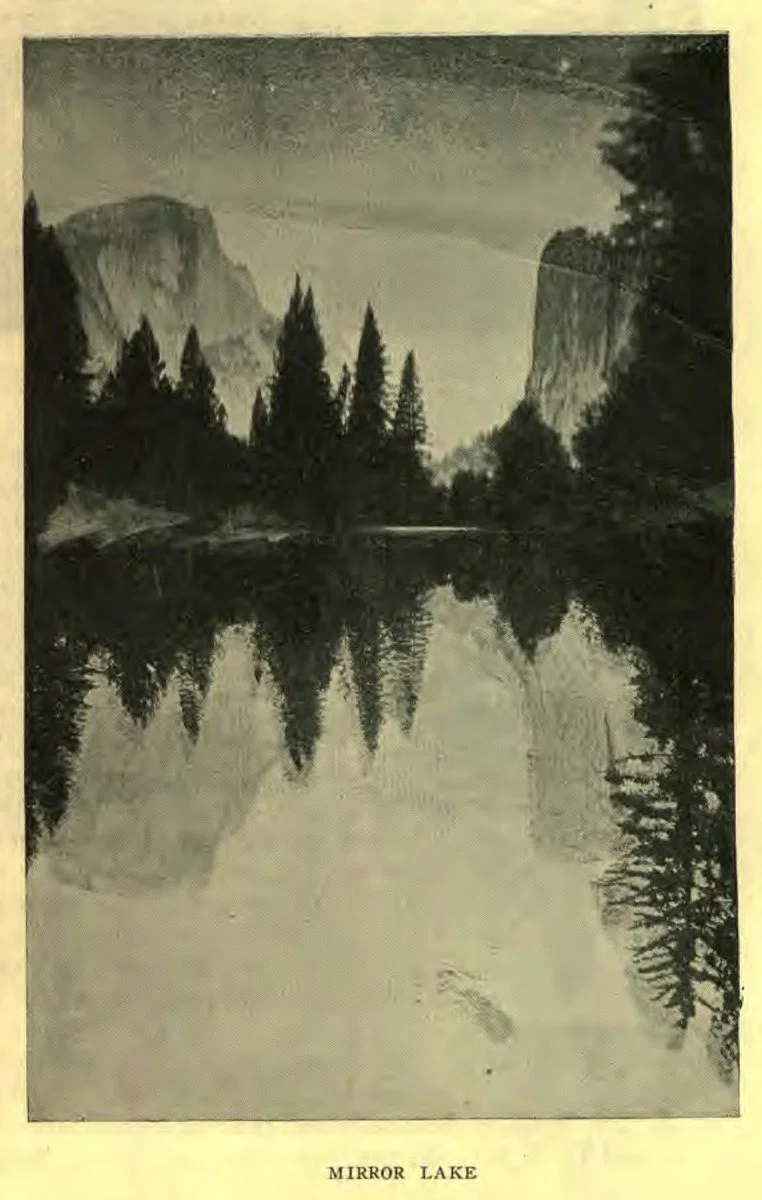
The trip to Mirror Lake, taken on the following day, was an easy one, as the lake is situated in a portion of the valley that is easy of access by team. The powers of this lake as a mirror are beyond comparison. No mirror we have ever seen could give a more perfect reflection. The great mountains and the trees are faithfully pictured there. We mounted a large rock at the edge of the lake, and noticed that some persons standing on another rock that projected out into the lake seemed to be making fun of us. It was some time before we realized what it was all about; but when we did, it was our turn to laugh. They were laughing at the ludicrous picture we all made standing on our heads in the water; but when we looked into the water below their standing place, we could see them in a similar position, and the amusement was mutual. But the picture of the mirrored mountains is one never to be forgotten. We saw the sun rise that morning several times in this little lake, as it came up over different mountain peaks. We decided that the reason for this lake’s being such a perfect mirror is because it is so completely surrounded by high mountainous walls.