SOUTHERN California offers much of interest to tourist, student, or agriculturist. From Mecca, of Riverside County, we will take a look at one part of this land.
Mecca is on the Southern Pacific Railroad. The valley in which it is situated is known as Coachella Valley—meaning “valley of shells.” All of this area, like Imperial, is a part of the Colorado Desert. The branch of the sea which covered this country, formed a narrow neck, extending from the present Gulf of California in a northwesterly direction.
Indio is situated at the upper, or northwest, end of this dry sea basin, and is about fifteen feet below sea-level. Mecca is about one hundred eighty-seven feet; while Salton Sink, the lowest part of the valley, is nearly three hundred feet below the level of the sea.
Coachella Valley is bounded on the north and east by the San Bernardino Mountains, and on the southwest by the Santa Rose and San Jacinto ranges. A space between the mountains is left near Salton, where the railroad passes, and that opening connects Coachella Valley with Imperial Valley. This last-named valley exported over three hundred sacks of grain this last season. Imperial gets its water-supply from the Colorado River, while Coachella gets its supply from surface and deep artesian wells, which vary in depth from three hundred feet to six hundred feet, while the surface wells are only a few feet deep. In the lowest elevation the surface well usually gives out a stream like a spring.
There are millions of little white sea-shells of various shapes and sizes which were left here when the Gulf waters changed their course. The old beach line is very distinctly seen along the mountains’ side. Beautiful coral beds are found here. From Coral Point, which was once a small coral island, excellent pieces of coral may be obtained. A short distance from Coral Point is the Salton Sink, or Basin, where the Salton salt-works are located. Salton Sink can no longer be called a dry basin, but a lake, as about three hundred square miles are now under water, which is due to the great amount of waste water from Imperial Valley and the unusual amount of rain this last season, the rainfall having amounted to over twelve inches, while two inches is the average yearly fall. This increase of water has flooded the salt-works, and caused them to be closed, and has damaged the works considerably.
Fish Springs is another place of interest, and obtains its name from the many fish that are in this large flowing spring. No one has been able to tell how the fish got there. This spring is sometimes called a bottomless pit, as the longest testing cord that has been used in its measurement was two hundred fifty feet, but it did not reach the bottom. The spring is about twelve feet across at the top, but much wider underneath the rim, which is formed of coarse grasses that have grown up and matted together year after year. One may stand on the bank and reach a six-foot pole back under the crust of ground on which he stands, and a stamp of the foot will spring the ground for several feet back.
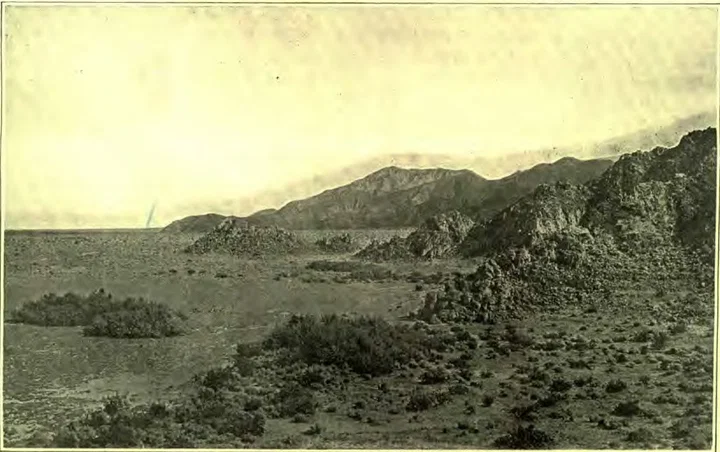
The desert air is light and pure. Fogs are unknown in this desert, and there is seldom dew enough to moisten the grass. The temperature is very pleasant most of the year, though it gets as hot as one hundred twenty degrees in August. Freezes are few and light, seldom killing garden truck, as we had roasting ears in February. They were somewhat injured, however, by the frost. The best-paying crops are grain, alfalfa, sweet potatoes, asparagus, early melons, figs, oranges, and grapes. Summer squash and string beans were shipped out the middle of April, melons and corn the middle of May, and potatoes from July first till the following spring.
The government has started a date farm near Mecca, and it gives promise of a paying crop. Perhaps the INSTRUCTOR readers will be interested to know that southern California exported this season thirty thousand car-loads of oranges and four thousand car-loads of lemons. These bring an average of five hundred dollars a car-load.
MRS. JOCIE WALLACE.
If the reader is not familiar with the location of the places mentioned by Mrs. Wallace, he will find the use of a geography or atlas adds much to the interest of the article. The editor speaks from experience. The suggestion seems more pertinent because of the three articles on the same subject to follow the one that appears in this number.—Ed.