THE interest of all Washington, of all the land, centers on Capitol Hill, the site of the legislative building. “The Capitol is distinguished for its commanding situation and majestic properties; for the dignity, grace, and beauty of design, and the adornments and decorations which beautify it without and within.” As an architectural object it ranks among the noblest in the world, claiming close relationship with the Milan Cathedral, and St. Paul’s, the Houses of Parliament, and Westminster Abbey.
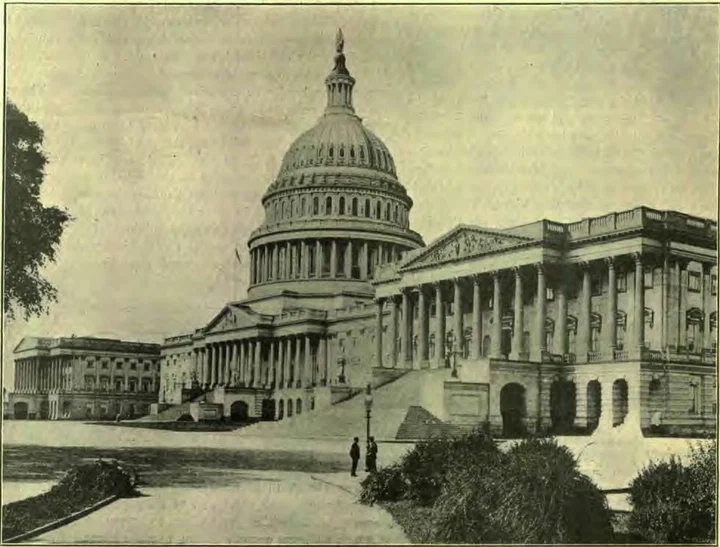
The Capitol is seven hundred fifty-one feet long, and three hundred fifty feet in greatest breadth, and measures three hundred seven and one-half feet from the ground to the crest of the Liberty Statue surmounting the dome. The architecture is modified Corinthian upon a rustic base. The cost of the structure is estimated at fifteen million dollars. The building faces the east; for it was expected that the city would extend in that direction; but the development of Washington has been chiefly toward the west. The grounds on the west side of the building therefore have been beautified and ornamented more than those on the east, the real front. Here on the east utility takes the place of beauty, and the large plaza passed over daily by carriages and multitudes of pedestrians is simply cold, bare concrete. Thus the path that leads the representatives, senators, and other official dignitaries to their honored place is not velvet-carpeted by nature, lined with roses, nor perfumed with rich fragrance. The hard pavement is perhaps more suggestive, however, of the difficult path some have had to tread in attaining the goal of their ambition. This large plaza is where the immense crowds gather to witness the inauguration of the president.
There are three flights of broad steps; one leading up to the central entrance, and one to each wing, giving an appearance of breadth and solidity to the building, whose walls are nearly hidden by the three rows of large monolithic fluted marble columns. On either side of the central flight of stairs from the level of the portico extend two great buttresses, each adorned by colossal pieces of marble statuary, which together cost forty-eight thousand dollars. It is unusual to find the entrance to a building attracting the special attention of visitors, yet it is so here; for the famous Roger’s bronze door can but command attention. It is nineteen feet high,—tall enough for any dignitary,—weighs ten tons, and cost enough to build a modest mansion for you or me, twenty-five thousand dollars. The door is so nicely hung that even a child can easily swing the massive leaves back and forth. Each leaf is divided into eight panels, all of which are superbly enriched by scenes portraying the chief events in the life of Columbus and the discovery of America. The key of the arch of the casing is ornamented with the head of Columbus, and on the sides are typical statuettes of the four leading continents, and a running border of ancient armor, banners, and designs. Pizarro, the conqueror of Peru, Ferdinand and Isabella, and the leading historians of the voyages of Columbus, Irving and Prescott, are each given a place on this historic door. As I stood studying the various panels, I heard a lady remark to her friend—they also had been admiring this marvelous work of art—that “the inside of the door is ornamented as beautifully as the outside.” The lady’s appreciation was thus at once doubled; but the fact is, only the outside is adorned. Here was certainly an illustration of the oft-repeated saying, “Where ignorance is bliss, ’tis folly to be wise.”
This door admits one to the Rotunda, the center of the Capitol. It is said that “the crowning glory of the Capitol is the imposing dome, springing from a peristyle of fluted Corinthian columns above the central building, the Rotunda, and terminating in a lantern lighted by electric lights, which is surmounted by the Statue of Liberty.” The dome is of cast iron, and weighs nearly four thousand tons. It is so constructed that with the variations of temperature the iron plates expand and contract, like “the folding and unfolding of a lily.” It is thoroughly protected from the weather by heavy coats of white paint. It cost a million and a quarter of dollars, and required eight years in construction, being completed in 1865. The lantern is fifteen feet in diameter, and fifty feet high. Over the lantern is a globe, and standing on the globe is the bronze Statue of Liberty. This is no pigmy goddess; for she is nineteen and one-half feet high, and weighs seven and one-half tons, and cost twenty-four thousand dollars. Amid the salutes from guns in Washington and surroundingp. 2 forts, and the cheers of thousands of soldiers, the Goddess of Liberty was raised to her commanding position. It is to be hoped that the principles which the statue represents may never be forgotten nor ignored by those that fill the legislative halls below.
The Rotunda
The visitor willingly tarries long in the Rotunda; for its walls are decorated by costly paintings, frescoes, and statuary. Here are found the four celebrated paintings of John Trumbull, few others, if any, being more highly prized than these. Mr. Trumbull when a young man was aide-de-camp to General Washington. He had a natural taste for drawing; and while in the war conceived the idea of cultivating his talent with the purpose of commemorating by it the great events of the Revolution, preserving faithful portraits of the leading men, and accurate details of scenes, dress, and arms. To this end, after the war Mr. Trumbull studied art in this country and in Europe. In 1816, after thirty years of preparation, he was commissioned by Congress to paint the four great pictures, commemorating the signing of the Declaration of Independence, the surrender of Burgoyne, the surrender of Cornwallis, and the resignation of Washington. Copies of these, doubtless, are familiar to many of our readers. Mr. Trumbull received thirty-two thousand dollars for his work. Four other paintings of equal size and great merit complete the circle adorning the Rotunda walls.
One must remember here as elsewhere that the crown is above; so lift your eyes, for the vaulted canopy of the dome glows with color. This is the artist Brumidi’s masterpiece. Brumidi was born in Rome in 1805, studied art, and at the age of thirteen became a member of the Academy. He painted frescoes in Roman palaces, in the Vatican, and did considerable work in Mexico. He decorated the Public Reception Room of the Capitol, and the walls and dome of the Rotunda. These are said to have been the first frescoes in the United States. His masterpiece, “The Apotheosis of Washington,” cost fifty thousand dollars. The artist died in 1880 from an injury sustained by a fall while painting this frieze. The central figure is Washington. On his right sits Freedom, on his left Victory, and around him float aerial figures representing the thirteen original States of the Union. On their banner is inscribed the motto of the United States—E Pluribus Unum—Out of many, one. Appropriate groups of figures representing the Fall of Tyranny, Mechanics, Commerce, Arts and Sciences, Agriculture, form a part of this wonderful fresco,—all a pleasing conception of the history of our country.
Legislative Hall
Passing to the south from the Rotunda, one comes into Statuary Hall. Every State in the Union has been invited to send statues of two of her noblest sons to adorn this room. A little farther on is the Hall of the Representatives. Its extensive dimensions, the warm colors of its carpets and drapery, the white and gold of its ornamentation, the exquisite paintings on its walls, and the richness of its furniture make it a legislative chamber, it is said, unsurpassed in the world. The Senate Chamber, occupying the north wing of the building, is not so large as the Hall of the Representatives; but the blending of the green of the velvet floor and the rich mahogany doors and desks, and the gilding about the walls and ceilings, make it not inferior in elegance. The Supreme Court Room is a particularly attractive point of interest to the throng of sightseers daily traversing the corridors of the Capitol; for “all seem anxious to get a peep at the room, and the nine intellectual giants upon whose learning and logic too often depend happiness and misery, wealth and poverty, life and death.”
There are many other interesting rooms here and there, some of which you may enter; and some into which the curious eye of the visitor is not even permitted a passing look—unless he can claim relationship with some of the nobility. In one of these small rooms open to all, hang the two famous paintings by Thomas Moran of the canons of the Yellowstone and Colorado Rivers. These two pictures cost the government twenty thousand dollars. So indescribably rich and varied is the coloring of these—and we are assured that it does not equal the real—that it would seem a score of rainbows had dissolved, and their glory had floated down to give a peculiar softness and beauty to the scene. As one stands before such a work of art, he feels impelled to go at once to purchase a ticket that he may revel to his heart’s content in the grandeur and the glory the artist has but pictured. And it is only the peculiar sensation that comes over him as he grasps his pocketbook that brings him to himself. Do you know the feeling?
The east stairway of Tennessee marble is lighted by a richly stained skylight. On the wall of the landing hangs a spirited painting of the Battle of Lake Erie, which occurred on Sept. 13, 1813. It pictures the gallant exploit of Commodore Perry, transferring his colors from the disabled flagship “Lawrence” to the “Niagara” in the face of a terrific cannonading. It was after the victory here that Perry dispatched the famous message, “We have met the enemy, and they are ours.” On the west landing is another painting of equal merit, Emanuel Leutze’s Westward Ho! having for its legend the familiar lines, “Westward the star of empire takes its way.” Such a combination of glory of color, of grandeur of almost impassable heights, of human suffering and privation, of indomitable courage and surpassing endurance, and of hope and joy at sight of the promised land—the Golden Gate of San Francisco—as is expressed on this one canvas, can hardly be conceived. Marvelous is the artist’s power to portray life, but more marvelous is the power of Him who gave the life! Vain is the attempt to tell of the things of interest found within the walls of the Capitol; for there is scarcely an historical event of note relating to our country that has not been handsomely portrayed or suggested by painting, sculpture, or fresco somewhere within this great building. But why go further? All of earth’s rarest things are not to be compared to the eternal glory freely offered to you and to me.