A Historic Town

8%

Review and Herald Publishing Company · Battle Creek, Michigan · August 20, 1903

FromThe Youth's Instructor, Vol. LI, No. 33

Read the full edition

A Historic Town

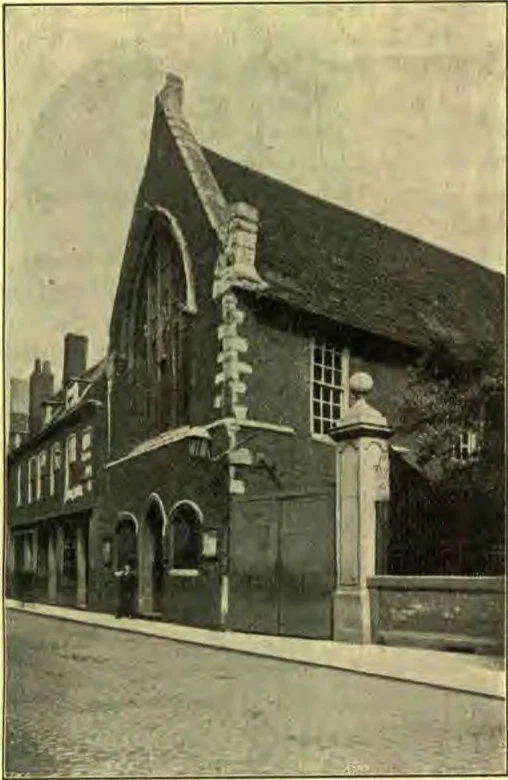
THE TOWN HALL
THE TOWN HALL
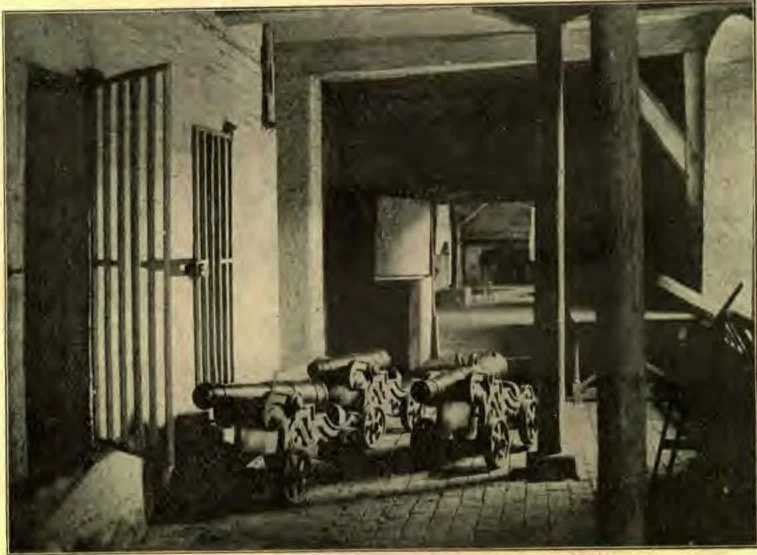
I HAVE just returned from Boston,—not the city by that name in Massachusetts, but the Boston which is situated on the east coast of England, the town from which the more modern Boston took its name. While there, I held meetings in an old hall, which in the seventeenth century was known as the Guild Hall of St. Mary. In the basement of this ancient structure, the old prison, with its iron-grated cells, remains practically as it was when John Cotton and his fellow “Pilgrim Fathers” were there imprisoned, and kept on bread and water, while in an adjoining room the prison keepers, with their friends, were regaling themselves with savory joints of meat which were there roasted before the great open fireplaces.
The room here shown, in which are the three cannon, is the old prison. At the left are seen the two cells, one with the grated door closed, the other having its door open. Mrs. Corliss and I were locked into the open one for a short time, just to understand how it would seem to be in such a place. These cells are about five by eight feet in size. The open door at the back, behind the cannon, gives a glimpse of the old kitchens, where the feasting was carried on during the imprisonment of heretics. In this room are the same flagstone floor, oak tables, and large open fireplaces used in those old days. One of the fireplaces still has over it the spit used for roasting meat, with the chain by which it was operated.
From the prison room, just back of the cells, there yet remain the narrow stone steps up which prisoners were led, through a trap-door, to the room above, for the purpose of standing trial before the town magistrate.
The hall where my meetings were held is in the front of the second story, being lighted at that end by the quaint old window seen in the engraving. The hall is entered by passing through the front door from the street, and traversing the flag pavement half way to the rear, to a flight of stairs. At the head of these a turn is made, and the distance is again traveled over to reach the hall.
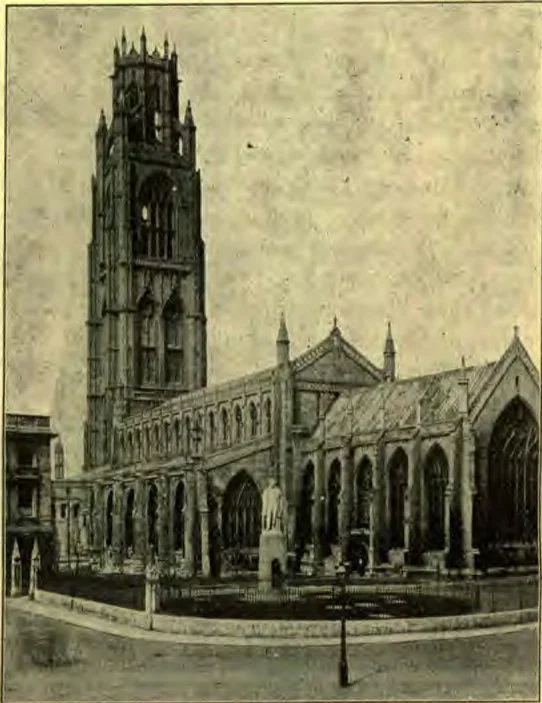
The first bishop of that town was St. Botolph, who is said to have appeared there as early as the seventh century, and built a monastery. From being known as St. Botolph’s town, the name was contracted to its present form,—Boston. The large church building which was afterward reared as the result of St. Botolph’s work, still stands as a monument to his earnest labors. It is now called the “Boston Stump,” from the fact that its spire was never finished, though the top of the base for it reaches three hundred feet in height. From an account preserved in the structure, I learned that the church was founded in 1309, and that the first stone was laid by one Dame Margery Tilney, in a bed of clay, nine feet below the bottom of the River Witham, on the bank of which it stands. The length of the building is over three hundred feet, the width one hundred feet. Its roof is arched with beams of Irish oak, adorned with embossed gold and curious figures. The pulpit now in use there, is the same from which John Cotton thundered forth the alleged heresy which resulted in his imprisonment in the guild hall, and his after retirement, in company with others from that place, and from Plymouth on the south coast of England, to America in the early part of the seventeenth century.
At one side of the town is the Hussey Tower (now in ruins), so named from a celebrated Quaker family that was associated with John Fox, whose residence was in Boston. The poet Whittier was also from that region; and Jean Ingelow’s residence is pointed out, with its garden running back to the river.
The town itself is quaint enough. Its narrow streets wind in and out like cow-paths in a New England pasture, and their names are as strange as their appearance. Here are a few, gathered at random: Liquorpond Street, Shodfriars Lane, Bargate, Threadneedle Street, Petticoat Lane, Wormgate, White Horse Lane, Pump Square, Pinfold Lane. The origin of such names is traced to events or scenes occurring within their precincts at an early day, when people were wholly absorbed in local affairs.
ST. BOTOLPH CHURCH
ST. BOTOLPH CHURCH
The town is one of deep interest to those who care to look over the place whence America’s “Pilgrim Fathers” began their stormy voyage across the western ocean, ostensibly to found a home free from persecution. It was with pleasure that I presented the message for our time in the very building where so many thrilling events occurred in the darker centuries of the past. J. O. CORLISS. London, England.