Among the most fascinating of the many historic places in Rome and its suburbs are the Catacombs; and as these are referred to in the “parallel reading” of the young people’s lesson for this week, I will try to tell you of our visit to these wonderful subterranean cities of the dead.
There are several of these underground cemeteries in the environs of Rome and Naples, Italy, and in Alexandria, Egypt; but I will confine my description to the catacombs of St. Calixtus, the largest and most celebrated of all the Christian cemeteries, as these were the only ones we had the pleasure of visiting. They are situated in the suburbs of Rome, about four miles from the heart of the city.
An Early Drive
As there are no street-cars running to that locality, it was necessary to drive; and what a delightful drive it was! Imagine it if you can. It was early Sunday morning—one of those perfect days which have given Italy a world-wide fame, and together with its historic attractions have made Rome one of the world’s most famous resorts. The busy streets had scarcely begun to stir with life. The refreshing coolness; the deep, blue, cloudless sky; the grand old relics, and beside them the modern shops and dwellings, hotels and castles, where the merchant drives his bargains (as only an Italian merchant can), and the rich pursue their pleasures within the very shadows of a dim, gray past—ah, it can not be told fittingly! Some day you may be privileged to see the Italian skies, and feel the strange, wierd, yet delightful, influence of the Eternal City. Some day you may be called to carry the gospel to “them who are at Rome also.” I have no better wish for you.
Along the Way
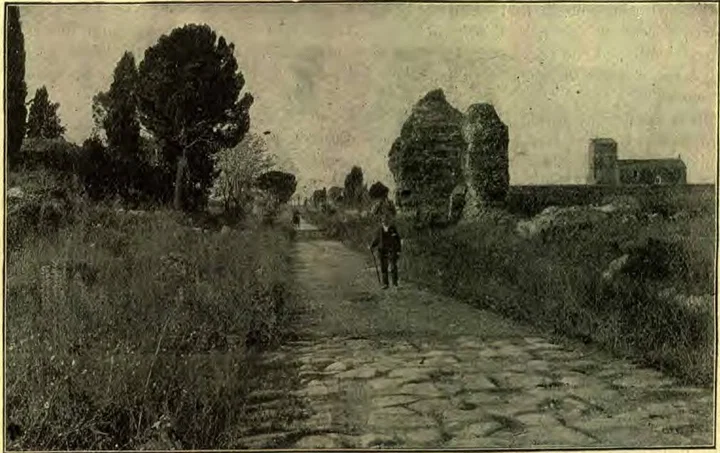
But let us be off to the catacombs. After a few minutes’ drive we pass on our left the ruins of the Golden House of Nero, and the Coliseum, and on the right the Roman Forum, the Arch of Titus, and the towering remains of the palaces of the Cæsars. Passing beneath the Arch of Constantine, the best preserved of all the relics of Rome, we leave the crowded city streets, and soon find ourselves actually driving along the Appian Way (Via Appia), that most famous of all the roads of Italy. It was begun by Appius Claudius in 312 B. C., and was the great military highway to Brindisi. It was over this road that Paul journeyed when he visited Rome; and he tells us (Acts 28:15) how he “thanked God, and took courage” when his friends met him at “the Three Taverns.”
The Monks for Guides
At the entrance to the catacombs we were directed to a little office where we were met by two monks, who sell admission tickets, candles, and curios, and act as guides. They belong to a peculiar order of monks, as indicated by their deep wine-colored gowns and hoods. Their general appearance is strikingly wierd and solemn, their movements are slow and mechanical, and their voices have a high, hollow, ringing pitch, as if acquired from the sepulchral surroundings.
We paid the entrance fee of half a franc (ten cents), were each provided with a little candle, or taper, about the size and length of a common lead-pencil, and were directed to follow the guide.
The City of the Dead
The entrance to the catacombs is not unlike a large western cyclone pit. Descending a flight of about fifty stone steps, we entered the first street of this wonderful silent city of the ancient Christian dead.
This description can not be more fittingly introduced than by St. Jerome’s account of his visits to them in his youth.
“When I was a boy,” he writes, “receiving my education in Rome, I and my schoolfellows used, on Sundays, to make the circuit of the sepulchers of the apostles and martyrs. Many a time did we go down into the catacombs. These are excavated deep in the earth, and contain on either hand as you enter, the bodies of the dead buried in the walls. It is so dark there that the language of the prophet (Ps. 16:15) seems to be fulfilled. ‘Let them go down quick into hell.’ Only occasionally is light let in to mitigate the horror of the gloom, and then not so much through a window as through a hole. You take each step with caution, surrounded by deep night.”
Streets and Tombs
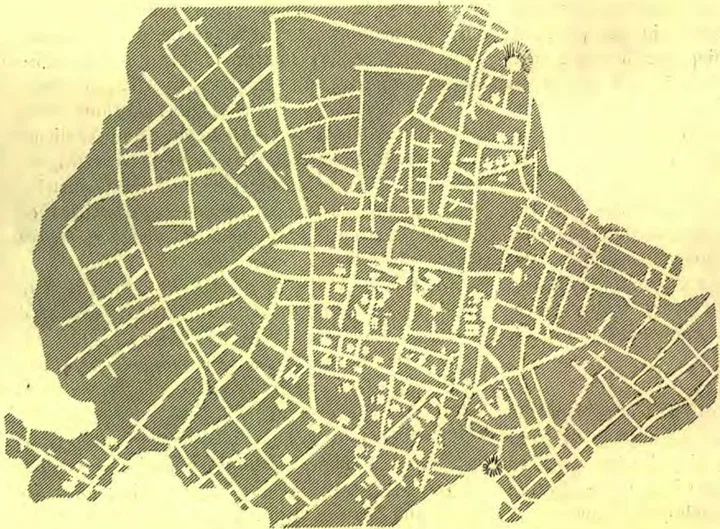
The accompanying diagram represents very accurately the intricate network of galleries or streets. Think of this as the map of a city, as indeed it is, each white line representing a street. This city lies from fifty to one hundred feet below the surface of the ground, and is lighted in places, though very dimly, by shafts extending to the surface. The streets are from three to five feet wide, and from ten to forty feet high. These are not the passages leading to the cemeteries; they are themselves the cemeteries, the dead being buried in horizontal recesses in the vertical walls of the passages, rising tier above tier like the berths in a ship, from a few inches above the floor to the ceiling, to the number of five or six, or even sometimes twelve, ranges. Each recess, or tomb, is about seven feet long, from one foot to eighteen inches high, and from three to four feet wide. After the body was deposited in this recess, the opening was closed with the greatest care with a marble slab running the whole length of the aperture, or with huge tiles, cemented together with great exactness, so as to prevent any escape of the products of decomposition. If any name or epitaph was given, it was always painted or engraved on this slab.
At frequent intervals there are doors entering into private burial places. These are seldom more than twelve feet square, and have burial places in the walls like those described in the passages. In some parts the doors to private tombs follow each other in orderly succession, like the doors to the chambers along the halls of a hotel.
Occasionally there is a large room or a connected suite of rooms, used evidently for worship during the dark periods when persecution raged most violently. Baptistries, supplied by spring water, and deep enough for immersion, are still in existence. Other evidences, such as fragments of altars, platforms, etc., bear conclusive witness to the well-known fact that these subterranean tombs were at times used as secret gathering places for worship.
Hiding-Places
The catacombs are admirably adapted for hiding-places. The intricate network of passages extends for many miles in such a maze that any one not familiar with the clue would be inevitably lost. The most conservative authority states that there are no fewer than three hundred andp. 4 fifty miles of passageways; and as these wind in and out and up and down on different levels, and are studded all along the way with private passages and chambers, the pursued would be easily passed unperceived by the pursuers. As a rule, also, the catacombs have more than one entrance, so that while one entrance might be carefully guarded, escape would be easy by some secret entrance far away.
History
The earliest Christian catacombs may be assigned to the second century, and the largest number to the third and fourth centuries; and it is believed that their use as cemeteries entirely ceased with the sack of Rome by Alaric, 410 A. D. Near the close of the eighth century, and at the beginning of the ninth century, the popes removed many of the relics and remains from the catacombs, until they were nearly despoiled of their dead. The relics having been removed, the visits of pilgrims naturally ceased, and by degrees their very existence was forgotten, until in the sixteenth century (May 31, 1578) they were accidentally discovered by laborers who were digging for sand, thus revealing to the amazed inhabitants of Rome “the existence of other cities concealed beneath their own suburbs.” Bosio, who in the beginning of the seventeenth century devoted his life to the personal investigation of the catacombs, has been aptly designated “the Columbus of this subterranean world.”
It has often been conjectured that the catacombs were formed by the quarrying of materials for the building of Rome; but this supposition must be quite erroneous from the following facts: The formation of the earth in the greater part of the vicinity of Rome is in three principal strata, known as the “stony,” “granular,” and “sandy.” The first is quarried as building stone, and the “sandy” is used in making mortar. But the “granular” is a soft, volcanic formation, mixed with sand and clay, and wholly unfit for any use in building. The catacombs are invariably constructed in this “granular” strata. And the reason is evident; for while it is soft enough to be worked without great difficulty, it is hard enough to form good vertical walls with little danger of crumbling seriously or falling in.
Original Use
Undoubtedly these catacombs were formed as a part of the public works of the city of Rome, or at least with the consent and assistance of the city, as a provision for the burial of their Christian dead; and their later and secondary use, as hiding-places, and for secret worship, followed as the result of persecution.
We can not know definitely the history of these wonderful tombs, though little by little they are giving up to the world their long-hidden secrets; but when the Life-giver shall come, and call for his own, thousands from these mighty caverns will respond, and will come forth bringing with them long-hidden experiences, which, may God grant, each reader of this paper will be privileged to hear. E. R. PALMER.