In countries where there are free public schools, every boy and girl has a chance to secure an education. Our Chinese boys and girls are not so fortunate in this respect, for the majority of them never learn to read or write.
In this section there are few, if any, free public schools for boys. The boy whose parents are poor has little opportunity to secure an education. He is kept busy helping to keep the family supplied with food and clothing. This is no easy task, for the mass of people of this land have a hand-to-hand struggle for their daily bread. It is all they can do, and more than many can do, to get the necessities of life. If the people own a few acres of land and are in fair circumstances, several families will unite and together hire a teacher for their boys.
I have not spoken of the schoolgirls, because there are none. Some of the missionary societies have schools for girls, but outside of these the girls do not learn to read or write. This is partly because they are regarded as not worth educating; and it is thought that if they were educated, they would not make so good wives.
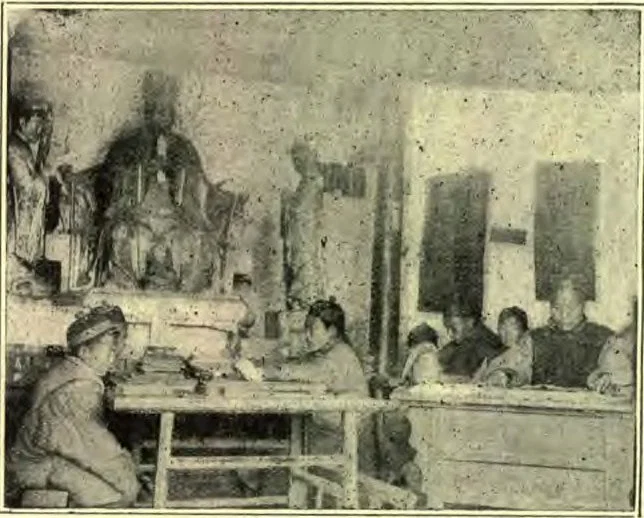
The teacher is hired for a year; and counting out the vacations, about nine months of this time is spent in the schoolroom. Sometimes the schoolroom is a spare room in the home of one of the boys. The floor is simply the beaten earth, the walls are plastered with mud, and the ceiling is coated with soot. There may be one or two small windows having a latticework, over which is pasted thin white paper. Sometimes one of the numerous temples is used for a schoolroom, and such rooms serve the purpose handsomely; for they are large, well built, and well lighted.
The interior of a temple schoolroom is shown in the picture. The desks are plain tables, and the seats are wooden benches with no backs. A little boy's head hardly comes up to the top of the table, and his feet swing several inches from the floor. Our little student does not murmur much about such inconveniences. He is spurred on to hard study by the feats of some of the ancient worthies. He is told of one poor boy, who, being without books, copied lessons on strips of bamboo; another boy, having no lamp, read by the glowworm's light; and another very restless boy tied his books to the cow's horns, and studied while he tilled the soil.
At the base of the platform on which the large idol sits will be seen a small wooden tablet. This is the Confucian tablet, and is found in every schoolroom, for Confucius is the god of learning. Several sticks of incense are kept burning before it. Three times a day every pupil makes his bow before this tablet, and on the first and fifteenth of every month the teacher also makes a ko-tow to it.
The beginners' primer is a little book called “The Three Character Classic.” It has over five hundred different characters in it, and the boys must learn to correctly recognize and pronounce each one. The first sentence reads as follows, “Men at their birth are by nature radically good.” Others are like the following: “If men do not learn, they are not equal to the brutes;” “To educate without severity shows a teacher's indolence.” His second book is the “List of Family Names.” This is a list of over four hundred characters which are in common use as names. His third book is “The Thousand Character Classic.” This is made up of exactly one thousand characters, no two of which are alike. It treats of some of the early kings, of the virtues of man, social virtues, and kindred topics.
The fourth book is “Odes for Children.” It is a book of easy poetry. The fifth book is the “Canon of Filial Duty;” and the sixth book to be mastered is “The Juvenile Instructor.” It treats of education and social intercourse. All these books were written hundreds of years ago, and one of them was written over two thousand years ago.
After finishing these books the young aspirant next takes up what are known as the “classics.” These are composed of four books, and contain the teachings of Confucius, and of a disciple of Confucius, named Mencius. Confucius lived 551-478 B. C. Mencius lived 371-288 B. C. There is nothing in any of these books about geography, arithmetic, or any of the natural sciences, which are studied by every schoolboy in Western lands.
The task of writing these characters must also be mastered. The teacher first writes a copy, and the pupil places a thin piece of white paper over this; and with a brush-like pencil, made of camel's hair or goat's hair, dipped in thick black ink, he traces the characters until his hand has acquired the skill to write them without a copy.
The boy must improve his time and get ready to take the examinations that will lead to his getting a degree. He puts in long hours in the schoolroom. He goes to school at daybreak, and comes home for breakfast; after breakfast he is in school until noon, and after noon he remains in school until sundown. In some cases he is even made to study at home after dark.
In the schoolroom every boy is repeating his lesson in a loud voice, and when there are twenty or thirty pupils, it makes a very noisy place. The teacher's ear is trained so that when any boy makes a mistake in pronunciation, he is at once corrected.
When the lesson is learned, he must recite, or “back the book” as they express it. He comes up to the desk, and turning his back to the teacher, repeats the lesson. If he makes a mistake, he may receive any one of several kinds of punishment. One form is to beat the hand with a wooden paddle, another is to whip with the rod, another is to pull the ear or the eyebrows, and the most common is to be berated with words, and called a dunce, simpleton, or some such expression. As a rule, the teachers are very strict, but are highly respected by the pupils. The saying of the common people is that the better the teacher is paid, the more he will whip the pupils. A. C. SELMON.