First Impressions
The European traveler, landing for the first time at Alexandria or Port Said, soon begins to realize that he has entered a new world. At first, perhaps, he is not so much surprised as he expected to be. The flat sands of the Delta seem very monotonous after the richly colored and beautifully picturesque mountains of Italy and the Mediterranean isles. There is little of that ingenious begging so prominent at Genoa and Naples, and the Egyptian peddler, of whose importunate cupidity the traveler has heard so much, is no rival in cunning mendacity to the Neapolitan vender.
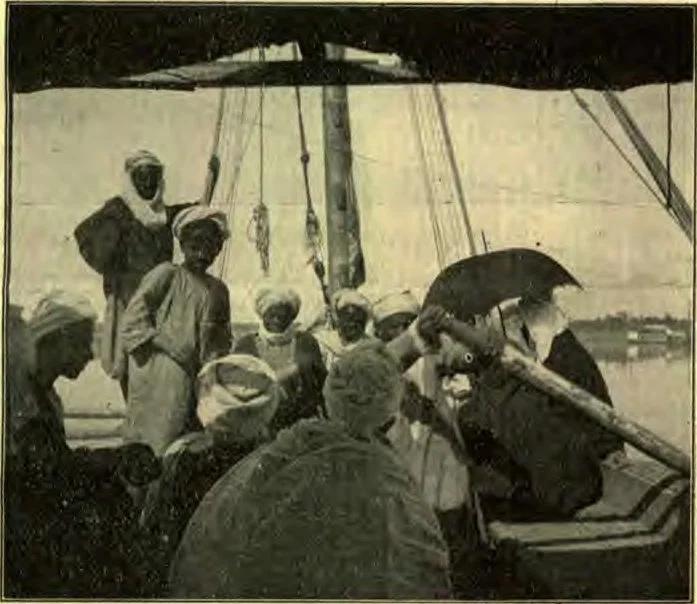
But as the steamer stops near the quay, and the crowds of porters and tourist company agents swarm over the side, he notices the coal barges approaching, black with a new race of strangely dressed, or, more properly, undressed, laborers; and probably, while he is being rowed ashore in a miserable little ferry boat, one of the swarthy rowers addresses him in a strange, guttural tongue, and he hears for the first time that most used and abused word of the Arabic language, “Backsheesh, backsheesh, yakawakia! ana miskeen, ana aiyan, ana gian keteer (a gift, a gift, O sir! I am wretched, I am sick, I am very hungry),” until it becomes as a rattle of a car, or the roar of the waves in a steamer,—a sound that must be endured and tolerated, because it can not be prevented. It is utterly useless to attempt to silence the cry; for any gift simply stimulates the recipient to more importunate appeals, and attracts a crowd of others, thus only multiplying the evil; and no matter how large a gift is presented, no thanks need ever be expected.
The journey from the coast to Cairo affords many surprises. If the traveler has the hardihood to buy a third-class ticket, as a few economical ones occasionally do, he is likely to receive a very unfavorable impression of Egyptian traveling facilities. The short, low, narrow car, furnished with cushionless wooden seats arranged in the American style, is crowded with good-natured jabbering Arabs, each one the happy possessor of two or three large bundles, or a bunch of sugar-cane like an American “corn-shock.” This property fills up the aisle, and all other extra space; and the owners, firmly seated upon their respective possessions, alternately smoke cigarettes and chew sugar-cane, depositing the refuse upon such portions of the floor as still remain available, until it is covered to a depth of some inches. Over this animated chaos the conductor comes stumbling along, keeping up a running conversation with every one he encounters in so loud and apparently angry a tone you imagine he is swearing, which is not infrequently the case. One vainly endeavors to catch something of the meaning in the conversation, as he can do with most of the European languages; but this strange tongue is entirely different. He can not recognize a single word.
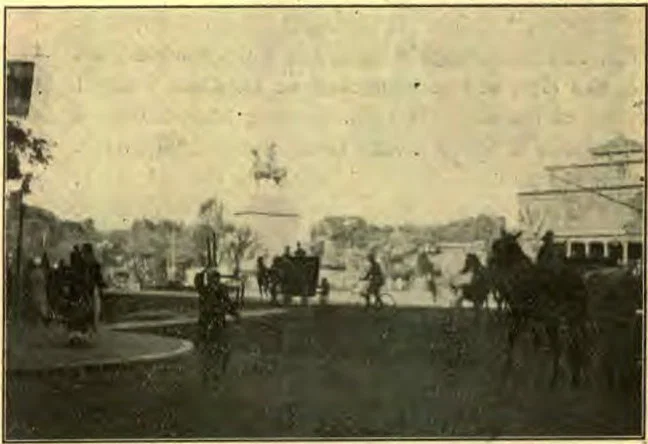
Upon his arrival in Cairo, which is usually at night, the traveler, having delivered his luggage to one of the importunate porters at the union station, enters a “victoria,” and is driven at once to his hotel. The conveyance passes along a wide street, looking very European, well lighted with electricity, so he sees nothing of importance that night except, perhaps, the fine statue of Ibrahim Pasha in the “Place d’ Opera.” He sleeps soundly, but on waking in the morning is surprised to find himself listening to the roar of a great city without. Going to the window, he sees for the first time that unending and ever-moving panorama which any one of the main streets of Cairo presents. The street is filled with a motley crowd, dressed in every style and color imaginable. He gazes fascinated for a long time, then turns, and prepares himself for sight-seeing in the capital of Egypt, with a new zest.
Cairo
Cairo is the largest city in Africa. Its population of six hundred thousand is one of the most interesting and cosmopolitan in the world. Greeks, Jews, Arabs, Copts, Bedouins, Syrians, Italians and Turks, in their respective costumes may be seen at any time in the streets. A dozen different languages are spoken, but almost every one knows Arabic, while French is used principally among the better classes of Europeans.
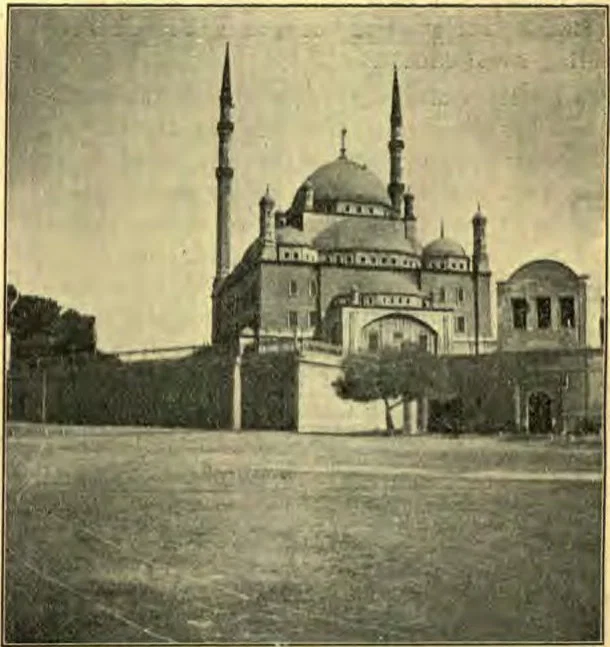
Although Cairo has suffered much from war, pestilence, and destructive fires, it has been an unusually prosperous city, and now, under the salutary influence of Great Britain, it is growing with astonishing rapidity, having increased in population over sixty per cent in the last decade. The large European quarters of the city are of recent construction, and are built in the French style, with clean, broad, well-paved and well-shaded streets. This part of Cairo comprises the Kasr el Nil district, and the extensive and rapidly growing suburbs of Shoubra and Abbessieh. But the bulk of the population is packed away in the older portion of the town around the “Mousky,” the principal business street of the city. The shops and stores of “Mousky” present a European appearance; but the crowd which surge along it furnishes an inexhaustible field for the student of orientalism, and a source of continual amusement to the superficial sightseer.
But it is in the by-streets around Mousky that the traveler finds orientalism proper. The one who starts out alone, with no guide save the compass, will enjoy himself the most thoroughly; for then he will search with all the energy of an explorer, and feel all the exultation of a discoverer at the strange objects he finds. As the streets grow narrower and narrower, finally closing entirely overhead, the spectacle becomes more and more strange.
The counters of the little shops open right onp. 2 the street, and behind each one sits the proprietor with his goods piled neatly around him. But one’s wonder increases as he sees the wealth displayed in the Jewish quarter. The dark, squalid, dirty streets, five or six feet wide, are lined with shops of goldsmiths, and silversmiths, jewelry stores, and miniature banks, whose safes stand in full view just back of the little counter. During business hours, when the streets are very crowded, these safes are usually open, displaying the piles of English, French and Turkish gold within. The display in the shops is not less striking, and a very wealthy visitor, such as the shah of Persia, not infrequently spends several thousand pounds during a trip through these streets. But the traveler is soon glad to leave the splendid squalor of these dark recesses, and feels almost relieved to find that an inexhaustible wealth of golden sunshine is pouring down outside.
To the lover of antiquities, a visit to the large museum is of interest. Here one may see dozens of kingly mummies, still resting in their splendid sarcophagi. It is wonderful to see the perfect preservation of these bodies, from two to four thousand years old. In form and feature, often even the color of the hair, they are so well preserved and the expression is so natural, that one finds himself half expecting them to smile. It would be beyond the compass of this article to try to enumerate the priceless treasures of ancient monuments, weapons, jewels, vases, etc., that this wonderful museum contains, so we will leave them to the imagination of the reader.
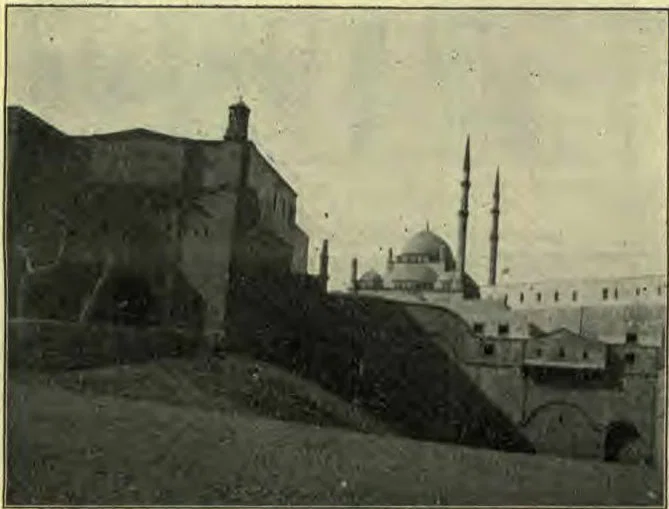
A prominent point of interest in Cairo is the citadel, built on a high rock in the southwestern part of the city, and commanding an excellent general view of the city. It is interesting historically as the scene of many bloody revolutions. The traveler is shown the court-yard, where, in the year 1811, the Mameluke Beys were treacherously massacred. In the midst of the citadel is the large and once splendid mosque of Mohammed Ali; but the decorative jewels and the finest of the columns were long since taken to Constantinople by the Turkish conquerors. Owing to the advent of modern long-range artillery, the citadel has lost its strategic value for the defense of the city, but it is occupied by a strong British garrison, whose guns command the city.
Near the citadel are the highly interesting tombs of the califs and mamelukes, whose bold domes and slender, graceful minarets present a highly novel and beautiful aspect.
The tomb of Keyet Bey is perhaps the most graceful specimen of Arabian architecture. Built in the style of a mosque, the stalactite decorations, the marble mosaic, and the elaborate ivory carvings are of unexcelled beauty. Within the mausoleum are two black stones from Mecca, which are believed by the faithful to bear the footprints of Mohammed.
In returning we will visit the great university, which has the distinction of being the oldest and largest in the world. None of the seven thousand pupils pay any fees, nor, with the ex-ception of the principal, who is paid about $500 a year, do any of the two hundred professors receive any salary. As this building is a mosque, the visitor must remove his shoes on entering. He finds the numerous students sitting on the floor, or rude benches, reading or reciting in the high-keyed monotone so universal in Eastern schools.
Returning, then, to our quarters, we will take a good rest to prepare for a longer excursion tomorrow.
GLEN WAKEHAM.