THE raising of flowers for pleasure or profit is not necessarily confined to grown people. When a boy or girl has natural liking and ability for the work, it may be undertaken with a fair assurance of success. And when the requirements of the plants are not fully understood by young persons who desire to undertake their culture, there are often florists in one's neighborhood who could not only give practical advice, but also help one over the difficult places. Then, too, there are periodicals published exclusively for the aid of the amateur florist, and in those one may find just the advice and help needed.
There is no reason why any boy or girl should not manage a collection of flowering plants with success, when once their culture is understood; and there is no reason why these same plants should not yield a respectable income, if they are grown for that purpose, especially in communities where there is no local florist. However, the presence of a dealer in flowers need not deter one from attempting flower-growing, because his friends will often buy of him when they see that he means business.
In advising a novice to undertake the culture of flowers, I should recommend that he select such varieties as require the simplest treatment. Roses and carnations, although general favorites, are quite difficult to manage; and unless one has a greenhouse and can secure the aid of some one who understands the needs of the plants, it is best not to undertake their culture. They will prove a disappointment in the average living room; and even geraniums, unless thoroughly understood, will refuse to blossom at the season when their flowers are most desired.
The class of flowers that I would recommend to beginners in floriculture, demands no great expense, no greenhouse, no nicely regulated temperature, no extra attention to light, no worry in regard to insect pests, and neither previous knowledge nor skill to make them blossom into things of great beauty. Holland bulbs, when once planted and given reasonably good care and accommodations, will bloom with ease and certainty in most living-rooms; and no beginner need hesitate to undertake their culture for fear of failure.
Everybody knows what tulips and hyacinths are, and many are glad to buy these favorites during the winter months, when flowers are scarce. The former has fully opened flowers of bright, cheerful colors; the latter has thick, substantial trusses of deliciously fragrant, bell-shaped blossoms. In addition to these two favorites may be named the Chinese sacred lily, double yellow daffodils, paper-white and other varieties of narcissus, and crocuses.
During the fall, in September if possible, secure a fall bulb catalogue from a seedsman of good repute, and make your selections, so as to be sure of receiving the bulbs in October, in which month most of them will require to be planted, if they are expected to blossom by Christmas. After planting, the bulbs have to be set away in the dark for a number of weeks to form roots; and three months is none too long a time to allow for this purpose; therefore, aim to get the work done in October.
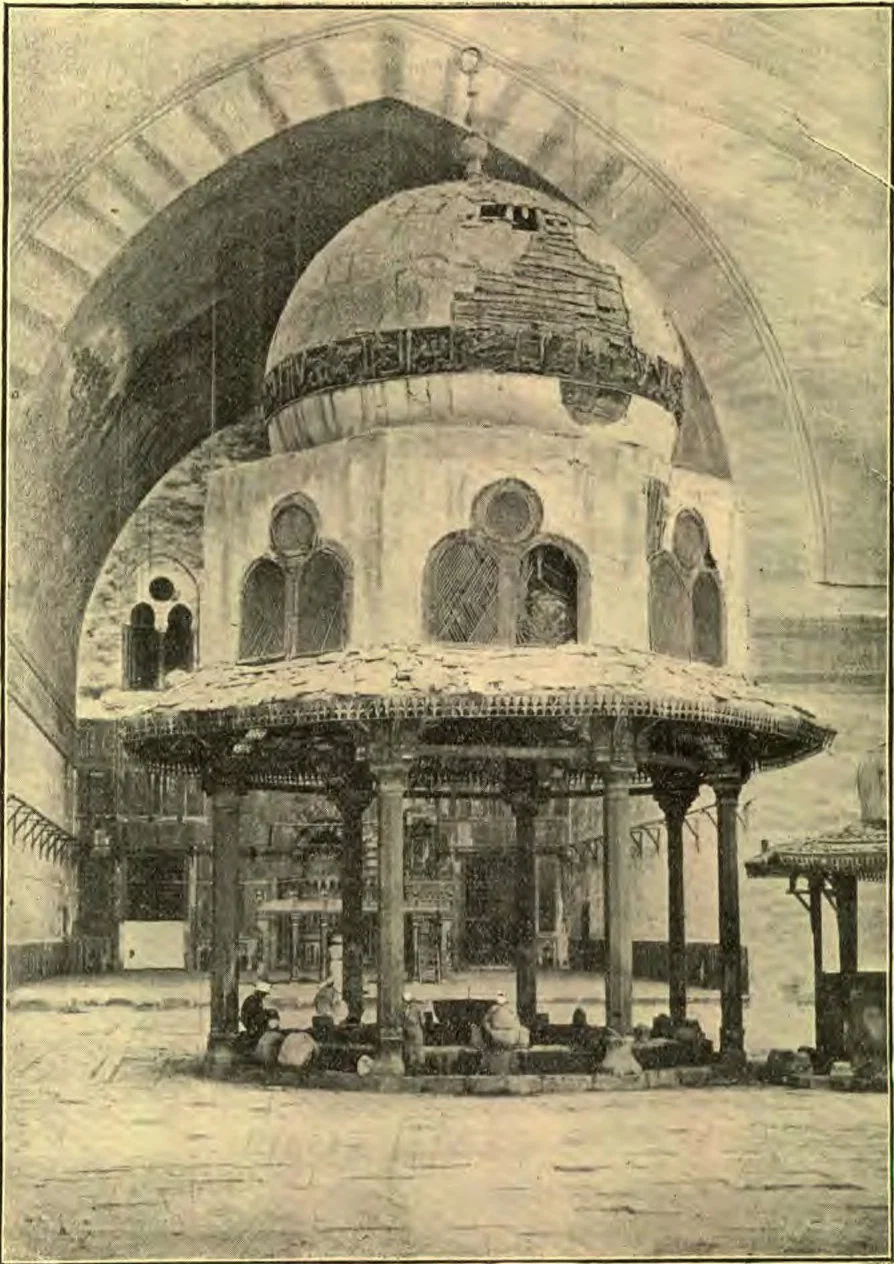
FOUNTAIN OF ABLUTIONS, MOSQUE OF SULTAN HASSAN, CAIRO, EGYPT
By investing from two to five dollars in bulbs now, one may reasonably hope to realize the sum expended and quite a bit besides, in a few months. To the person just beginning I would say, Content yourself at first with a few dozen each of hyacinths, narcissus, and Chinese lilies. These are about the easiest of any to get along with; and when once their culture is understood, you can branch out more extensively. A dozen each of Roman, Pampa, and single Dutch hyacinths, a dozen of daffodils and paper-white narcissus, and a half-dozen Chinese sacred lilies, together with a few Duc Van Thot tulips, will make a very beautiful and interesting window garden, and the proceeds from the hyacinths alone will probably cover the cost of the material, outside of the bulbs themselves.
Hyacinths, in bloom, ought to bring from fifteen to thirty cents apiece, according to the size and condition of the plant. A well-grown Chinese lily should demand at least fifty cents, while daffodils and narcissus usually go for about twenty cents each, tulips a few cents lower. Of course the cost of the pots, etc., has to be taken into account in fixing the price of flowers.
However, most people are not particular about what the bulbs are planted in; and if tin cans are used instead of flower pots, for at least half the bulbs, this expense may be considerably diminished. Fall bulbs will do quite as well in pint and quart cans as in costlier receptacles; and while the order is on its way, it would be a good plan to collect an assortment of cans, unsoldering the tops on a hot stove, and paint the outside surface dull-green or red. The bottom of each can should also be punched two or three times with a small instrument to afford sufficient drainage.
It will also be necessary to prepare a large box of soil in which to plant the bulbs when they arrive. This is the part of the work “where the fun comes in;” it is only a pleasure to collect the different kinds of soils, sift them, and mix them together. A half bushel of soil from the vegetable garden or almost any place around the yard, is the first thing to get; then a peck of fine, thoroughly decayed stable compost manure. Persons living in the country, or near woods, have the advantage of rich, brown leaf-mold, found under the layers of dead leaves, and a peck of this should also be added. A peck of sharp sand completes the compost.
It may often be necessary to “bake” the woods dirt and manure in a hot oven to kill insect and weed germs; and the soil should be passed through a coarse sieve to make it mellow and fine, and rid it of substances that would injure the bulbs. If one has no sieve handy, an old tin pan, with the bottom full of nail holes, will make an excellent substitute. After sifting, the different soils should be thoroughly mixed, and set where compost will keep moist. The soil should never be dust dry at any time of planting.