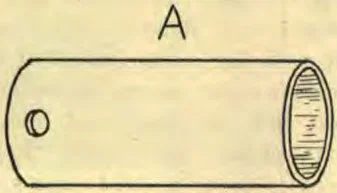
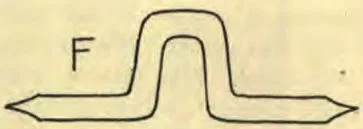
THE cylinder (a) is a brass (or any material that can be soldered onto) tube about one and three eighths inches long, and about five eighths of an inch in diameter, and must be perfectly smooth inside. The hole, which is in the end, is about one eighth of an inch in diameter, and must be the only one in the cylinder; make it just as the figure shows.
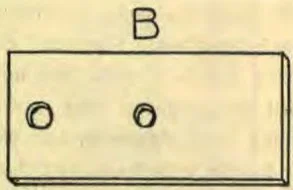
The plate (b) is made of brass, copper, or any metal that is soft, yet does not bend too easily. This plate should be about the same length and breadth as the cylinder. Drill a hole in it corresponding to the one in the cylinder, as shown in the illustration.
Drill another, not necessarily the same size, but exactly in the center of the plate. This hole is for the pivot (g) to be put through, and must fit perfectly.
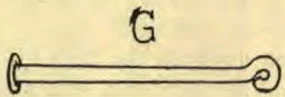
The pivot, which may be made of a nail, should have a small and flat head on one end, for the purpose of keeping the pivot from slipping through the hole, and an eye on the other. (Don't make the eye until the engine is nearly complete.)
After the holes are drilled into the plate (b), polish one side of it on an oilstone until it is perfectly smooth. Put the pivot through the center hole, with the head on the unpolished side. Solder the plate with the pivot in it onto the side of the cylinder, so that the hole in the end of the plate will be exactly over the hole in the cylinder. Put a wooden plug through the hole in the end of the cylinder and plate, so as to keep them directly over each other, and also to keep them from filling with solder. Be sure that the plate and cylinder are parallel when they are soldered together. After the plate (b) and the cylinder are soldered together, the pivot should be solid.
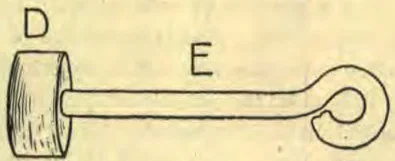
The piston rod (e) is made from a small wire about one eighth of an inch thick and about two inches long. Fasten one end in the center of the piston head (d). The piston head is made of Babbit metal mixed with a little solder. Fill the cylinder with damp sand until it is about a quarter of an inch from the edge of the end that has no hole in it. Make a few notches in one end of the piston rod on the center of this sand; be careful to hold it parallel with the cylinder. Pour the melted Babbit metal in this space until it is filled, and hold it steady while it cools. Be sure the piston head fits snugly in the cylinder.
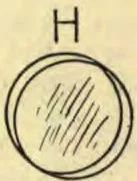
The cylinder head (h) is a round piece of tin just a trifle larger than the end of the cylinder; make two like this, and in one make a hole in the center, just the size of the piston rod. About one fourth of an inch from this hole make another, to allow the air to pass out and in easily. Solder the cylinder head that has no hole in it, to the end of the cylinder where the hole is. Solder the other one on the other end after you have put the piston rod through the center hole, and push the piston head to the other end of the cylinder. Leave it this way while you solder the piston head on, be sure and have the center hole in the cylinder head exactly in the center of the end of the cylinder.
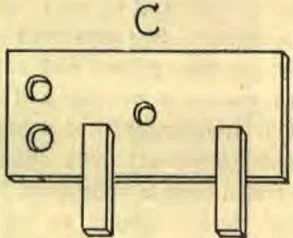
The plate (c) is just the same as the plate (b), with the exception of the position of the two holes on the end. These two holes are as far apart as the diameter of the hole in the end of the other plate. Put the pivot (g) which has been soldered on to the side of the cylinder with the plate (b) through the center hole with the polished sides facing the polished side of the other plate. Be sure that these plates fit perfectly together. The two holes must be at the same end as the hole in the plate (b).
The next thing to do is to make the eye on the end of the pivot about an inch from the back of the plate (c). Take a spring like the ones in the stoppers of a window, and put over the pivot. Put a cross piece of wire through the eye of the pivot to keep the spring in place. The spring must be longer than the pivot (after the eye is made on the end of it) so that it will keep the two plates snugly together.
The boiler can be made from a baking-powder can (a round one) about seven inches long and three inches in diameter. Solder the lid on, and resolder all the seams.
The shaft (f) may be made of a copper wire about one eighth of an inch thick. The fly-wheel should weigh about six ounces, and be about one and three fourths inches in diameter. Fasten the fly-wheel on the shaft about half-way between the crank and the end of the shaft.
Get two strips of brass about one and one half inches long, one half inch wide, and one eighth of an inch thick. Make an indentation near the end of each, in the middle, with a center punch. Solder them on one side of the boiler, facing each other, about the same distance apart as the shaft (f) is long. The shaft, which is made pointed at each end, should be placed between the two, with its ends resting in the indentations.
Solder the two strips of brass onto the plate (c), as shown in the picture. These strips must be just long enough to bring the piston rod in line with the shaft and the crank when it is horizontal.
Make an eye on the end of the piston rod and fasten it to the crank. The eye and the crank must be so made that when it is turned to its highest point up, the hole in the plate (b) will be exactly under the lower hole of plate (c). Turn the crank to the farthest point out or the nearest point, the hole in the plate (b) can not be seen through either hole of plate (c). Turn it again to its lower point, and the hole in the plate7(b) will be exactly under the upper hole in plate (c). (The crank should be about as long as the distance between the pivot and the holes in the plates.)
Solder the strips, which are fastened to plate (c) on the boiler, at the place where the cylinder oscillates correctly, as described above. Solder a small tube over one of the holes in plate (c), and the other end of the tube over a hole in the top of the boiler. This is the steam pipe. Make another hole in the top to pour the water into the boiler. Fix a cork for this hole, so it can be pulled out without burning your fingers when there is steam in the boiler.
Now the engine is complete. Dig a hole in the ground, lay the boiler in the top of the hole. Plaster it all around with mud, leaving a hole at one end for a smoke stack. Fill the boiler nearly full of water, get up steam, and the engine will run.