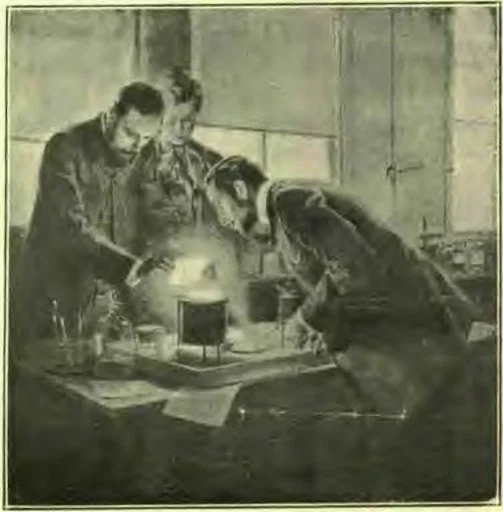
RADIUM is a word unknown to the dictionaries, even to the Century, yet it is a word familiar to many a schoolboy of to-day. The reason lies in the fact that only recently was radium discovered; Professor and Madame Curie, of Paris, having the honor. It looks much like our common table salt, yet it is worth three thousand times its weight in gold, being the rarest of the seventy elementary substances. Barium and uranium have long been known to possess the properties, though in a much less degree, that have given radium its unique position among the chemical elements. Only a few ounces of radium have been separated from the rock in which it is found; yet, it is said, there are indications that it exists in considerable quantities in the earth. The water from mineral springs, and the air from deep borings in the earth, are found to be radio-active.
Copyrighted, 1903, Mc Clure Co. Courtesy Mc Clure's Magazine
FINISHING PREPARATION OF RADIUM
As one picks up a rock or some earth, he little knows what valuable thing it conceals, only waiting to reveal its secret some day to a searching chemist's eye. The dull clay brick, it would seem, ought to brilliantly shine with its fifty per cent of aluminum, the human skeleton with its eighteen thousand three hundred dollars of calcium ought not to appear so unattractive, especially to the avaricious eye; the ocean water which hides, it is said, in its crystal depths all of earth's valuable chemicals, arouses but little thought of its worth as it surges, foams, and breaks upon the rocks at our feet.
Each year of this age of increasing knowledge serves to give a little more penetration to the eye; yet we shall, after all, only see as through a glass darkly until the eternal gates are opened to us.
An article that appeared last autumn in McClure's Magazine gives some figures showing the rarity of the metal. The article says that “France has about one third of an ounce, Germany possibly has about the same amount, America has hardly as much as these countries, and the rest of the world may have perhaps about one sixth of an ounce; an ounce and a third, therefore, would be a large estimate for the world's present output of radium. A teaspoon would hold it all.” The students of Princeton University consider themselves fortunate, since the university recently received a gift of twelve and one-half grains of the new metal in honor of Prof. A. H. Phillips, who first extracted radium from American ore. It is estimated that with the very cheapest methods now known of purifying the crude material, nearly one and three-quarter million dollars would be required to obtain two pounds of radium.
Professor Curie has a piece about the size of a buckshot, which he says is worth twenty thousand dollars, the price depending much upon the purity of the specimen. Besides the heat and light rays given off by this metal, there are three kinds of invisible rays that move with nearly the velocity of light. These rays, like electricity, may be helpful or harmful, may destroy life or stimulate it. The length of exposure affecting the result.
The medical world is looking with much interest toward radium, hoping it may prove a successful remedy for the dreaded maladies of lupus, cancer, and kindred diseases.
Radium maintains a temperature two and seventh-tenths degrees Fahrenheit warmer than the surrounding atmosphere. Professor Curie says: “One hundred ten pounds of radium would give out as much heat continuously as a stove would give out that burned twenty-two pounds of coal every twenty-four hours. Some have estimated that a given quantity of radium after throwing out heat, as I have stated, for one thousand million years, would have lost only one millionth part of its bulk. Others think the loss might be greater, an ounce, perhaps, to a ton in one thousand years.” The amount is at least too small for the most delicate instruments to measure; but the heat energy given off by a cold piece of radium is sufficient to produce definite results, even causing a piece of platinum wire to glow with a white heat.
Radium wrapped in thick paper and held to the closed eyelid, will give one the sensation of a soft diffused light outside the eye, the sensation caused by the penetrating of the rays into the eyeball. If the metal is placed on the forehead, and the eyes closed, a similar effect will be produced. This intense penetrating power of the rays makes it a dangerous substance to carry about, as it will cause serious burns without giving any personal inconvenience at the time of its evil working. Lead seems to be quite impervious to radium rays, making therefore a good case in which to carry the bit of metal.
The spinthariscope, recently invented by Sir William Crooks, is a small microscope that permits one to observe a tiny piece of radium, not more than one sixtieth of the millionth of an ounce. The fragment of the metal is supported on a wire over a screen spread with sulphide of zinc. To the eye made sensitive by a darkened room “and looking intensely through the lenses the screen appears like a heaven of flashing meteors among which stars shine forth suddenly and die away. These myriad bursting, blazing stars” are assumed to be the radium emanations. This vision, contained within the area of a two-cent piece, Professor Curie says, “was one of the most beautiful and impressive he had ever witnessed; it was as if he had been allowed to assist at the birth of a universe—or at the death of a molecule.”
The intensity of radium is measured by its power to render the air a better conductor of electricity. Uranium has been known for some time to possess this property, therefore its intensity is taken as the standard. The purer the radium, the greater is the intensity. As it comes from the purifying works, its intensity is about 2,000; and Mr. Curie prefers after that to give the finishing touches himself; so he treats it2until it is brought, perhaps, as high as 1,500,000. So complicated and laborious a process is the extraction of the metal, that a visit to the purifying works outside the city of Paris, reveals the fact that the true scientist is not daunted by prodigious undertakings, and that patience is allowed to have her perfect work, whatever the cost. For years the refuse powder from the uranium mines, after the metal had been removed, was regarded as worthless, and was left quite at the disposal of whoever wished to haul it away. Now this once worthless material is secured by the ton—eight tons being required to produce a gram of the metal—from Bohemia for the radium extraction; for it is this—that hides in itself in infinitesimal quantities this rarest of metals. One person has said hunting for radium in this refuse “is like searching for specks of dust hidden in a sand heap, or for drops of perfume scattered in a river.” Only recently “the news comes from Paris that the operation of extracting radium from the ores has been considerably shortened. The preliminary process, which reduces the material to laboratory dimensions, now occupies one month, whereas it has previously taken three months. It is estimated that up to the present about 730 tons of ore have been used to produce about one fifth of an ounce of radium.”
We shall look to the future to reveal greater wonders in regard to this interesting metal; for it is hardly to be expected that radium has even yet disclosed all its secret charms and powers.