In the great harvest field the Lord has a place for every worker; he is calling every believer to service. He gives to us the privilege of being the agents through whom he communicates this gospel of the kingdom. The Lord called us to the field where the needs seem the greatest. China, with its four hundred twenty-six millions of people, has been neglected all these years. The needs of China’s millions was a call we must obey; one man out of every four in the world is a Chinaman, and this message must go to “every creature.”
During the summer of 1903, six responded to China’s call for help: Dr. A. C. Selmon and wife, who were connected with the Sanitarium work in Battle Creek; Dr. Miller and wife, and two nurses, Miss Carrie Erickson and Miss Charlotte Simpson, who were connected with the medical work in Chicago. The Lord soon provided the way to go.
The party of six met in Seattle, Washington, October 3, and after a few hours’ ride northward, we bade farewell to our native land. Reaching Vancouver, we were joined by Mr. B. E. Reese and wife, who were on their way to Kobe, Japan, to join Dr. Lockwood in the work there.
About noon, October 5, our boat weighed anchor, and America soon vanished from sight. We were somewhat disappointed in the name Pacific, for the first two days out the ocean was anything but pacific. The sea soon calmed down, however, and after a week’s sailing we caught our first glimpse of land, some islands belonging to the Aleutian group. Their rocky, barren surface looked very uninviting, yet they are inhabited by a dwarfed race of people, the Aleutians.
Our boat, the “Empress of India,” is one of the Royal Mail steamers plying between America, Japan, and China. She has a length of four hundred eighty feet, and a tonnage of six thousand. The two triple-expansion engines have a total of ten-thousand-horsepower. The two sixteen-foot screw propellers will in a favorable sea give the boat a speed of three hundred ninety-four miles per day; our longest day’s run was four hundred six miles.
Occasionally off in the distance we saw a whale spouting, a stream of water being thrown up in the air about ten or twelve feet. The body of the whale lay just beneath the surface of the water.
As we went on from day to day with nothing in sight but ocean, ocean, ocean on every side of us, and miles of it beneath us, we sang the song, “There’s a wideness in God’s mercy like the wideness of the sea,” with a new and deeper meaning than it ever had for us before.
When we were in longitude about one hundred sixty degrees west, our boat ran into a dense fog; we were crossing the warm Japan current. While passing through this warm water we saw a very pretty display of phosphorescence. At the stern of the boat, where the water is churned up by the propellers, great patches of phosphorescent light appeared.
We retired Monday evening, October 12, and wakened Wednesday morning, October 14, since during the night run we had crossed the one hundred eightieth meridian, which marks the division between the Eastern and Western hemispheres. It is the exact antipode of Greenwich, and is almost midway in the course across the Pacific. In going out to Japan a day is dropped in the calendar, while in moving eastward the day is doubled.
A shoal of porpoises varied the scenery for one day of the trip, and as they raced ahead of us, leaping in and out of the water, they looked like a drove of pigs running over one another. There were thousands of them, stretching out in a line at right angles to the boat as far as one could see.
October 19 we saw a very beautiful oriental sunrise. We were in sight of the coast of Japan, and standing out in bold relief was Mount Fujiyama. After passing several strongly fortified points, we anchored at the lighthouse outside Yokohama breakwater for the quarantine inspection.
Two Japanese medical inspectors came aboard. The first- and second-class passengers are counted to see if all are able to be up in the cabin, and a statement of the ship’s officers relative to any of these passengers having a contagious disease, is taken. The multitude of steerage passengers are driven out on deck, and carefully looked over one at a time. As no evidences of a contagious disease were detected, we moved farther in, and cast anchor about one half of a mile from the city. No sooner had we cast anchor, than we were surrounded by every conceivable kind of Japanese craft, from a sampan to a modern steam launch.
Our boat swarmed with the energetic little Japs, every man bent on securing a passenger or a piece of baggage.
The sampans are small flat boats, propelled from the stern by one, two, or three oars, depending on the size of the boat. The Japanese learned their method of propelling boats from studying the shape and movements of a fish’s tail. The oars are moved from side to side in the water without being lifted.
Yokohama
At Yokohama we were expecting to meet our missionaries from Tokio, Professor Field and family, and Elder Burden and family. It was but a few minutes after we anchored until we caught sight of them on board our ship. Knowing we had but a few hours to stay, they had planned an instructive trip for us through the city of Yokohama.
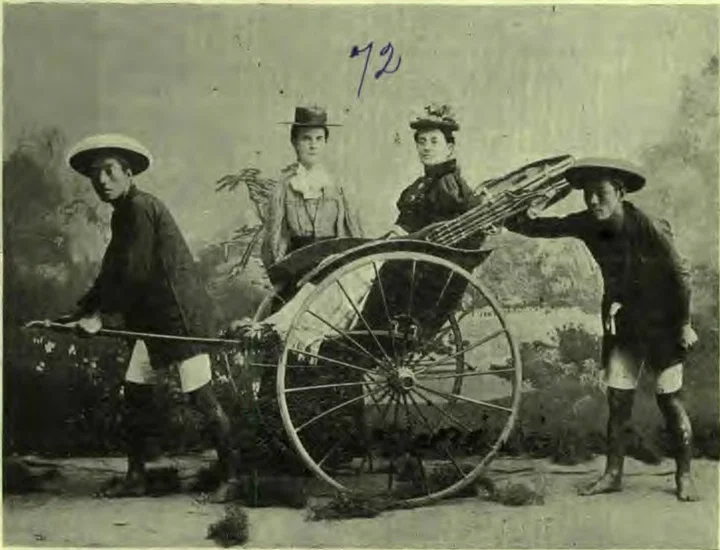
We all went ashore with them, and had no sooner struck land than we were surrounded by a score or more of jinrikishas, the coolies dropping the shafts in a circle around us, inviting us to take a seat in their comfortable, cushioned vehicle. This to us was a new mode of travel, but it was enjoyed, if only from its novelty. Stepping into the shafts, the wiry little man, in tights and mushroom hat, starts off at a trot down the narrow streets.
The jinrikisha is a two-wheeled vehicle, usually accommodating but one passenger. It has a cushioned seat and a top similar to that of an ordinary buggy. Very few other vehicles are used. In the city of Tokio fifty thousand jinrikishas are in use; they are to a Japanese city what cabs and street-cars are to an American city.
Having been accustomed to the sky-scrapers in Chicago, the one-story houses of the Japanese city seem to be veritable dwarfs. The streets have no sidewalks. Japanese shops are constructed in such a way that the front can be removed during business hours, and replaced at night. Inside upon a raised floor sits the merchant, surrounded by his goods. Along both sides of the street in front of the stores you will see a row of wooden sandals, having a check attached to each pair, as the customer is obliged to remove his sandals before he can enter the store to inspect and purchase goods.
Passing a carpenter shop, we saw the workmen sitting on the ground sawing with a square saw, which cuts on the up stroke instead of on the down. This is an illustration of many thingsp. 203 one sees in the Orient which appear upside down to those living in the West. In a restaurant the kitchen is in front and the dining-room in the rear; the fruit is picked several weeks before it is ripe; the women hang their washing in the front of the house; in building a house the roof is built before the walls.
Before leaving this little company of workers, Professor Field gave us a brief report of the work in Japan. They now have a church of fifty members. Ten were baptized last year, and already this year he has baptized twelve. They are publishing a paper in the Japanese language, and the native workers are selling a thousand copies each month. We are glad that the light is shining in this land of heathendom, and feel encouraged to continue our voyage to establish similar work in heathen China.
H. W. MILLER, M. D.