The whole world has sung the “Ninety and Nine,” and listened with pleasure and delight to the cheering words that tell of a Saviour’s care for the one that “was out on the hills away.” It only remains to tell the simple, strange little story of the song itself. Songs seem nearer and dearer when we know something of their history.
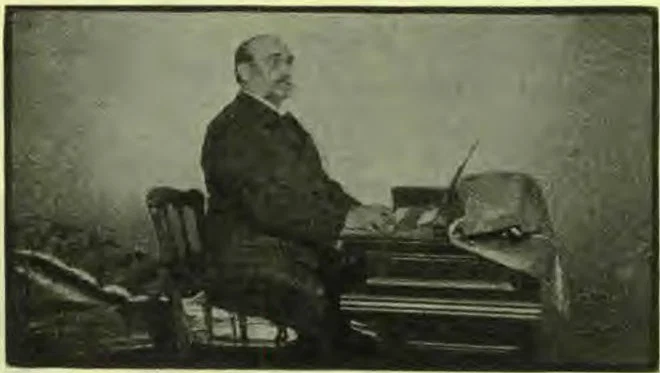
Thirty years ago those famous evangelists, Moody and Sankey, were preaching and singing together in old England. One day they were going from Glasgow, Scotland, to Edinburgh for a great meeting there, and Mr. Sankey as he stepped aboard the train, purchased a penny religious paper. As he settled down in the car to read, his eye caught the lines of a poem, away in an obscure corner of the paper,—
“There were ninety and nine That safely lay In the shelter of the fold.”
The great singer read on, till the entire poem had been perused, and then he exclaimed, with a note of triumph in his voice, “Mr. Moody, I have found the hymn I have been looking for years!”
“What is it?” asked Moody, looking up from the letter he was reading.
His friend explained that it was about the lost sheep.
“Read it to me,” said Mr. Moody, his eyes still fixed on the letter.
So Mr. Sankey read it, putting much expression into his voice, trying hard to do justice to the beauty of the sentiment. But alas! when he looked up, Mr. Moody was absorbed in meditation over his letter, and had heard scarcely a word.
“All right,” said Mr. Sankey to himself, with a smile, “you won’t get off so easy, my friend; you’ll hear this song later.” He cut out the poem, and stored it away in his pocket scrapbook.
So on their second day in Edinburgh before a great audience Mr. Moody had spoken eloquently and touchingly on the Good Shepherd, when he said, “Mr. Sankey, have you a solo to sing on this subject?”
The great singer was at a loss for once. Three times that day the congregation had sung the twenty-third psalm. So that would not do, and he could think of no other. And then those verses he had read on the train came before him like a flash, with the thought, “Sing those, by all means.” “But,” he objected, “how can I sing without a tune?” The audience was waiting. Mr. Sankey took the little scrap from his note-book, struck a full chord on the organ, and then, note by note, never sung before, came the first stanza. The thought flooded upon the singer, Could he remember to sing the second in the same way? But concentrating his mind, the second stanza, the third, and on through the fifth he sang, while the delighted audience sat still as death, little dreaming that the wonderful melody had never been heard before, even by the singer himself.
“Mr. Sankey,” exclaimed Moody, coming down where he sat, “where did you get that song? It’s wonderful! I never heard anything like it!”
“O, that,” said Mr. Sankey, to his friend’s evident confusion, “that is the hymn I read to you on the train the other day!”
EDISON DRIVER.