TWENTY-EIGHT years ago the railroad system known as the Southern Pacific, or Sunset Route, was completed, and travelers who dreaded the idea of being snow-bound on the more northern roads went to New Orleans, and there began their long journey to the Pacific coast. In passing through Louisiana they became much interested in the rice fields. The railroad company published glowing accounts of what immense and quick returns could be realized from the cultivation of rice, so it was not long until farmers from the Northern States began to arrive in the level prairies of southwestern Louisiana. They brought their families, and were prepared to make homes. The Acadians were their neighbors, and from them they learned the first lessons of rice culture. But the Acadians had not made the cultivation of rice a business, having planted only a few acres for their own use; so they always trusted the clouds to water their crops. They had not thought of mechanically flooding them.
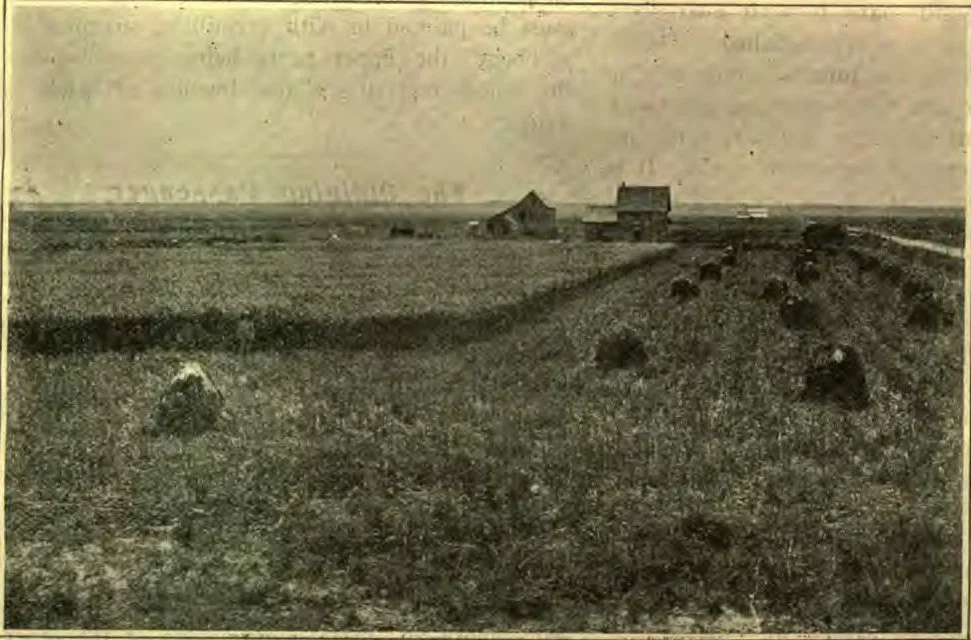
LOUISIANA RICE FIELD
The Northern farmers seemed to think that if there was profit in raising a few acres, there was more in raising many, so they planted great fields of rice very much as they had sown wheat in the North; then they pushed up the levees around the fields to hold the water on them, and, like the Acadians, they waited for the clouds to flood them, but often the rain did not come, and they saw their fields dry up and wither away, until they almost doubted that they had planted rice. Other summers, however, the clouds brought rain in abundance, and then the farmers all looked cheerful and happy, and in the beautiful autumn the fields gave up their treasure, and all felt repaid for the disappointments of the past. When they did have a good crop, they reaped such little fortunes that they began to scheme with all their Yankee ingenuity for a way to make their water-supply sure; for they had learned that rice demands an abundance of water. The bayous are generally bordered with timber and swamp-land, so it was impossible, with their limited means, for the farmers to build the necessary canals, and put in the machinery for pumping bayou water, but soon a company of men, with sufficient capital, started a large pumping plant which proved a success. It was not long then until there were many such canals, and the rice industry in Louisiana took its first bound toward a financial basis.
But there were many farmers out on the prairies, away from the canals, and they continued to plant rice and succeeded in getting a crop about once every three years. They were given the name of “providence” rice farmers by their neighbors on the canals, who were reaping yearly large harvests, and getting rich. They didn’t seem to realize that it was through Providence that they were successful, and through Providence that we all “live, and move, and have our being.”
A WELL FOR IRRIGATION
In boring wells for the water-supply for their homes, some of these “providence” farmers noticed that at a certain depth they reached a strata of water that was inexhaustible, and that it came very near the surface; in some instances flowing over the top like a spring.
They determined to try a large well for irrigating purposes, and were well repaid; for there was more water than they had ever imagined could come from the ground. Those who first drilled these wells found that with a small engine and boiler and pump they could flood a quarter section or more of rice land. They decided that it was not so bad after all to be “providence” farmers; and they congratulated themselves still more, when, one autumn, the farmers on the canals awoke to the fact that they had flooded their rice with salt water, and had ruined the crop. The summer had been dry, and the canals so numerous that all the fresh water in the bayous had been pumped out on the fields, and salt water from the Gulf had come back to the pumps. It was a new idea to flood rice from the Gulf of Mexico, and a complete failure taught the canal men that it was not a good one; hence some way must be devised to keep the salt water out; for it is worse than none at all. It not only ruins the rice, but for sometime also the land.
During these years of experiment and advancement, persons from the North had been coming in by thousands, and they brought the latest improvements in farming methods from their Northern farms.
Wells became so numerous that the supply of water was almost exhausted under the ground as well as above. It is said by geologists that this strata of water is simply a great underground lake, and that its source of supply is probably the Ozark Mountains. The pumps on the numerous wells lowered this underground lake so that instead of coming nearly to the surface,2it was forty feet or more below, and many of the wells failed altogether.
In drilling some of these wells the drill has passed through logs which were well preserved over a hundred feet from the surface, and many other curious specimens were brought to light.
The presence of crude petroleum was discovered near Welsh when one of these wells was being drilled, and it has since developed into quite an oil field, but the oil field, though very interesting, is distinct from the rice field, so we will not speak of it at present.
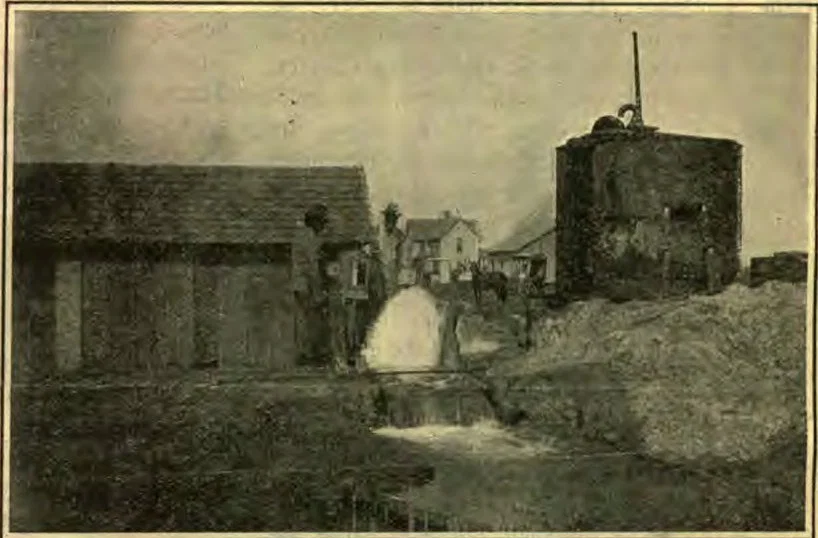
From a good irrigating well, about twelve or fifteen hundred gallons of water can be pumped in one minute, and this will flood at least ten acres in twenty-four hours. To give some idea of the large number of wells and pumping plants on the prairies, it is enough to say that the engineers of the plant in the illustration could count fifty engines in sight, all pumping at the same time.
There are among these engineers, young men who have been reading the INSTRUCTOR since they were small boys, and now they are paying their way through school by working during the summer on the rice farms. There were three of these young engineers in the Keene Industrial school last year, one in Union College, and three in the Southern Training School at Graysville.
As soon as the pumping season is over, harvest begins, and the boys enjoy work of a different kind. Rice is harvested with binders, very much as wheat is in the North. There is one difference, however, in the binders of the rice fields. They are made in such a way that they will work in mud and water if necessary; for often the rains begin before harvest is over, and a rain of eight or ten inches in as many hours is not uncommon on the Gulf coast: but the autumns are usually the most pleasant part of the year. The sun shines very clear and bright day after day, and yet it is not too warm for comfort. Every one seems to take new life, and harvest is indeed a merry time.
The rice looks very pretty as it stands in the shock ready to be thrashed, but it is never permitted to stand long, for fear of storms. The thrashers follow close in the wake of the binders, and then the great bags of rough rice are ready to be taken to the mills, where the rice is hulled and prepared for market.
In the mills the hulls are cracked between two large millstones something like the stones in the old-fashioned flour-mills; then after being well fanned and cleaned of waste, the rice goes to the polisher, where it is rubbed and polished with sheepskin until it is perfectly smooth and white, and now it is almost ready for market. Still, first, it must be waxed carefully with paraffin, powdered lightly with talcum powder, and then graded according to the size of the kernels. It is sewed up in strong bags containing just one hundred pounds, and is shipped in this form all over the world.
As one buys rice from the little corner grocery, he probably never thinks of how it was polished, waxed, and powdered to make it look attractive; but it all passes through these processes, and is becoming every year more popular as a staple food. Japan is buying much rice at the present time, but the market for this cereal is not increasing as fast as the production, and on this account the farmers do not receive as much for it as they did a few years ago. Taken all together, however, the life of the Louisiana rice farmer is interesting, and generally a happy one.