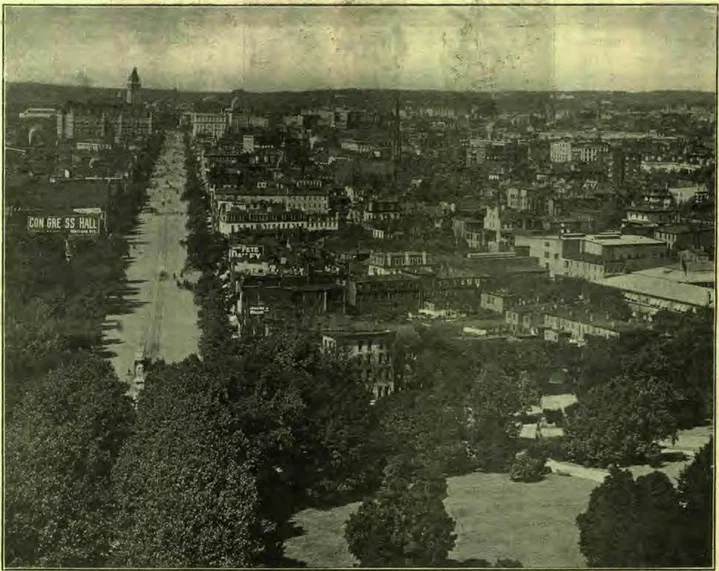
WEALTH, learning, art, commerce, and natural scenery have each made various cities famous; but Washington owes its fame to its wise and just laws—“a government by the people and for the people.” Each of the others, however, has had a share in making the capital one of the world's chief cities. So important an event as the choosing of the place for the seat of government, could hardly be expected to take place without quickening the pulse of the laudibly ambitious cities. No sooner, therefore, was the question of a choice of the capital city before the public, than New York, Philadelphia, Baltimore, and other cities presented strong claims for the honors of the Federal City. After much discussion, Congress empowered President Washington to select a location on the Potomac River. It is said that on an early surveying expedition Washington had been attracted by the site he finally chose for the city.
The government was removed from Philadelphia to Washington in the year 1800. Fourteen years after this, it was captured by the British, who set fire to the public buildings and to some of the residences, intending to destroy the town altogether. More kindly disposed was the storm of wind and rain which came that night, and saved the town. The following day the British left in a panic of causeless fear, save a large number who decided to remain, and cast in their lot with the “rebels.”
The city was rebuilt at once, and continued its rapid growth. Its population at the time of the Civil War was sixty thousand; its present population is three hundred thousand. The District of Columbia, which exists for Washington, is located on the north side of the Potomac River about one hundred six miles from the Chesapeake Bay.
Its area is sixty-nine square miles, or forty-four thousand one hundred sixty acres. Originally it was ten miles square; but Virginia's portion, over thirty square miles south of the river was ceded back to her in 1846.
Architecturally, Washington has become one of the most attractive places of the world. Its numerous public buildings—the Capitol, of world-wide fame, the White House, the War and Navy buildings, Patent Office, Treasury, Pension Office, Congressional Library, and the Smithsonian Institution—are the focus of national interest. The Washington Monument, rising majestically more than five hundred feet into the ether blue, adds much to the interest of the city. The cooling, exhilarating breeze that sweeps down the tower constantly from the upper atmosphere on the most excessively warm summer day, fitly suggests the pure political wave that should blow from Washington as a center over all this fair land.
The happy repartee a Boston man made to a gentleman from Philadelphia who was making some rather unpleasant contrasts in regard to the streets of the two cities, is familiar. “When Boston gets to be as dead as Philadelphia, it will be as well laid out,” said the Boston gentleman. Those who had the planning of the capital city determined it should be intelligibly laid out. This determination, carried out wisely, has made the simple, artistic plan of its streets and avenues one of Washington's acknowledged charms. A hill was chosen for the Capitol site. From this radiate, like the spokes of a wheel, the main avenues. The city then is platted into rectangles by streets; those running north and south are numbered, those east and west are lettered. Two long streets at right angles passing, as it were, directly through the Capitol, divide the city into four divisions, —Northeast, Southeast, Northwest, Southwest. The Northwest is the main division. The government buildings and grounds seem arranged for the convenience of the visitor. Passing out of the Capitol at the west entrance, one comes easily to the Botanical Gardens, then just beyond these to the Public Gardens, the Fish Commission and Armory, one on either side of the street, then to the National Museum, the Smithsonian Institutionp. 2 and grounds, Agricultural Grounds, then to the Monument. Beyond the beautiful, extensive grounds of the Monument, on the right-hand side of the street, are the Executive Mansion, President's Park, State, War, and Navy buildings, and the Treasury. From the Public Gardens one has simply to pass down Fourth Street for a short distance to come to the Judiciary Square, Pension and Patent buildings.
Seemingly, lest visitors should be tempted to confine themselves to the places of interest grouped together so near the Capitol, thus failing to get a general view of the city with its broad, paved streets, delightful boulevards, pleasant parks, and costly statues in various parts of the city, some of the points of interest have been placed at the very outskirts of the city, and toward all points of the compass, thus compelling extended observation. On the outlying borders, therefore, the visitor will find the Zoological Park, United States Naval Observatory, Soldiers' Home, United States Navy Yard, and the Congressional Cemetery.
The relations of the District and capital city to the Union are peculiar.
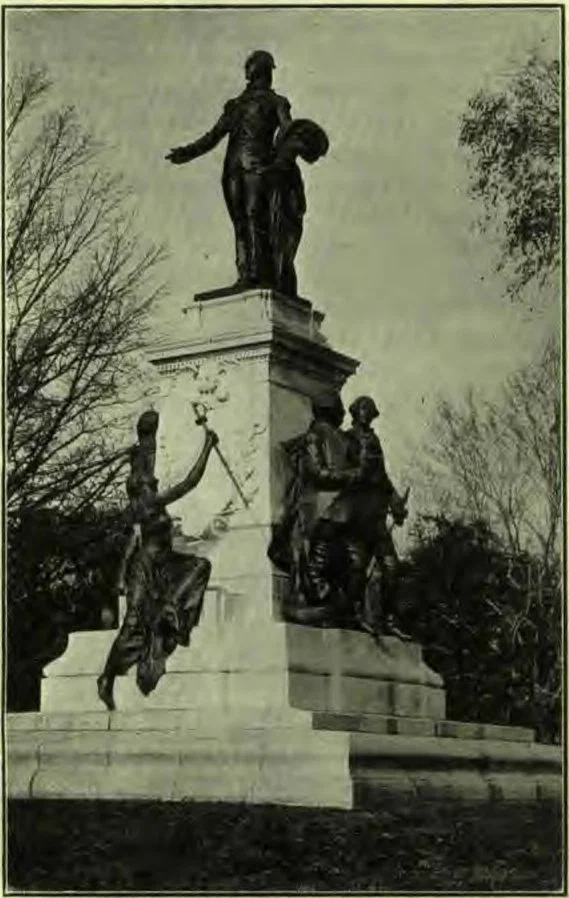
After several unsatisfactory experiments in municipal government, “Congress created a form of administration of District and city affairs, which consists simply of two civilian commissioners appointed by the President, and confirmed by the Senate, and one army engineer officer detailed by the Secretary of War, the three constituting a Board of Commissioners for three years. They are empowered by Congress to make, and change at will, building, health, and police regulations. They also appoint all subordinate officials and clerks.” The District being under the exclusive legislation of Congress, its citizens have no part in the election of the president or vice-president, nor in the affairs of the District. The people are to take quietly what they get, and be therewith content. All, dutiful submission, however, to rightful authority brings its own reward; so the Federal government contributes one half of all the expenses of the District, and does much besides, in maintaining beautiful parks and boulevards; so that Washington has a larger area devoted to streets, avenues, and parks, in proportion to its size, than any other city in the world. A glimpse of the Capitol will be given in the next article.
Over Washington have blown the winds of political strife and corruption, of bitter jealousies and intrigue; also the refreshing winds of loyalty to principle, devotion to the people's interests, and of strict integrity. These each have swept over the capital city with such force as to carry for a time, seemingly, everything before them. We wish that only the good might blow here, purifying and sweetening the political and social life of Washington, the heart of the fairest country of earth, making it indeed the ideal capital city. But Lucifer's breath poisoned the air of heaven; so it is in vain to hope against hope.
“KNOWLEDGE comes, but wisdom lingers.”