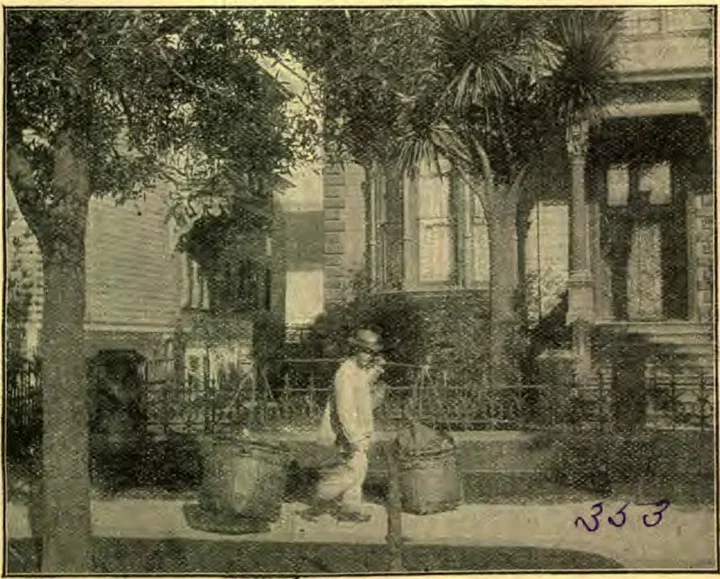
The trip across the country to our station from Sin Iang Cheo usually requires three days; but on account of the size of our party and the delay caused by stopping to hold meetings, four days were consumed. Where the roads are in many places nothing but foot-paths, the problem of transporting our baggage, consisting of boxes too heavy to be carried by coolies, proved a serious one. But the rivers are to China what the railroads are to the United States, so we found that our goods could be carried from here to our station on rafts. There were no rafts to be secured then, and we were told they might come tomorrow or next day, or perhaps not for a week or two. This uncertainty determined us not to wait. Our goods were left in charge of two of our native converts, who were to come as soon as possible with them. The river is one mile from the railroad station, so coolies were secured to take the goods to the rafts. Their method of transferring freight is to tie the burden on a pole, which is carried between two men. Or if it is light, one man carries the load, divided into two parts and suspended from either end of the pole. Produce of every kind is carried in this way. It is not uncommon to see a man passing along the road, having suspended from both ends of his pole a rope, which is tied around the legs of one or two pigs, according to the size of the animals. The Chinese pig has learned to be content with this method of travel, for he seldom makes any noisy remonstrance.
After three weeks of anxious waiting at the mission for our baggage, a messenger, who had cut across the country, arrived and gave the news that our goods were on the road. He explained that the river was much longer now than a few months previous, because the water was very low, and they had to dig channels for their boats in some places. The Chinaman does not measure distance by the actual length of the road, but by the time required to travel it. The trip being so long made it expensive; for the boatman demanded a great deal of “wine money.” The giving of “wine money” is a pernicious custom, to which one must submit in Central China. Even though a laborer is hired to work for you, and the wage stipulated beforehand, yet every day he expects you to give him something extra to pay for his tobacco. He not only expects it, but it must be paid him, or he will not work.
For the first stage of our journey from Sin Iang, the ladies had sedan-chairs, the baggage was hauled on wheelbarrows, and the men of the party walked. The sedan-chairs used here are made like a box, with a straight back and a narrow board for a seat. The chair is suspended between two poles, and carried by coolies. The chairs are neither elegant nor comfortable, and the only safe position the passenger can take in them is to lean forward with arms resting on the knees, bracing himself on either side and in front, to prevent falling headlong when the coolies stumble, step into a hole, or suddenly quicken their pace.
The roads differ in various parts of China, according to the kind of conveyances used. In the district about Sin Iang Cheo, wheelbarrows and sedan-chairs are used, and the roads are little more than foot-paths. The country is rolling. The long and constant travel has cut the roads into the hills to a depth of several feet. For a long period of years the Chinese have taken no pride in public improvements, having made no new roads or bridges, nor do they keep in repair those already in use. If a spot in the road becomes impassable, the road is turned to one side, through some man’s field; if the bridge breaks, the stream is forded thereafter. Although Sin Tsai Hsien is sixty miles northeast from Sin Iang Cheo, it required two hundred and ninety li, or ninety-six miles of travel to reach it, due to the crooked course of the Chinese roads. While in the West much time and energy is spent to make the shortest and straightest roads possible, the Chinaman spends much energy in making the course as crooked as possible. The first day’s journey of sixty li brought up to U-li-tien, a Chinese city where we have an evangelist and a small chapel. The chapel served as our inn for the night.
U-li-tien to Lo-Shan
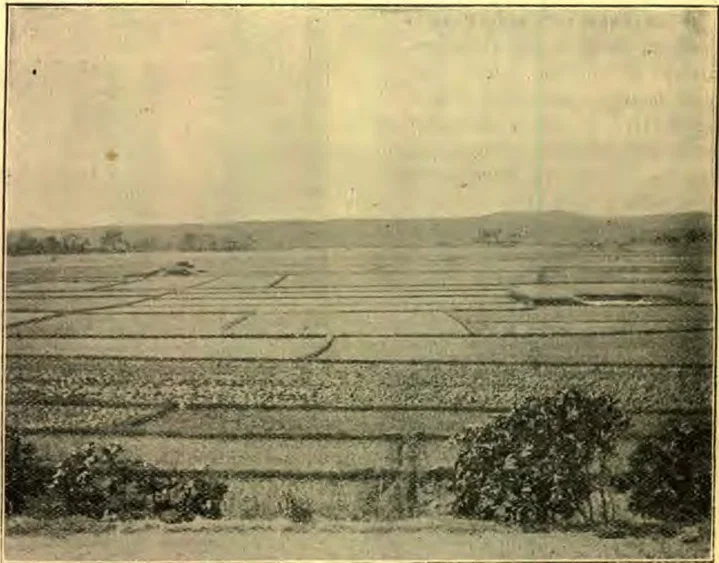
Starting on our way at one o’clock the next morning, we came to a river which must be ferried. The rivers of China seldom have bridges, and ferries are furnished by the government to supply their places. The water on the farther side of the river being too shallow for the ferry-boat, some of our party were carried ashore on the backs of the coolies. Our road led us through one of the most fertile farming districts of Central China. The farms are small, but they are most thoroughly tilled. Adjoining farms are separated by a strip of unplowed ground, or a ridge of earth, which, while serving for a fence, also makes a basin of the field for irrigating purposes. All the fields are level as a floor, and so arranged that they are easily irrigated.
In some parts of the country, and especially near the cities where the farms are very small, the water for irrigating is drawn from a well and poured into the trenches. It is a tedious task to draw water from a well twenty-five feet deep in sufficient quantity to irrigate a field, but it does not try the patience of the Chinese farmer. The farmers take great pains to keep the soil fertile, and every particle of fertilizing material is carefully collected. The boys and old women can be seen out on the streets and along the public highways, collecting everything that will serve to enrich the soil of their little farm. Two crops a year are raised on most of the ground. The soil is largely a black loam, and in many places resembles the black muck found in the lowlands of the Mississippi River valley. As a class, the farmers are very industrious. During the busyp. 2 season they are out at work as early in the morning as one o’clock; and if the nights are moonlight, they work as late as nine at night. The farming utensils are very crude, and the cultivation is largely done with spade and hoe. Thrashing is done as in the days of Abraham, the thrashing-floor being a level bit of ground, smooth, hard, and clean-swept. In some cases a flail is called into service; in others a stone-roller, drawn by a cow or donkey, is used to thrash out the grain. We called to mind that in such a country, amid similar scenes, our Master worked, traveling on foot from village to village, over a dusty road, wearing such sandals as the people here wear, and stopping at inns such as those which afforded us shelter.
In this district, sheep, hogs, and cattle are also raised, but not to any great extent, for agriculture is the main occupation. The products vary greatly in different localities. Rice and wheat may be said to form the staple product. Six different varieties of beans are grown, and large quantities of vegetables, such as spinach, Chinese cabbage, onions, sweet potatoes, and carrots. Very fine peanuts are produced, and also millet and hemp. Not a single fruit-tree or fruit-bearing shrub is to be seen in the country about our station, but fifty miles north of us a very fine quality of pears is grown.
Lo-Shan to Ching-Yang
About three in the afternoon we arrived at Lo-Shan, which was but sixty li, or twenty miles, from U-li-tien. Here we passed under the city wall, and lodged in another of our chapels, where we have a native evangelist. At this place we changed conveyances, substituting for the wheelbarrow, donkey-carts, drawn by two donkeys hitched one directly in front of the other. To the large carts two donkeys are hitched in front, and one in the shafts. The bed of the cart sits directly on the axle, the two wheels are high, so that one gets the full benefit of the rough roads.
Upon reaching the chapel in Lo-Shan, we were met by the Christian family, and given a hearty welcome, not alone in words, but in deed, as they prepared for us the only warm meal we had in the four days’ journey. After supper the yard was full of women, who came to learn about us. The ladies went out to visit with them, which consisted of smiling at the Chinese, the native women returning the compliment. The ladies were given seats on the little wooden chairs. The visitors took the liberty of examining the dress of our company, which seemed to be a real curiosity to them. Our ladies in turn examined the clothing of the Chinese ladies. One of the women was kind enough to unwind the bandage around her foot. They laughed and talked among themselves, and made signs to the ladies. Brother Pilsquist, acting as interpreter, told them the ladies were very sorry they could not talk with them. The women replied they hoped the missionaries would soon learn the language, so they could tell them of heaven.
After traveling this day a distance of forty miles, we reached Ching-Yang at sunset. As we were all very weary, we retired early. But our friends did not allow us to rest undisturbed, as they were peeping in at every crack, eager to see what kind of people we were. We arose at twelve o’clock, and started on our last day’s journey at 12:30 A. M.
Ching-Yang to Sin Tsai Hsien
This day’s travel was through a very level country. In crossing the river, the wheels ran off the ferry, which delayed us somewhat, as Chinamen are no good in an emergency. They have no idea what to do, and do first everything but the right thing. About sundown we saw the walls of an ancient city across the plain. It made us rejoice, as this was the city we had been traveling toward for five weeks and four days. We found native Christians at the gate, waiting to welcome us. We felt thankful for God’s protecting care during this long and trying journey. Our health was preserved, even while sleeping on the dirt floors of a mud house. God has led us so far; we will trust him the remainder of life’s journey. H. W. Miller, M. D.