Luxor and Karnak
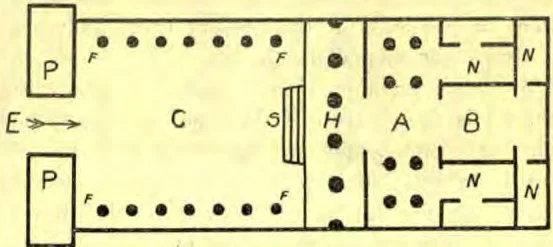
BEFORE visiting the ruins of Upper Egypt, we will notice the general plan of Egyptian temples, and some of the terms that are used in describing them, so that the reader may more intelligently follow us. Taking the small temple of Rameses III at Karnak as a typical example, we notice first in the diagram the pylons (PP), two large rectangular towers, tapering toward the top. Between these is the portal (E), or gateway, above which the pylons meet. This gateway leads into a large court (C), open above, but usually surrounded with a colonnade (FF), or row of columns. Traversing this court, and ascending a short, broad flight of wide steps (S), we reach the terrace (H), a broad porch, the roof of which is supported by large columns. Back of this we find the hypostyle hall (A), a large and often imposing hall of massive columns. Still beyond is the sanctuary (B), or holy place, often perfectly dark, surrounded by the private chambers of the priests (N). This, with various modifications and embellishments (some of the parts often being repeated) is the general plan of all the ancient Egyptian temples.
Even a slight knowledge of the hieroglyphics of the cuneiform writing and the religion of the ancient Egyptians adds greatly to the interest in exploring these ruins. A few hours’ occasional study, combined with careful observation of the reliefs one encounters, will soon give some knowledge of the alphabet; and a little practise will enable the traveler to recognize at once the representations and symbols of the more common deities; while, if persistent, he will soon find himself searching with feverish interest, and often successfully, for the cartouche (seal) of some king mentioned in his guide-book. Of course a knowledge of Egyptian history is essential to maintaining or even producing an interest in this kind of work.
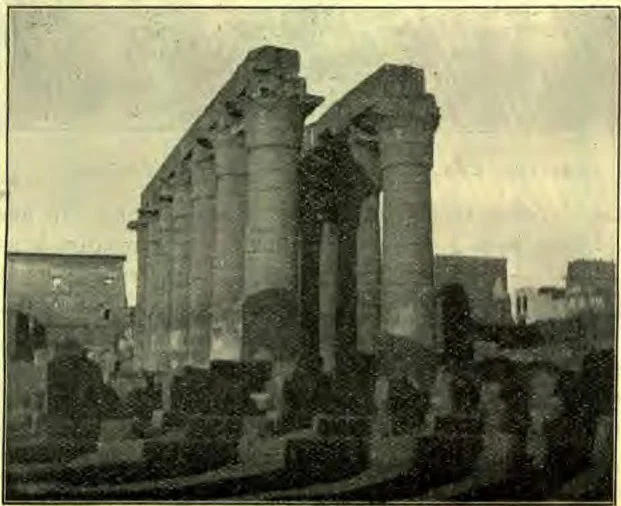
With this introduction, then, we will visit first the large temple of Amenophis III at Luxor. In front of the ruined pylons are six large colossi of Rameses II. Entering the large court, we find one corner of it embellished by a small mosque, while just opposite is another fine black granite statue of Rameses II, who has left his mark on most of the temples, having built as many as all the other monarchs of Egypt combined. Leaving this court, we pass between two stately rows of massive columns (see illustration) into a second court, less pretentious but better preserved than the first, beyond which is the comparatively small hypostyle hall. The sanctuary back of this hall is divided into two sections, reminding one of the Holy Place and Holy of Holies in the Jewish tabernacle, and abounds in interesting inscriptions.
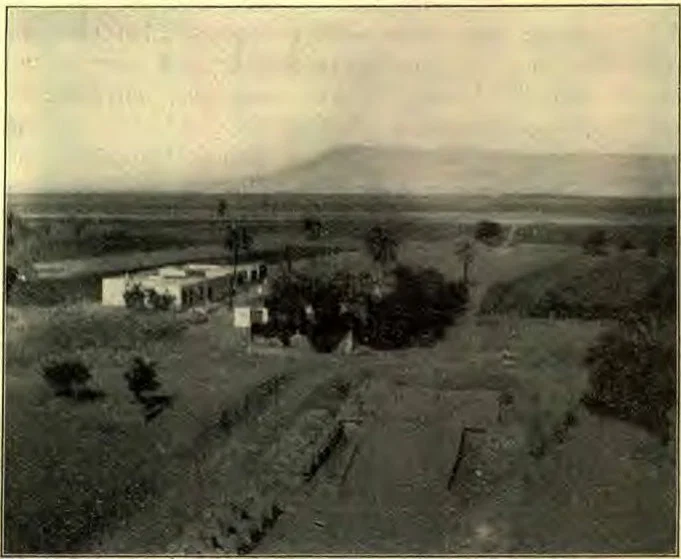
Having completed the exploration of the Luxor temple, we hire donkeys, and start with eager expectancy for Karnak. The principal temple here, dedicated to Ammon (the national Theban sun-god), was probably founded during the twelfth dynasty; but nearly all the later kings took a part in its construction, many of them erecting smaller private shrines within the temple grounds. Especially did the mighty monarchs of the eighteenth and nineteenth dynasties vie with one another in the magnitude of their designs, adding pylon after pylon, colonnade after colonnade, lavishing the enormous spoils of their numerous campaigns on the shrine of Ammon, until it became the most extensive and magnificent temple in existence, the “throne of the world:” and to-day its stupendous ruins are ranked in the mind of the traveler with the pyramids of Gizeh as the mightiest of all the monuments of antiquity.
The temple grounds are approached by four avenues of sphinxes, one of which was originally nearly a mile long. Entering the great court through the first pylon, which is one hundred yards long and fifty yards high, we ascend at once to its summit, from which a good general view is obtained. West of us flows the Nile, while beneath is the avenue of sphinxes we havep. 2 just traversed. To the south are various pylons and small temples, the columns of the Luxor ruins rising above the town. To the northeast, among the chaotic ruins of the great temple of the middle empire, stand two great obelisks.
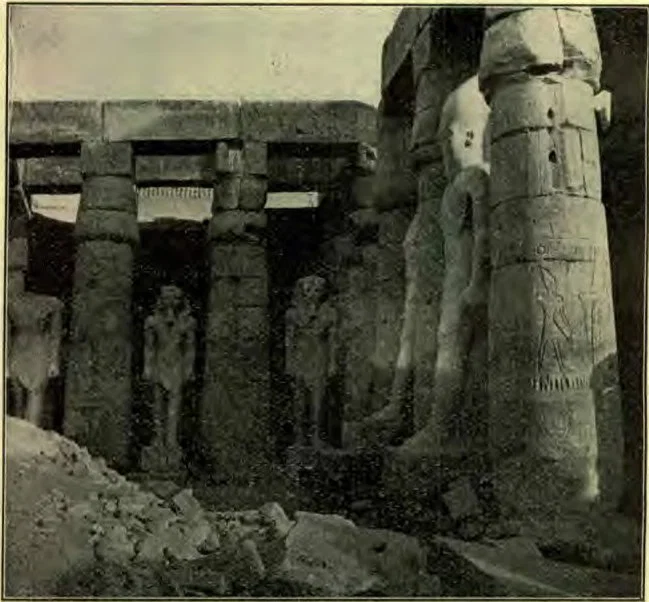
Descending, we traverse the court, passing the temple of Rameses III, which opens onto it; and entering a portico, we find the interesting monument of Sheshonk, commemorating his triumph over Rehoboam, king of Judah. See 1 Kings 14: 25, 26, and 2 Chron. 12: 2-9. We next pass beneath the large second pylon of Rameses I, and enter the hall of columns, the crowning wonder of Karnak. The roof of this imposing hall is supported by one hundred and thirty-four columns, arranged in sixteen rows. Many have fallen, and others are leaning; yet still the effect is indescribably wonderful. Especially by moonlight, when the inky shadows of the columns fall one upon another, the charm of the place is almost intoxicating. Perhaps some idea of the magnificent proportions of this grand hall may be conveyed by the statement that each of the columns that line the central aisle is eighty feet high and over thirty-five feet in circumference. The entire hypostyle hall covers about two acres.
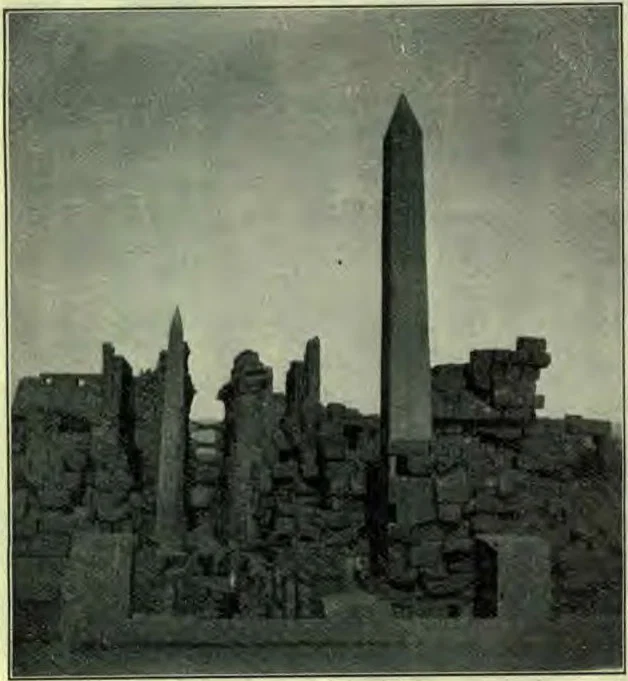
We pass from this hall into the hopeless ruins of the earlier temple. Conspicuous are the two great obelisks of Queen Makare, which were cut from a solid piece of the finest Assuan granite, and brought one hundred and forty miles down the Nile. One has fallen, but the other, which is nearly one hundred feet high, and nine feet square at the base, stands as the largest obelisk in the world, save one in Rome. The upper part of this obelisk is plated with a gold and silver electrum. Farther on, is another obelisk of smaller size and less interest.
Time forbids us to visit the many smaller temples and monuments that crowd this interesting place; so we depart, but only with the determination soon to visit again these magnificent ruins.
GLEN WAKEHAM.