Among the Country Folk
A TRIP through the country districts of Korea furnishes the traveler an opportunity to become acquainted with the people, and familiar with their manner of life. The most common mode of travel is on foot, and nearly all the so-called roads are mere paths through the fields. The dwellings of the people are grouped into small villages. As we near these, our approach is announced by the barking of numerous dogs, every household seeming to possess at least one noisy cur. Groups of children run out to watch the strangers, and the older people pause in their work while we pass.
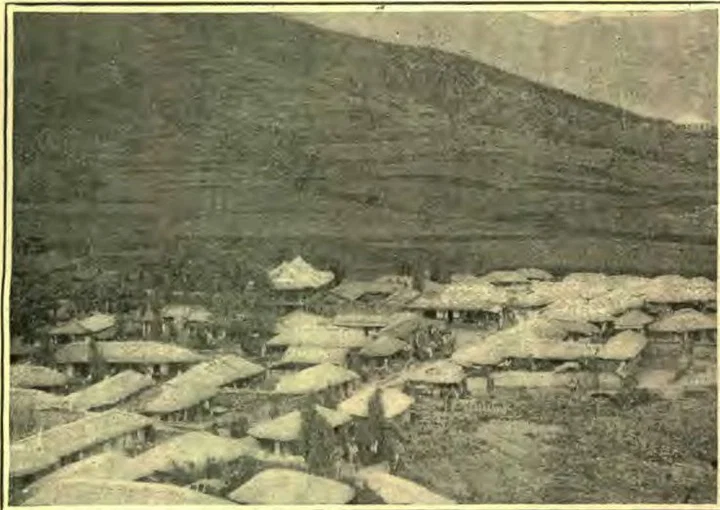
We notice that there is no regular arrangement of the houses into streets, but narrow paths lead from house to house. In front of nearly every house is a cleared place where the grain is threshed. This threshing-floor lies just outside a small dooryard, usually enclosed by a fence or stone wall. These garden walls sometimes form three sides of a kind of shed which is roofed with thatch the same as the house. The side next the house is generally left open. This shed is used as a sort of storeroom; here also the family pig is often tied, and the donkey or pony stalled. Some part of this shed may even be enclosed to form a guest-room.
After a long tramp across country, we are glad to accept the hospitality offered us. We leave our shoes at the door with the slipper-like sandals worn by the natives, and find seats upon the mats which cover the floor. The Koreans sit with their feet crossed tailor fashion, and never with the feet folded under the body, as the Japanese do.
At meal-time the food is served on tiny tables about a foot high, and as large as a common tray. A generous bowl of rice and beans cooked together forms the principal dish. Dried fish, a kind of egg omelet generously salted, and a salad of coarse vegetables and red pepper, are common side dishes. The only form of bread I observed was griddle-cakes made of bean meal. The principal meals are eaten in the morning and at evening, only a light lunch being eaten at midday. The people eat heartily and hastily of this soft, poorly cooked food, and as a result indigestion and dyspepsia are very common.
At night the mats upon the floor form the beds, and smooth blocks of wood do service as pillows; but some families have quilted mattresses, and pillows of rice chaff. We thought ourselves fortunate to secure such a mattress, thick as an ordinary comforter. Then, spreading over this a woolen deck robe and a pair of blankets, we slept to dream of anything but woven-wire springs, hair mattresses, and feather pillows. Yet who could complain when the people freely provide the best they have to offer?
These country villages are without stores or shops of any description. All purchases must be made at the large cities and towns. In these same towns are the only post-offices; letters addressed to country places are delivered by private messengers in a very irregular and uncertain manner.
Because of their isolated condition and the inconvenience of travel, the country people live almost independently of the outside world. They eat the produce of their farms; cotton is grown, spun, and woven into the coarse fabrics which form their every-day garments; shoes are braided from straw, marsh grass, and a few strips of old cloth. A few kitchen and household utensils, and the material for their better clothes are the principal purchases made in town.
In the work of the farm all have a part; the women as well as the men and boys, may be seen working in the fields. The harvested crops have all to be carried over the narrow paths to the village. The men and boys carry heavy loads on their backs, the women place their burdens on their heads. The cattle are used as beasts of burden rather than as producers of milk and butter. Ponies and donkeys are also common. One may travel day after day and not see any sort of wheeled vehicle.
The village well or spring is a very busy place. Here the women do the family washing; vegetables and fish are brought here to be prepared for cooking. Water is carried in large earthen vessels upon the heads of the women in true Oriental style, and with an ease not unbecoming.
A Korean village forms a picturesque part of the landscape; the thatched cottages do not obtrude themselves upon the eye as our modern dwellings do. But upon closer inspection, the beauty of the scene is marred by much disgusting filth. These people are greatly in need of instruction in the science and art of cleanliness. Here is a great field for missionary effort. The observance of a few simple sanitary rules would do much to improve the health and to increase the comfort and self-respect of these easy-going, unambitious villagers.
F. W. FIELD.