OUR party started from Cape Town for East London, South Africa, one Sunday evening about eight o’clock. The train was of the ordinary English type, consisting of carriages divided into small compartments. In each compartment are six berths, three on each side, as in a ship’s cabin. In the center is a table. These are much more convenient than the American carriages, as are nearly all the accommodations. The rate of travel, however, is exceedingly slow.
The first morning we awoke to see the broad stretches of the karoo all about us, with its dry, brown surface but slightly relieved by the boulder-strewn hills, or kopjes. These look like great sections of earth turned on edge, showing the strata of rock, which appear like great plowed furrows along their sides. There was no grass or timber, only stunted bushes and rocks.
We saw a few cattle by the side of the line,2quite a number of sheep and goats, and some horses; but the land is so very dry and parched that one wonders how even these keep alive. This scarcity of stock was noticed all through the country, and is due to the late Boer War, and to the terrible rinderpest which killed live stock by the thousands only a few years before the war.
Along each side of the line can be seen the remains of old forts used during the war. They were built so the sentries could see from one to the other, and were surrounded by great entanglements of barbed wire. Between the forts were barbed-wire fences on each side of the railway, and at each bridge a permanent stone fort was erected. In many places also are long trenches on each side of the line, sometimes double rows of trenches. Even with all this guarding, the Boers many times broke through and blew up the line and the bridges. These relics, with the graves scattered along the way, first a solitary one, and then a whole graveyard, bear silent testimony of the terrible war which devastated this sunny land.
We passed several ostrich farms, where hundreds of these great birds roamed the vast expanse of seemingly barren land. One of the most interesting sights was a small animal very much like our Western prairie-dog. It is of a grayish-brown color, has a bushy tail like a squirrel, and lives about the same. It is called the “meerkat;” but more properly the suricate.
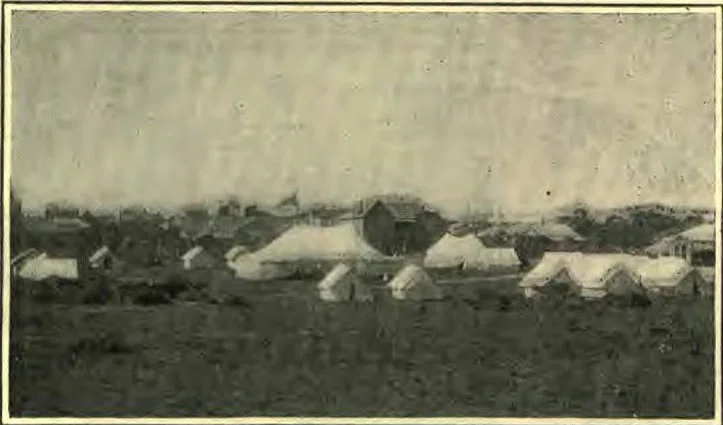
The camp-ground was reached on Wednesday morning. It was located on the main street, in a central part of the city. East London is a growing South African city, situated at the mouth of the Buffalo River, where there is an excellent harbor. It is a great wholesale center for a large inland district, and contains the largest number of wholesale stores in South Africa.
Our meetings were good, and the Spirit of God was manifested throughout the session. The one central theme was, Jesus is coming in this generation; we must get ready to meet him. When one can attend a meeting of this kind where are gathered workers from the missions, conference laborers, and many brethren and sisters who are holding up the banner of light in lonely and difficult places, one is bound to feel one’s own heart thrill with a love for this glorious truth, and a desire to bear the glad tidings to others. I only wish you might all have heard our dear brethren from the missions tell how the message was going to the native tribes of this dark land. Brother and Sister Sturdevant and Brother Sparrow from the Buluwayo Mission, Brother Chaney from Basutoland, Brother Armitage from Matabeleland, and Brethren Moco and Shone, who work for the Kafirs, were all there to report progress. It was evident that these brethren love the work. The statement made in a recent Testimony that “whole tribes will pick up the trailing banner of Prince Emmanuel, and carry it on to victory,” has put new life into our missionaries. We can see the beginning even now, and we know the work must quickly be finished.
A number of the Kafirs near East London have accepted the truth as the result of the labors of Brethren Shone and Moco; and by the intelligent testimonies they gave at the meetings, it was plain that they were well grounded in the faith.
Brother Moco has encountered many difficulties, and has met opposition and persecution in his work, as do also some of the converts. On several occasions he has been told to leave the location, and violence has been used to make sure his departure. One brother, who had been a minister, accepted the truth, and his former brethren did all they could to get him to give it up, finally telling him to leave. One morning he came to Brother Moco, all bruised and bleeding. Brother Moco said, “What is the matter; you are all covered with blood?” “O, those fellows caught me last night, and they gave me a jolly good hiding, I tell you.”
But still he stands a witness to the truth. As Brother Moco related this experience, I could see the face of this brother light up with joy, and I knew he esteemed it a privilege to suffer for Christ’s sake.
A baptismal service was held, at which several of these earnest souls were buried with their Lord. The illustration on first page shows Elder Tarr in the water baptizing a Kafir sister. Brother Moco can be seen on the extreme left, and just back of him Brother Armitage, standing with his hand on Brother Sturdevant’s shoulder. The picture below shows the camp-ground.
I am thankful to God that I have had an opportunity to attend an African camp-meeting; and I wish all our young people could hear and see what God is doing, especially for the native work in this country. They would be inspired to more earnest efforts in the accomplishment of our grand aim—“The Advent Message to All the World in This Generation.”