WHEN a current of electricity flows through a wrapping of wire on an iron bar, it makes a magnet of the bar, giving it power to pull other iron to itself. That pulling power is able to turn machinery, and, in fact, all the electric machinery in the world runs by it.
We work with our hands; electricity works with its hands, too, but they are magnets. They pull and push on the rims of wheels, and turn them, just as our hands do.
Knowing that one simple fact, I am sure no wide-awake “Work-Table” boy will say “I can’t” when it comes to building our little electric engine. It is simplicity itself, can be constructed very cheaply, will run at a great speed, and will give a clear insight into the way electricity does things.
Making the Magnet
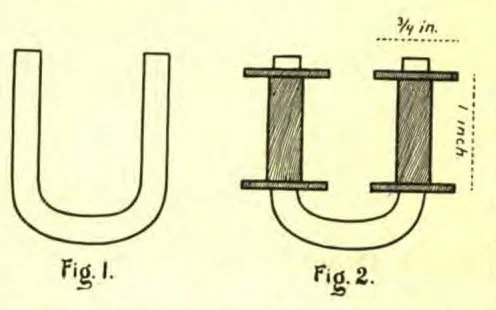
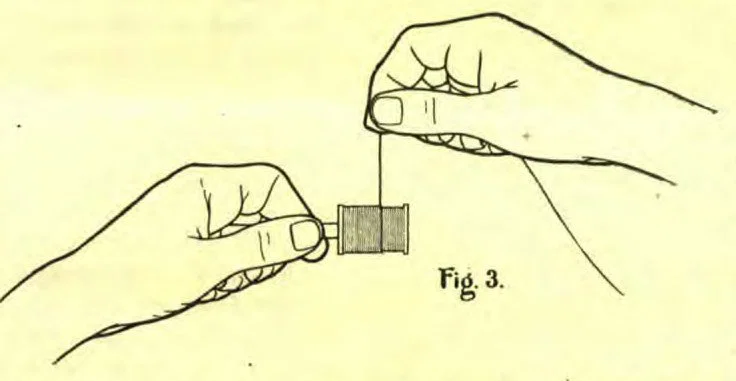
Fig. 1. Fig. 2.
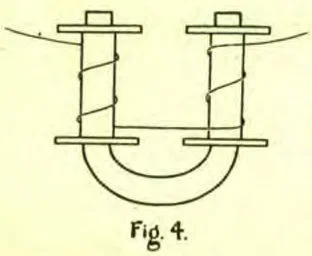
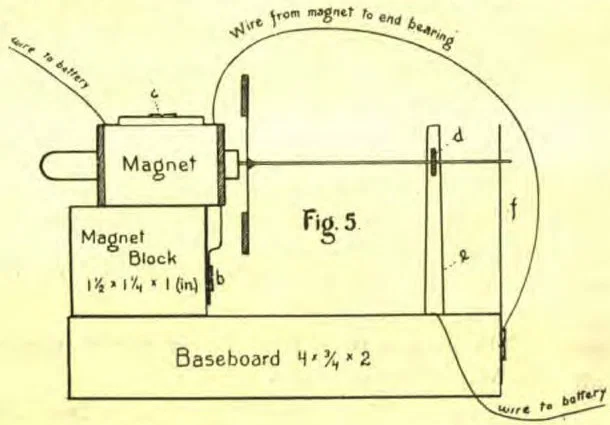
Every electric machine must have a magnet connected with it somewhere. The motor needs one of the little electric-bell magnets, and one can probably get an old one for five or ten cents at an electrical shop. But if he can not buy it, he can certainly make it in the following manner: bend a piece of round iron ¼ x 4½ inches into a horseshoe, like Fig. 1. File the ends off level. With pasteboard, writing paper, and glue or mucilage make two bobbins as shown in Fig. 2. The stems of the bobbins consist of from three to five layers of paper, brought through the cardboard discs, and glued on the ends. The bobbins should fit loosely. Fig. 3 shows the method of wrapping the magnet with wire. One should have from three-quarters to one ounce of cotton-covered copper magnet wire of No. 24 or 26 for each bobbin; it will cost from five to ten cents an ounce. Wrap tight and even and level. When both bobbins are wrapped as smooth as a spool of thread, without having the wire cut between them, they are ready to slip on the horseshoe-magnet. Fig. 4 shows how to put them on. One can see also that the two bobbins are wrapped differently, one one way and one the other. This is very necessary, for the magnet will not work unless it is thus wrapped.
Fig. 3.
The magnet is now ready for use, and when connected with a battery, it should lift large pieces of iron readily. If it does not, some mistake has been made in the wrapping, and the spool will need to be rewrapped.
Building the Machine
Fig. 4.
Fig. 5 indicates the best way of mounting the magnet. A small block, c, is screwed upon the top of the magnet, the screw being long, and going down between the bobbins into the “magnet block” below. This holds the “electric hands” solid and steady.
Fig. 5.
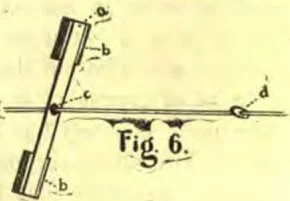
Fig. 6 is the running-gear. The spindle is a piece of hat pin; a is a one-quarter inch strip of heavy tin soldered on the pin at c, one-half inch from the end; b and b are little pieces of iron three-eighths inch square, on which the magnet can pull; d is a little oval of copper or brass soldered near the other end and at right angles to a.
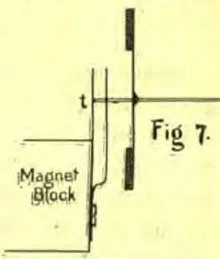
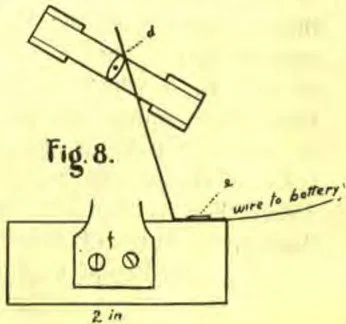
Some little strips of tin or sheet brass are quickly fashioned into bearings. The front bearing, Fig. 7, has an extra strip of brass or tin, against which the magnet pulls the spindle. It is marked t in the diagram, and is bent backward or forward till the running-gear works quite close to the horseshoe, yet without striking it. The end bearing shown in F, Figs. 5 and 8, and also in the photograph, needs no further explanation.
Fig. 6.
Fig. 8 shows a very thin brass strip rubbing against the oval soldered on the spindle. Just how heavily this must touch, and just when it must begin and end its touch, can only be determined by experiment. The strip can, of course, be bent to touch just as may seem necessary.
Connecting with the Battery
Fig. 5 leaves little to be explained as regards the wiring. One wire from the magnet runs directly to the battery. The other magnet wire runs to the end bearing. Another wire goes from the spring shown in Figs. 5 and 8, to the battery.
The Battery Required
Almost any kind of battery that can be named will make this little engine hum. A dry battery, such as is used for door-bell and telephone work, will do very well; one cell is enough.
If one is to make a battery, and do it simply and cheaply, I would recommend him to make the bluestone gravity, or the bichromate tumbler battery described in the INSTRUCTOR dated Dec. 22, 1903.
The value of this little motor is not in the amount of work it can do, for it will do none, but rather in the experience and dexterity one acquires while making it, and in the insight he certainly gets into the workings of this mysterious power—electricity, which is the world’s willing servant to-day.