The Gospel in Korea
It is said that Christianity first found its way into Korea in 1777, by the sending to that country of certain Jesuit writings in Chinese from Peking. From the very first, the new ideas spread rapidly, although the government was very determined in its opposition. Many were tortured and exiled; and the persecution continued till 1787. Four years later the first foreign missionary entered the country.
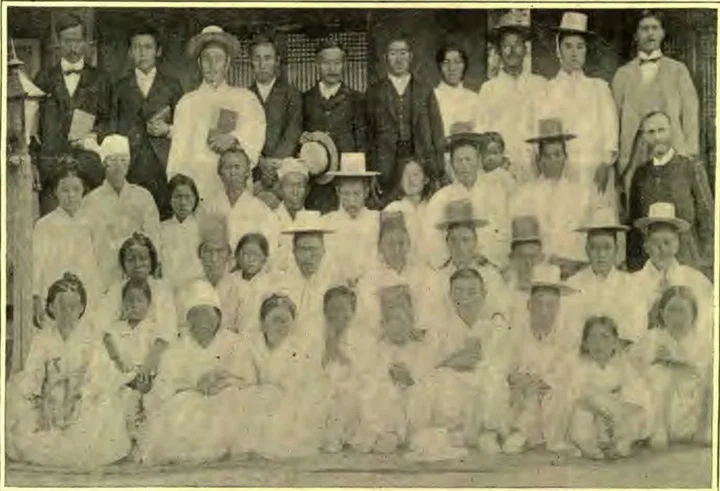
The work of Protestant missionaries in Korea is much more recent, dating back only about twenty or twenty-five years. But during this time the progress of the work has been quite remarkable. Various missionary societies of America and Europe have entered the field, and many thousands of the people have professed Christianity. As a rule the Korean people have laid aside their opposition to foreign innovations, so that the gospel may be freely proclaimed. There are also no laws to interfere with missionary work.
The missionary society of the Church of England began work in Korea in 1891. Bishop Corfe was the pioneer in this undertaking. Upon his arrival in Seoul, he wrote: “There are a large number of foreigners in Seoul,—chiefly Americans, and these mostly missionaries,—Presbyterian, Episcopal Methodist, and a few nonconformists from Canada, working on independent lines.”
Since that time many more missionaries have entered the field, and every year new workers are being sent out. A large number still make their homes at Seoul; but many other places, on the coast and in the interior, have been entered.
The missionaries in Korea have undertaken various phases of Christian work,—evangelical, educational, and medical. Churches, schools, and hospitals have been established in various places. I can speak, from personal observation, only of the work established at Pyeng Yang, the ancient capital. The Methodists have several missionaries resident here; also a substantial brick church, and a well-built hospital, with physician’s residence. All these buildings are within the city walls, but are pleasantly located on high ground. Just outside the walls, west of the city, the Presbyterians have purchased quite a piece of ground. Here are located the residences of the missionaries, also church, school, and hospital buildings. There are also a number of church buildings in the city. We saw one quite large church, just recently erected. The Presbyterians have their work well established, and their communicants are said to number over four thousand in this place alone. The work of the Methodists is more recent, and their churches are mostly located in the country round about.
We often hear the Korean Christians spoken of in terms of commendation; and our brief stay among them confirmed these reports. As a rule, they are teachable, and readily receive the truths presented to them. Further, they seem to possess the true missionary spirit, and so are very active and earnest in communicating what they learn to others. Also, in spite of their poverty, they do remarkably well in supporting their work. It seems to be a rule for the native congregations to build their own meeting-houses. Those we visited had been so built, without any aid from mission funds. This way of doing cultivates a spirit of self-reliance that is wholesome.
The story of the entrance of the third angel’s message into Korea has already appeared in the Review and Herald, but may be briefly summed up here. Last summer two Korean believers, while in Kobe, Japan, came in contact with our workers there, accepted the truth, and were baptized. One of these went on his way to Hawaii, where he is faithfully living out the truth, but hopes soon to return to his native country and teach his countrymen. The other, while on his way back to Korea, communicated his new-found faith to a fellow passenger, who gladly accepted it, and upon his arrival at Chinnampo began to publish it among his friends and neighbors. Soon quite a company began to observe the Sabbath; and these sent an earnest plea for help to our workers in Japan. So Brother H. Kuniya went and labored among them, and a few weeks later the writer joined him. As a result, seventy-one were baptized, and four small churches were organized. Many others were interested, and fifty or more of these began to observe the Sabbath, but needed more instruction before being received as members. Since our return we have been informed that others have received the truth, and have begun to obey it. And now these Korean believers are anxiously waiting for help,—for some one to come and help carry forward the work thus begun. Though you may not be able to respond to this call, you can at least unite with us and them in prayer that they may not have long to wait. F. W. FIELD. Tokyo, Japan.