Woman’s Dress in China

11%

Review and Herald Publishing Assn. · Washington, D. C. · March 14, 1905

FromThe Youth’s Instructor, Vol. LIII, No. II

Read the full edition

Woman’s Dress in China

THE defects of the modern woman and of her Chinese sisters in the matter of dress have been compared by the people of both nationalities. The comparison, it must be confessed, is rather in favor of the Oriental. While both have sacrificed comfort and good sense to custom and pride, it is the Chinese woman whose vital processes are the least interfered with as a result.
Aside from the long white bandages which have shaped her foot so different from its natural form, restricting the circulation of the extremities, and making her, on foot, awkward and uncomfortable, there are many physiological points in the dress of the Chinese woman which merit attention. And even with their crippled feet, our friends in China are able to get around and do their duties, and to climb up- and down-hill with heavy burdens, in a way which surprises us. These little women have no long skirts to catch the dust and damp from the earth below. Only a few possess skirts, and these are ornamental affairs, which are kept folded away in the clothes chest. The women move about comfortably every day, in what an American would call “bloomers.” But perhaps it is because the American woman does not know how to wear “bloomers” that she so abhors them. At least our Eastern sisters can look as neat as a pin in their simple blue gowns and loose garments. It is quite a shock to the modesty of the Chinese when they first see in the port cities the close-fitted, misshapen form of the modern woman.
In the south of China, and during the summer, the garment worn is more like a divided skirt, being loose at the ankles, and trimmed with a colored border and silk braid. But in the north, all the year round, the bright-colored tape is worn, tying up the plain, neatly folded garment at the ankle, and a little embroidered or figured piece is included in such a way as to adorn the little feet. The gown is loose, with large, flowing sleeves, and usually long enough to reach to or just below the knees. All the garments, under and outer, winter and summer, are made on the same pattern, and there is room enough inside her gown for the mother to carry her infant to protect him from the wind.
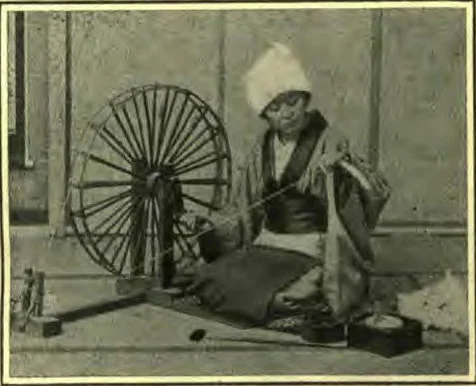
A JAPANESE LADY SPINNING
Were it not for the impoverished diet of many, leading to an over-diet of coarse vegetables, and, consequently, a dilated stomach, the form of the Chinese women would be quite perfect. As it is, she has a control of her muscles, and an ability to work, which few in modern dress could imitate. For once comfort and fashion agree.
A girdle is worn about the waist, but the wide band of the lower garment makes it unnecessary to wear this drawn very tightly. The pervading color of Chinese dress is blue, the nation’s color; other colors are the exception. Coarse homespun goods is worn almost constantly by the common people. The different seasons and weather changes are far better provided for in the Chinese economy than in Western garb. There are three classes of garments—unlined, lined, and cotton-lined, or wadded, garments. Changes are not made on the first day of June, nor at any other stated time. The nights are usually cool, except in the heat of summer, and the Oriental woman rises early, dons her wadded gown, perhaps two of them, and a lined one besides. Later on, as the sun shines brighter, or she is warmed by the day’s duties, she lays off first one, then another, till she has only a light garment remaining. Thus her dress is always in keeping with the temperature and her comfort. The padded garment worn in winter is much warmer than the burden of skirts worn by the Western woman in a vain effort to keep out the cold.
Many Chinese homes have neither fireplace nor heating stove. In the very coldest winter those in central China have only a little open fire of straw or stalks on the floor, to warm their hands and feet. Farther north they have the kang, or heated brick bed, to which they resort when the quilted garments prove insufficient. Here American heated homes would indeed be a luxury.
BERTHA LOVELAND-SELMON, M. D.