“GOOD MORNING, young people; come right in,” said Professor Leiter, kindly, opening the laboratory door.
Heartily thankful for such a cordial welcome, we entered a splendidly fitted room, and looked around in some surprise at the array of apparatus and gleaming instruments, while one of our number explained to the professor that we were very anxious to see him at his work.
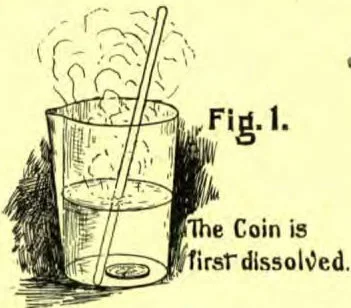
“Ah,” he exclaimed, “that is well; and I am really fortunate this morning in having something simple to do.”
“Here,” he continued, leading the way to his work-table, and opening a drawer therein, “I have an old Mexican coin to analyze. The man who left it wants to know just how much silver, copper, and lead have entered into its composition. Do you suppose we can find out?”
What a question? Did we suppose he could find out! No; we didn’t suppose—we knew he could do whatever he undertook.
“Well, young people, the very first thing the analyst has to do is to dissolve the substance he wants to analyze. Sometimes it is rock, sometimes glass, sometimes rubber; but whatever it is, it has to be dissolved. See, I drop this coin into this hot nitric acid,—”
“Whew! We saw, indeed, and smelled the sharp, pungent vapors that rose, cloud-like, from the acid. We rushed to the open window.
“O children! children! it’s all right now,” said the chemist, presently. “You will at least remember about the ‘dissolving of the substance,’ won’t you?”
“Isn’t it lovely!” exclaimed a girl, as the professor poured the bright-blue liquid into a clean test-tube.
“No, Alice, it’s copper,” said the professor.
“That blue color fairly shouts ‘copper’ at the chemist. He can’t mistake it. When that appears in the solution, he knows that that money had copper in it.”
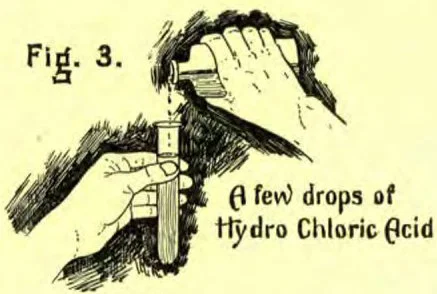
“But look—I am pouring some hydrochloric acid into the solution. Before I do this, however, I want some bright boy or girl to tell me what the nitric acid made of the silver, copper, and so on—quick!”
“Nitrate of silver, copper, and so on!” said one of the boys, with a grin.
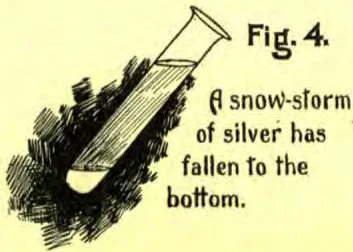
“Right!” assented the teacher, pouring in the hydrochloric acid. “Now watch the silver snow-storm!”
The blue liquid lost its color in an instant, and became white as milk, or as air filled with snow, and these white particles slowly (“Don’t jar the table, young people”) floated downward till they rested in a white drift on the bottom, leaving the liquid as blue as the blue sky again.
“Listen, boys, girls! Hydrochloric acid makes chlorides out of nitrates. It made chloride of silver that would not dissolve or float in water out of the nitrate of silver that would dissolve and would float.”
“But why didn’t the copper sink, too?” I asked.
“A fair question deserves a fair answer,” he responded. “This last acid did make copper chloride and lead chloride, but both of them will dissolve and float in hot water. So of course they remained in the solution after the snow-storm.”
Professor Leiter now quickly poured off the copper and lead solution from the silver, dried the latter, and weighed it on the most delicate scales we had ever seen. “You have heard,” he said, “of balances so delicate that a name written in lead-pencil can be exactly weighed. These scales are of that kind; the bearings are of agate and ruby, like the jewels of a watch. An analyst, especially a quantitative analyst, must have such an instrument, and it will cost him hundreds of dollars.”
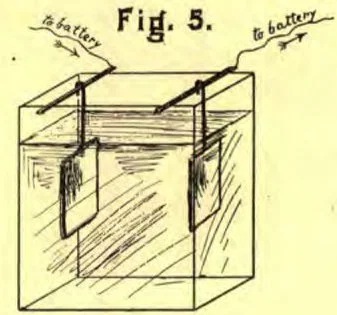
Having ascertained the weight of the silver, and written it on the analysis blank, our instructor turned his attention to the blue liquid again. “These two little sheets of platinum,” he said, “that I put in here [the liquid] are connected with a strong electric battery. O, don’t be afraid to look close: this kind of battery doesn’t shoot!”
Pretty soon one of the platinum electrodes—for that is what he called them—began to get yellow and bright, the other dull and scaly. “The electricity is depositing copper on one terminal,” he explained, “and lead on the other. By and by, when all the metal has been deposited, I will weigh them, subtract the weight of the platinum, and, of course, know exactly how much copper there is, and how much lead.”
“Now, you see,” he exclaimed, laughing, “the wonders of chemical analysis are not so difficult to understand, after all. Of course you haven’t seen it all. The delicate tests for arsenic and strychnine, the wonderful detection of really scarce substances, the analysis of organic products,—all these things you do not understand yet; but you have the working principle just the same, for them all. Has any one of you a question he would like to ask?”
“Yes, I have one,” said a girl; “can chemists tell what people and animals and plants are made of?”
“Certainly they can,” responded the professor. “They can take the plants and animals apart just as readily as we took the coin apart. You ask them how much carbon there is in an eye, and they can tell you; or how much oxygen in a brain, how much phosphorus,—how much iron in the blood. Ah, but should you ask how much life is there in the eye, the brain, the heart, the blood, he could not answer. No, he says, I can’t tell you that. That life is God, and we can’t find out God, no matter how deep we search. We only know he is. The chemist sees him at every turn; but the mystery of his life in the world is just as much a mystery to me as it is to you.”
EDISON DRIVER.