REAPING

4%

Review and Herald Publishing Company · Battle Creek, Mich. · October 10, 1901

FromThe Youth’s Instructor, Vol. XLIX, No. 40

Read the full edition

REAPING

To all sowing there is a certain definite reaping. This is but another phrasing of the great principle of cause and effect. It is but an expression of the one eternal law of continuity.
No one thing or event stands out by itself. No one thing can come into being of itself, neither can it sustain itself alone; and further, it must in turn impress other things. Call to mind anything you please,—you will find it but a link in one or many chains. Link by link you can follow the chain back far into the distant past.
I see a mullein, perhaps, growing by the roadside. I know that it did not come there of itself. It grows there because, some time before, a seed fell in that spot,—a seed from some other mullein that grew and thrived as it now grows. And that other mullein came from still another mullein plant, that grew in days still earlier. Thus we may trace it back, but always there is something before it until we come to the great cause of all earthly things, the creation of the world.
In a similar manner what I do to-day is not to be set aside as a thing which has nothing to do with the events of the past. For every event of your life or mine, there is a good and sufficient cause,—a cause that is sometimes made up of many factors, all born of the days now gone. What happens now is but the result of yesterday and the days before; it is the harvest of the past sowing.
But you may think that, if this is so, we are held in the grim embrace of fate, and that we are thus to-day only the creatures of those circumstances that have bound us about. But remember, what I am to-day is my harvest from the sowing of the past; and as I sowed then to produce this, so I may sow now to produce a better.
In a moment I may will a decision that shall change events and modify all results, but even so, in the new result will still be seen some impress from the things of the past. When the tribe of Levi sinned against God, he declared that they should have no inheritance in Israel. Nothing they might ever do could reverse that decree. They should have no inheritance in Israel. This was their harvest for their evil sowing. But later, by steadfast loyalty in the midst of universal apostasy, they sowed for another harvest. God still said, “They shall have no inheritance in Israel,” but he now also said, “I am their inheritance.” Though they were forever shut out of the first, they were now most gloriously ushered into the second and better. They were to become the priests of God. They were in an especial manner to be representatives. The sowing of the good seed could not reverse the decree, but it could lead to something better and higher than anything they had known or hoped for before.
You and I can not get away from the results of our past lives, but by the proper sowing we can change and modify results; and this is far better than to obliterate the past.

WHAT SHALL THE HARVEST BE?

And then the harvest. It depends for quality and quantity on a number of things. First of all, the harvest in quantity and quality depends upon the essential nature of the seed itself. Some seeds, under like good conditions, will yield far more heavily than others. For instance, wheat may yield a crop of twenty bushels to the acre in Illinois, but corn under no better conditions will yield perhaps fifty or sixty bushels an acre. But the wheat makes up in quality what it lacks in bulk, and each is profitable in the markets when the price is normal. The Canada thistle will produce a larger crop than will some less harmful plants.
But there is always more than we plant. Plant a handful, reap a sackful. Sow to the wind, reap the whirlwind. The wicked are forever being surprised because so much comes of what they do. They can not think that what they did, that little act, could possibly produce all the evil that has come. It seems all out of proportion that the momentary act of a mad assassin should produce a crop that would cause the whole world to stand aghast. But it is always so. A few words may ruin a whole church, and throw souls into a hopeless condition. You never know, when you sow evil seed, what harvest it will produce.
‘And so, too, the righteous are forever being surprised that the little good they do should so prosper and gladden all within the radius of its influence. A single seed may produce all the wheat in all the fields of the world, if given time and the right conditions. It was one mad act in Eden that brought the harvest of seven thousand years of sin and pain; and it is the one act of Another in another garden that will yet bring the brighter, better harvest that will save the world.

POWER OF CONDITIONS

Secondly, conditions are a potent factor in determining the size of the harvest. For instance, the germs of disease are so small that it requires a powerful microscope to reveal them. And yet from any one of these germs, if all the circumstances were favorable, within five days the product, or harvest, might fill all the seas of the globe! But the conditions are not favorable, else all the waters of the earth would soon be reeking with the terrible germs of typhoid fever or something worse.
There are two mullein plants growing in our country, but they do not look very much alike. Yet the seeds are so similar that I doubt if any one can tell them apart. The common mullein produces many times more seeds than the moth-mullein. You will find several hundred seeds in each nutlet of the common mullein, with several hundred nutlets in a single plant. To know the number of seeds, you must multiply hundreds by hundreds, which gives ten thousands as the number on a single plant. But these seeds are destroyed by the hundreds and the thousands; many are eaten by grubs, which live in the nutlets, and comparatively few come to maturity. But all of those of the moth-mullein ripen unmolested. There are fewer seeds to begin with, but it fares as well in the end.
How often it is so in life. Some seem to have better promise of a magnificent harvest. There are glorious possibilities, but there are the moth and the rust and the canker, the blasting and the mildew; and lo! the glorious promise fades into night. Others did not promise so well, but they have sowed rightly, and their harvest is greater, not because of a better beginning; but because there has been no loss. The sowing was wiser, the seed was better chosen, the soil was more carefully tended, and the harvest was all carefully treasured.

SOIL FOR THE SEED

And then, last of all, the harvest depends so much upon the soil. How plainly this is brought out in the parable of the sower. Some seed fell by the wayside, and the fowls came and devoured it—the seed found no soil. Some fell upon stony places, sprang up, and then withered away, because it had no soil. Some fell among thorns, and was choked, for the thorns refused it soil. But some fell into good ground, and bore an abundant harvest.
The seed of this parable represents the word of God, and the soil it seeks is your heart and mind. If that seed can not get into some human heart, it positively can not grow. And this is but saying that God can not work in the world unless he can find those who will act as his agents. When you and I refuse to do his will, we cut off the hands by which he would work in the world, we cut off the feet by which he would carry his messages to the burdened hearts of men.
What a wonderful privilege to be used of God! What an awful thing to shut him out of the world! Either is ours to do. It will be as we choose.
And all the time God is at work casting the seed. He is the Master Sower. He tells us to sow, but already he has set us the example. And like the patient husbandman or farmer, he waits for the early and the latter rain, which will ripen the wheat. All through the years he has cast the seed. True, some has fallen by the wayside; some has dropped on the flinty ground; some has been choked by the thorns and briers; but some, thank God, has fallen in good soil, and in the great harvest day we shall find God’s granaries all filled to overflowing. For though he will burn the chaff with unquenchable fire, he will gather all the wheat in his garner. L. A. REED.
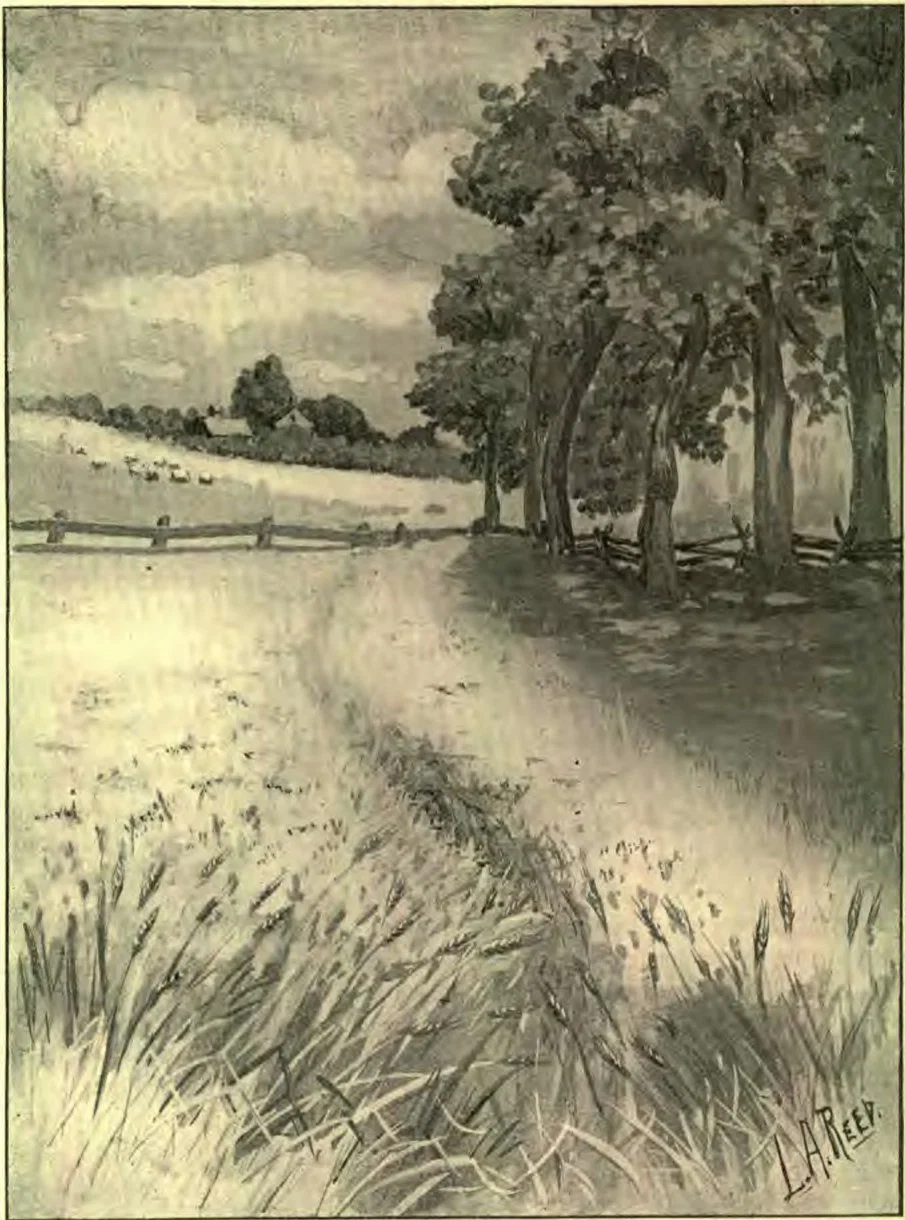
READY FOR THE 'REAPER