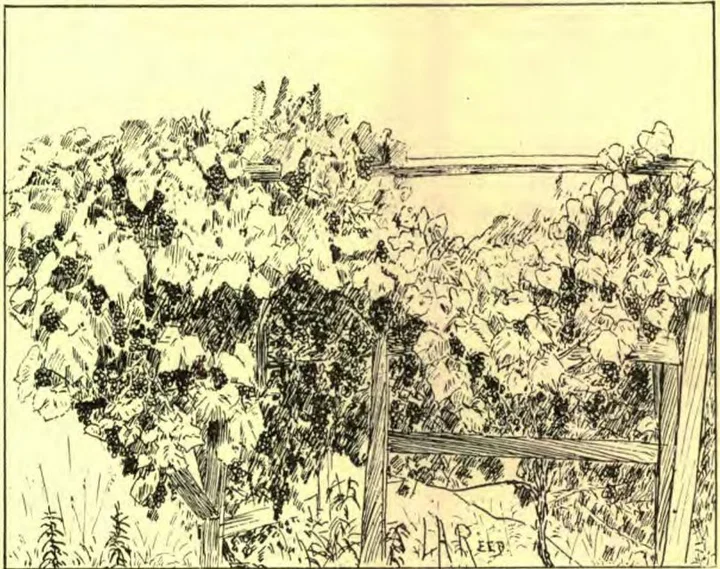
THERE is perhaps no other object in nature that can teach us so many deep spiritual lessons as the vine. To make a proper study of it, one should go to the arbor with his Bible open at the fifteenth chapter of John. Then with the symbol which God himself gave, and with the divine commentary which Christ has uttered, he will find much that is helpful and blessed.
“I am the true vine,” says Christ, “and my Father is the husbandman;” “ye are the branches.” Here is at once a picture of the relations which exist between all the ones concerned. We in Christ, and both Christ and we in the tender care of the owner and dresser of the vineyard.
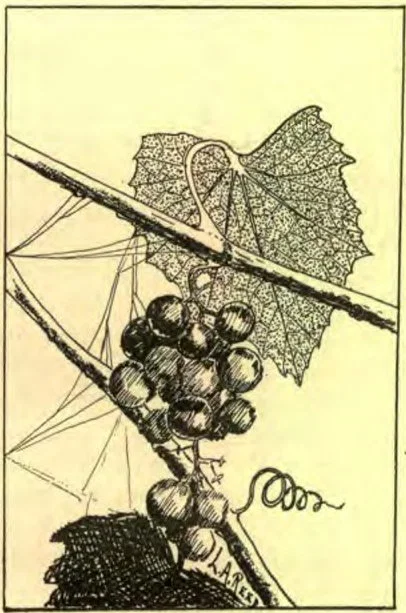
“My Father is the husbandman.” Many plants do not need the care that the vine requires. It has no sturdy trunk; it climbs by tendrils, and the husbandman must provide the trellis or the stakes that are to support it. The vine can not do this, but when once the support has been provided, it can take hold with its tendrils, and is thus secure. And, of course, the vine always takes hold; but we,—how often we fail to use the support that God provides, thereby failing to ascend, and becoming weakened and liable to die! But the husbandman lifts the vine up to the support, and leaves it there a day or two until it may have time to grasp and hold itself. So the Father is patient with us. Like a shepherd who carries the lamb in his bosom, he lifts us over the difficult places. He gives us time to grow and take hold.
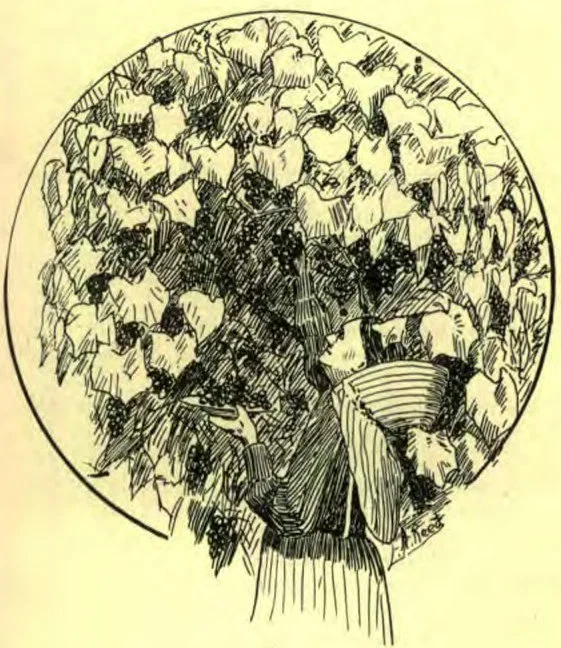
Probably no other plant is so capable of response to the hand of the intelligent gardener as the vine. It must be cultivated if it is to be of any value. The oak needs no care; it grows in stately grandeur, and bears its fruit. But the vine must be pruned and trained and cleansed, and then it will grow and bear abundant fruit. It is capable of great things when directed by the dresser; it is an utter failure without proper care. Is not this a faithful picture of human lives? Under the direction of God, there is no limit to our growth and progress; without it, we are absolute failures.
But we do not raise the vine merely for its shade. It is the fruit that makes it so desirable.
For this the keeper prunes, and trains, and guards the vine so faithfully. So with us. The one object of our having a place in God’s garden is that we may yield him an increase of fruit; for “herein,” said Jesus, “is my Father glorified.”
But to bear fruit the branch must be united to the vine. So, says Christ, abide in me; “for without me ye can do nothing.” More than that, if we do not abide in him, we wither, and are cast forth, and are gathered as fuel to be burned.
But, mind you, the vine does not bear fruit save through the branches. Examine the vine; you will find it so. And similarly, Christ can bear no fruit in his life, save as he bears it through human instrumentalities. It is a marvelous thing that God thus leaves himself utterly dependent for results upon the work of human hearts and hands.
The branches are much like the vine; they are formed upon the same pattern. Thus, too, we are to be in the likeness and image of Christ.
If the branch fails to bear fruit, the keeper purges it. But in doing this he chooses always those branches that are united to the vine. It is useless to cultivate a dead branch, a branch that has been separated from the main trunk. And yet we hear much about cultivation, or “culture,” these days. Let me tell you that culture will amount to little to us unless we remain united to Christ. Cultivation of the branch, to be of any avail, must be while the branch is alive, and can thus respond to the efforts put forth in its behalf. The dead branch makes no response. We may cleanse it, prune it, tie it to the trellis, ever so carefully. It may look better for a little time; but sooner or later it will perish. Let us be sure we do not cultivate a dead branch.
And the proof that we are in Christ is that we shall respond to the cultivation. And this union is shown at last in all its fullness when the branch puts forth its ripened purple fruit. So if we are united to Christ, there will be seen a steady progress, and, sooner or later, a certain wonderful yield of the fruit of the True Vine. Gal. 5: 22, 23.
“If ye abide in me,” says Christ, “and my words abide in you, ye shall ask what ye will, and it shall be done unto you.” L. A. REED.