NATURE is in truth the word of God; but the one whose studies of nature have been confined to school-book work in zoology, botany, and the like, can not see much of its truth,—not because what he studies is of itself false, but simply because he supposes that his study takes hold of the real essentials of nature, and is therefore likely to be satisfied with less than he might have. The anatomical study of nature is only the road to certain things, not the things themselves; and he who thinks that the facts taught by our common text-books are the great and only things of science to be learned, has stopped too soon on the highway of knowledge.
I would not decry botanical study, if entered upon with the proper purpose and understanding. I would not discourage it, if rightly gone into, any more than I would discourage a child from learning his letters. But if the child should think that learning the forms and names of the letters was the sum and substance, the whole end, of his labors, I should do my best to show him that a great world of art, literature, and letters lay far out beyond the narrow threshold of the alphabet that he was about to learn. I would seek to show him that the A B C was only a door to knowledge; that learning his letters was much like opening this door; and that out beyond this portal of the alphabet lay the real world to which he was to come. Last of all, I would be compelled to say that this alphabetical door had no excuse for existence unless it opened to lead him to this; and that he had simply wasted his time if, having opened it, he did not go forth to the great world that lay beyond.
So I would say that the great facts of nature should be learned, that we should study them as much as we can. But let us insist from the very beginning, and all along up to the very last, that these facts are but the doors through which we go to a higher and better knowledge. If these facts do not lead us to these higher things, they fail of their great purpose; and if we are content to learn only the facts, it is certain, to say the least, that we fail rightly to understand that purpose.
A man can become so wrapped up in the dry facts of botany that—
“A primrose by the river’s brim A diacotyledon is to him, And it is nothing more.”
But in every flower that blooms there flashesp. 290 forth a message from the great heart of Eternal Truth. A bunch of grapes contains a whole revelation. Every spear of grass, every leaf—in short, all that nature has and is—breathes forth the word of God, and re-echoes all that he has said in law and promise and prophecy.
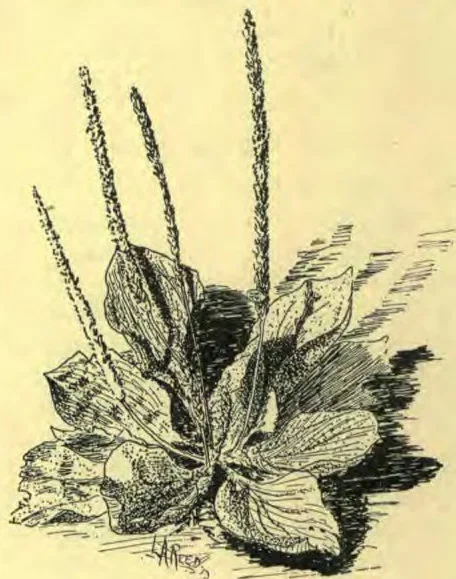
Take, for instance, the lesson of some of our common weeds. They live through droughts and wet seasons, through cold weather and through hot. How are they able to accomplish this?—Let us examine some of them. In almost every dooryard thrives that pest of lawn and garden, the plantain. It adapts itself with ease to various and varied surroundings,—that is one secret of its success, and one of the great lessons that it has to teach. If it grows in the uncut grass and weeds, it puts its leaves high enough to get the sun and rain necessary for life; if it happens to be living on a closely cut lawn, its leaves hug the ground; and if the seed-stalk is repeatedly cut off, the plant puts up successively shorter ones, and sooner or later, if not uprooted, produces seed, so that next summer there may be several plantains where now is but one. Thus it increases.
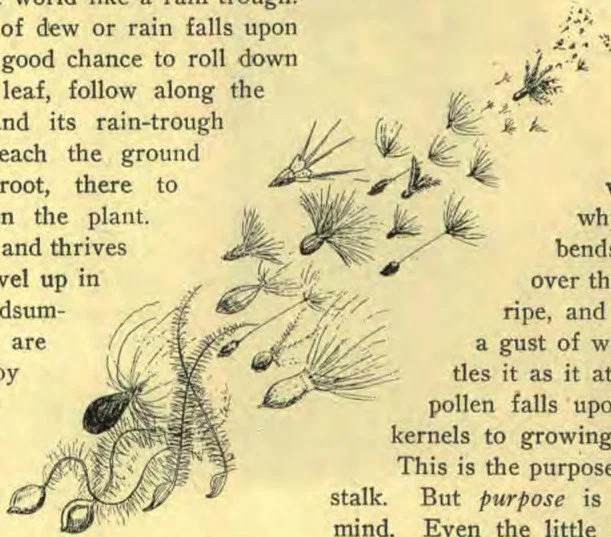
Then, too, it has broad leaves; but broad and crinkled as they sometimes are, their surfaces slope toward the midrib. And the stalk of the leaf is made for all the world like a rain-trough. So, you see, if a drop of dew or rain falls upon the leaves, it stands a good chance to roll down to the middle of the leaf, follow along the hollow of the leaf and its rain-trough of a stem, and so reach the ground quite close to the root, there to freshen and strengthen the plant. Thus the plantain lives and thrives when other plants shrivel up in the dry, hot days of midsummer. Further, there are many devices whereby the various weeds distribute their seeds. Some have little hooks, which stick into whatever touches them; others are tiny balloons, and soar away to some good growing spot. So it is that these plants flourish in the face of every difficulty, and increase in spite of every enemy.
As we study this persistency of the weeds, what is it that we are studying?—Why, it is but the persistency of that word which cursed the earth, thus giving to man his portion of sorrow and labor. That word decreed that in the sweat of his brow, man should eat bread. Now if man, by persistent or even herculean labor, could, once and for all, destroy every vestige of weeds upon the earth, he would have gone far toward defeating the purpose of God.
But only momentarily can man gain advantage over the weeds. Like an unconquered enemy, they steadily return for another contest. They are never driven out for long; and as we study even a little into the secrets of their lives, we see that God has made so great provision for their existence that it is impossible ever entirely to conquer them. We acknowledge that God’s will is greater than our will, and in the life of the weeds we see one means by which the divine will succeeds in the carrying out of its all-wise and persistent purpose. Thus this sort of study, though it be but a study of weeds, is, after all, a study of the will of God, and of the means by which that will operates.
Take another example. Many a time I have seen a corn-stalk tumbled over by the wind and rain, and never thought for an instant that it could in its downfall teach me any special lesson worth mentioning. But it can. In the accompanying picture, I have tried to show one of several stalks that are growing in my garden. When this stalk first fell down, it was straight throughout its course. But very shortly after it fell, the stalk began to bend, and push its tasselled top up into the air. You will notice that the stalk bends almost entirely at that part where the ear is situated; true, the stalk bends to some extent above it, but there is little or no bend below the ear. Now why did the corn curve thus? and why did it bend almost entirely at this one part of the stalk?
In answering this question, let me say, first of all, that out of the end of the ear project very many fine fibers, which we call the “silk.” Each thread of this silk leads back to a kernel—or what is later to be a kernel—of corn. In order that a kernel shall develop, it is necessary that a particle of dust from the tassel, called “pollen,” shall fall upon the silk. This particle of dust follows up through a tube, so to speak, in the silk, until it reaches the spot where the rudiment of the kernel lies, and there begins a growth that ends only with a ripened kernel of corn. And so the work goes on for each kernel.
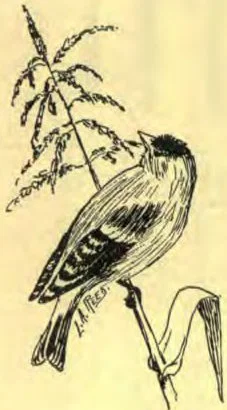
Now the dust must reach the silk, or the kernels of corn can not develop. A stalk of corn standing among other corn might get pollen from the tassels of its neighbors, but nature provides for each stalk as if no other were near. Thus you see why the stalk of fallen corn bends until the tassel is just over the ear. When the tassel is ripe, and the pollen ready to fall, a gust of wind comes, or a bird jostles it as it attempts to alight, and the pollen falls upon the silk, and sets the kernels to growing within the ear.
This is the purpose of the bend in the corn-stalk. But purpose is always an attribute of mind. Even the little folks know the meaning of doing things “on purpose.” A thing “done on purpose” means that some person has done the thing knowingly; that is, intentionally. But to know, to intend, to have a purpose, proves that it is a mind that thus knows, intends, and does what it does with a purpose.
Here is the corn plant. It has bent the tassel up above the ear intentionally,—yes, “on purpose.” But the corn-stalk has no mind, yet it does what any good mind would have it do. In other words, there is a mind somewhere thinking for the corn, and causing it to do just what it would do if it had a mind of its own. What mind is this?—It is the mind of the Creator. God thinks for the corn, and causes the corn to do just the right thing. The corn has the full benefit of God’s own mind.
But this is mind in nature. Yes; it is God in nature, of which you have heard so much. Here it is all clear and plain—God working in a common corn-stalk! It makes me stand in awe of it; not because the corn is so very much, of itself, but because I see that God is really working in it, though all these years I knew it not. Truly this world is the House of God, and all about us we find Gates to Heaven.
But that is what was said at the first. The facts of nature are but gates,—doors,—which we may open, and go forth to the great, true things of God.
This is true learning. This is true botany. This is true science. This is God in nature. And, acknowledged and confessed and lived out to its fullness, this is God in you, the everlasting gospel, the fullness of the word of God.
L. A. REED.