Model No. 5
The bases for these baskets are the same as those previously described. That of the plain basket is eight inches in diameter.
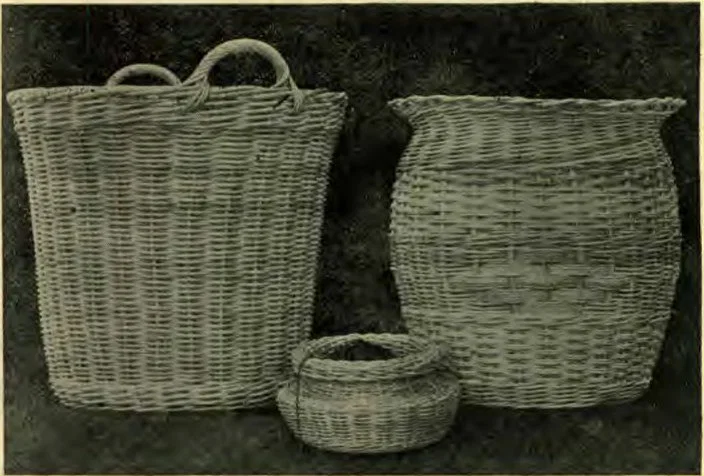
Twenty-seven stakes of No. 5 reed, each twenty-four inches long. Insert one at the right of any spoke, and one at each side of the next. Continue around the basket; they may not come out even, but that will not matter if you are sure to use the right number. Pinch the stakes, and bend up. Use No. 3 weavers. While weaving the upset, take great pains to evenly space the stakes. One row of rope twist and four rows of triple twist; then eight or nine inches of single weaving. Keep the stakes slanted slightly outward. Be sure to have the basket a good shape before putting on the waling. If you find it is not, pull out as much as necessary of the single weaving and try again. A little practise will enable you to produce any desired shape. Finish with five rows of waling. Top diameter is twelve inches. Border is the same as on the handy basket. For handles cut two pieces of No. 9 reed each ten inches long. Make a two and one-half inch slant at each end. At the left of any stake insert one end through border, waling, and an inch or more of single weaving. Insert the other end at the right of the second stake to the right of one just used.
Shape the handle, and bend slightly outward. Insert the other handle on the opposite side of basket. The winding is begun and finished the same as on the handy basket.
Slip a long No. 3 reed between the third and fourth rows of waling at left of handle; draw the reed together at the outer edge of border, and wind three times around the handle, pushing the ends through under, and bringing them back over, the handle, and spacing so that the third time reaches to the opposite side. Slip the two ends of the reed between the third and fourth rows of waling at right of handle. Turn the basket around, and wind back again to the starting-point, keeping the second row close against the first. Repeat until the handle is covered. For illustrations see the handy basket.
The Barrel-shaped Basket
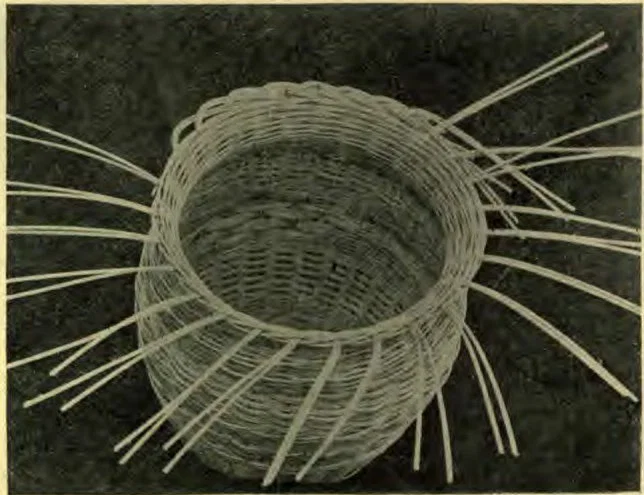
The barrel-shaped basket has a base seven inches in diameter. Twenty-seven double stakes of No. 4 reed, each twenty inches long; insert as directed for the plain basket. Pinch stakes, and bend up. Rope twist, and four rows of triple twist of No. 3 reed. Twelve rows of double weaving, two rows of triple twist, and about two and one-half inches of single weaving. This may be put in plain, or a pattern woven as shown in Fig. 1. This pattern is made by passing over each ninth stake five consecutive times. To do this the weaver must every other row be placed back of two stakes each side of the one you wish to pass over. This will become plain as it is worked out. The next five rows pass under the stake you have just passed over, and over the one at its right and left. Continue working on this plan until the pattern is complete. Follow with two rows of triple twist, twelve rows of double weaving, and twelve of waling twist. Bend the stakes to produce the shape desired. The border is made with the top of basket toward the worker. Take any stake, pass to the right back of one stake, in front of one and back of one. Leave the first one loose to allow for finishing off. Fig. 2. Work toward the right, using each stake in succession until all are used. Weave the last ones in to correspond with the rest. Cut each to rest against a stake on the under side of the rim.
The Knitting Basket
The small basket in the center is a convenient desk or machine basket for small scraps, but is especially adapted for a ball of yarn. Standing beside the one who is knitting or crocheting, the basket will not easily upset, nor can the ball escape. The base of this basket is four and one-fourth inches in diameter. Six and one-half spokes of No. 3 reed. Split three, and insert three and one half. Use No. 2 reeds for weaving, and make the base as usual. Twenty-five stakes, thirteen inches long, of No. 3 reed. Insert one each side of each spoke, except one, so as to have an odd number. Use the stakes singly in weaving. Space them evenly with the upsetting. No. 2 reed for weavers. Rope twist and three rows of triple twist. One and one-half inches of single weaving, with the stakes slanting outward. Then push stakes well toward the center, and continue single weaving one inch, then bend the stakes up to form the neck, using the same weave. For the roll bend the stakes outward and downward, keeping the weaving firm and close. No waling twist was used on this basket. To make the border, stand the basket on its side, with the top toward the worker. Take any stake, bring it forward in front of two stakes at its right, back of one, in front of one, and back of one. Treat each stake in the same way, except that the first should be left loose for the finishing, and all the others drawn down very tight. Always work toward the right. Draw the ends tight, and clip on the under side of roll. The height of the finished basket is three inches, and the inside diameter at top is four inches. By a little mentalp. 7 effort one can easily make larger- or smaller-sized baskets of the shape of any of the models. It would not be wise, however, to attempt to make a change in size before having made at least one basket just like the model.
MRS. E. M. F. LONG.