Wild Pasqueflower
DESCRIPTION.—Corolla absent; sepals five to seven; flowers purplish or whitish, one inch or more across, and borne singly on erect, silky-hairy stems from three to six inches high, which spring from a woody rootstock. Involucre sessile and cup-shaped, its upper part consisting of many narrow divisions. Leaves radical, twice or thrice ternately divided, and not developed until after the plant has blossomed.
In this description we have one new botanical expression,—“twice or thrice ternately divided.” A leaf that consists of more than one lobe, with the incisions extending either to the base of the leaf or to the midrib, is said to be divided. If the lobes are three in number, it is trisected, or ternately divided. Each of these lobes may consist of three divisions, in which case it is twice ternately divided. In some cases this branching process is carried further, and each secondary lobe is again separated in three parts, constituting a thrice ternately divided leaf.
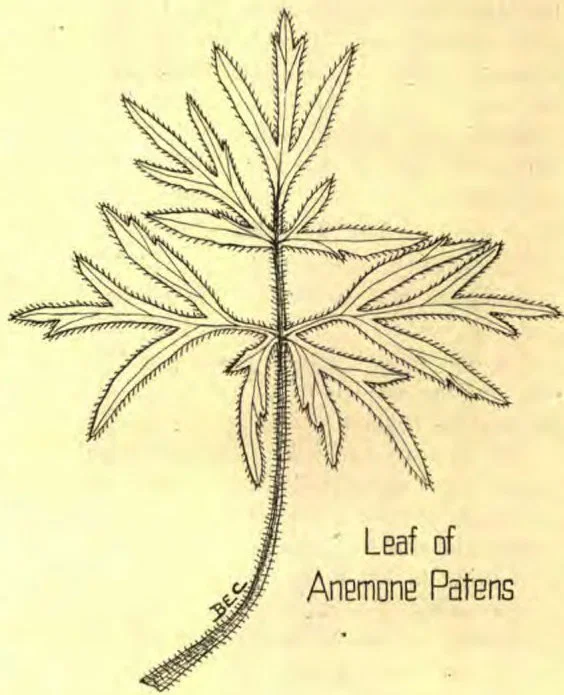
Divided leaves bear a close resemblance to compound leaves, and, in fact, there is no absolute distinction between compound leaves and divided simple leaves. If the separate pieces of which the leaf is composed have distinct petioles of their own, and are attached by means of joints to the main petiole, just as the latter is to the stem, the leaf is always regarded as compound. Otherwise it may be classed either as a divided simple leaf or as a compound leaf.
This species of anemone is known as the American Pasqueflower, because it is peculiar to America. A very similar one, however, grows wild in Europe and Siberia.
The pasqueflower does not grow in the eastern United States, but is found from Illinois north and west. It is one of the earliest spring flowers, blossoming during the last of March or early in April. On the rocky hillsides of Colorado it grows in great abundance.
The fruit cluster consists of a head of acheniums with long, silky tails. The thick underground stem, with its buds and scale-like leaves, affords an excellent example of the rootstock, or rhizome.
The plant is easily recognized by its peculiar involucre and its thick covering of silky hairs.
B. E. CRAWFORD.